Tuesday, January 31, 2012

Hope That Transcends the Groaning (Romans 8:18-25) John MacArthur

http://www.gty.org/resources/Sermons/90-424

We have been going through a series on the Holy Spirit. It was generated by my own heart concern for the terrible ways that the Holy Spirit is dishonored in the name of evangelicalism today. The Charismatic Movement sort of leads the parade on abusing the Holy Spirit, grieving the Holy Spirit, insulting the Holy Spirit, even blaspheming the Holy Spirit. And it just seems to be unbridled relentless abuse that is heaped upon the Holy Spirit. As I said very early on in the series, the unpardonable sin that Jesus addressed in the gospel of Matthew was attributing to Satan the works of the Holy Spirit. And I think there is a reverse of that sin today, and that is attributing to the Holy Spirit the works of Satan. This is rampant in our world and the abuses are obvious for all of us to see.

It's very popular today to say anything you want to say about the Holy Spirit to assign to the Holy Spirit anything you wish to assign to Him to gain power over people. Dishonoring the Holy Spirit is a kind of an open sport now. There are attacks on God the Father, open Theism, that's a theological attack that basically says God is not omniscient, He doesn't know everything, doesn't know the future. That's a theological attack....

Monday, January 30, 2012

"I believe all religions are the same."

Listen in as Ray Comfort shares the Gospel of Jesus Christ with Cat down on the Third Street Promenade in Santa Monica, CA.

Sunday, January 29, 2012

Sermon Audio: "Experience God". Genesis 3:1-9

Genesis presents a picture of warning showing the threats to a harmonious experience of fellowship with God. In Genesis 3:1-9 we see: 1)The Tempter (Genesis 3:1a), 2) The Target (Genesis 3:1b-3), 3) The Tactic (Genesis 3:4-5), and 4) The Tragedy (Genesis 1:6-9) [READ MORE]

Friday, January 27, 2012

John Piper - How God gives peace on earth


A Savior Is Born! Glory to God, Peace to Man
Luke 2: 1-20

Thursday, January 26, 2012

The Greatness of Being a Slave (Mark 10:35-45) John MacArthur

http://www.gty.org/resources/sermons/41-54

Open your Bible to Mark chapter 10 verses 35 through 45, next to the last section in chapter 10 and tonight we'll wrap it up in the final section. This message in verses 35 to 45 may seem a little bit like an echo because our Lord is working on communicating a very important spiritual truth to His disciples and they are fighting against it, resisting what He is endeavoring to teach.

We really would almost start our understanding of this section by going back to chapter 9 for a moment and verse 33. Still at the end of the ministry in Galilee, they came to Capernaum. He was in the house and He began to question them...what were you discussing on the way? But they kept silent for on the way they had discussed with one another which of them was the greatest. "Sitting down He called the Twelve and said to them, 'If anyone wants to be first, he shall be last of all and servant of all.'"

Just a few weeks ago when we talked about that, and it's just a few weeks later in the life of our Lord and His disciples as they are about to enter in to Jerusalem for His death and resurrection that the subject is addressed again. And I hate to tell you, but this won't be the last time either. The subject will come up during the Passion Week. It will still be on their minds when they are at the Last Supper, the night of our Lord's betrayal. Luke 22:24, "There arose a dispute among them as to which of them was regarded to be the greatest. And He said to them, 'The king of the Gentiles lord it over them, and those who have authority over them are called benefactors, but it is not this way with you that the one who is the greatest among you must become like the least and the leader like the servant. For who is greater, the one who reclines at the table or the one who serves? Is it not the one who reclines at the table, but I am among you as one who serves.'"...

Wednesday, January 25, 2012

Slaves for Christ, Pt. 2 (John MacArthur)

We're going to turn to a subject in the New Testament that as I think about it is largely ignored and overlooked. And I've been made aware of that in recent months. It was not too many months ago that I was flying on one of those jumbo jets from Los Angeles to London, in the process reading a book that dealt with the issue of slavery in the New Testament time and in the New Testament text. It set me thinking in all kinds of directions. I actually finished the book on the flight I was so rapt in my attention to this particular theme.

Being a slave of Christ may be the best way to define a Christian. We are, as believers, slaves of Christ. You would never suspect that, however, from the language of Christianity. In contemporary Christianity the language is anything but slave language. It is about freedom. It is about liberation. It is about health, wealth, prosperity, finding your own fulfillment, fulfilling your own dream, finding your own purpose. We often hear that God loves you unconditionally and wants you to be all you want to be. He wants to fulfill every ambition, every desire, every hope, every dream. In fact, there are books being written about dreams as if they are gifts from God which God then having given them is bound to fulfill. Personal fulfillment, personal liberation, personal satisfaction, all bound up in an old term in evangelical Christianity, a personal relationship. How many times have we heard that the gospel offers people a personal relationship with Jesus Christ?

Tuesday, January 24, 2012

Slaves for Christ, Pt. 1 (John MacArthur)

http://www.gty.org/Resources/Sermons/80-321

We're going to turn to a subject in the New Testament that as I think about it is largely ignored and overlooked. And I've been made aware of that in recent months. It was not too many months ago that I was flying on one of those jumbo jets from Los Angeles to London, in the process reading a book that dealt with the issue of slavery in the New Testament time and in the New Testament text. It set me thinking in all kinds of directions. I actually finished the book on the flight I was so rapt in my attention to this particular theme.

Being a slave of Christ may be the best way to define a Christian. We are, as believers, slaves of Christ. You would never suspect that, however, from the language of Christianity. In contemporary Christianity the language is anything but slave language. It is about freedom. It is about liberation. It is about health, wealth, prosperity, finding your own fulfillment, fulfilling your own dream, finding your own purpose. We often hear that God loves you unconditionally and wants you to be all you want to be. He wants to fulfill every ambition, every desire, every hope, every dream. In fact, there are books being written about dreams as if they are gifts from God which God then having given them is bound to fulfill. Personal fulfillment, personal liberation, personal satisfaction, all bound up in an old term in evangelical Christianity, a personal relationship. How many times have we heard that the gospel offers people a personal relationship with Jesus Christ?

Monday, January 23, 2012

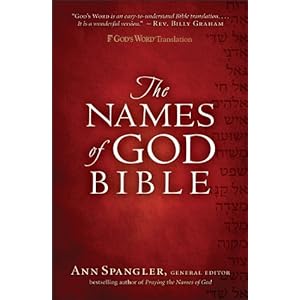
Bible Review: "The Names of God Bible"

Names of God Bible, The"The Names of God Bible" (NGB) uses "God's Word Translation" (GWT) as its base text. This is a relatively new translation from 1995 employing a translation method they describe as “closest natural equivalence” to express the meaning of the original text. This philosophy focuses on what the translators define as readability with an aim to mirror the structure common to our everyday day English, using grammar and punctuation that they feel contemporary readers would be most familiar with.

GWT is essentially a dynamic equivalent translation that is too interpretive for word for word study. Conceptually this seems strange for a Bible that aims for greater specificity indicating the names of God in their original languages throughout. Forfeited is an accurate word for word translation for more of a thought for thought. The individual authors writing style and choice of words is sacrificed. What is most lacking are the theological words that would enable meaningful short hand discussion.  Gone are words such as covenant, grace, justify, repent, resurrection and righteousness. These are serious omissions. Gone as well is the clear teaching of the doctrine of justification by replacing the translation of all of the different Greek words behind "justify," "righteousness," "reckoned," "imputed," "accredited," and "propitiation" with one catch-all word, "approval."

People can be seriously mislead by inaccurate translations of verses like James 2:24 that read: "You see that a person received God's approval because of what he does, not only because of what he believes". There is a radical misrepresentation of Justification by faith alone when one is promised Gods "approval based on what one does in such places like Rom. 4:16,20,  9:30, 32, 10:6, 11:20, Gal. 3:22, 5:5; and Heb. 11. The result is misrepresenting justification as the "cause" instead of the "medium" through which saving faith comes. 

Beyond the dangerous misrepresentations in the translation, NGB indicates more than 10,000 occurrences of at least 121 names (or titles of God) such as Yahweh, El Shadday, El Elyon, and Adonay. They state that this purpose is "to help readers connect with the Hebrew roots of their Christian faith and experience a deeper understanding of God's character". To do this the names are highlighted in brown ink to stand out within the biblical text.

Yet, there are instances where the original renderings are not clear enough. Such an example includes the GWT rendering of  “Lord of Hosts” (‘Yahweh Sabaoth’).  As ‘hosts’ could accurately be described as a reference to angelic beings, i.e. the hosts of heaven, GWT has chosen to translate this phrase “Lord of Armies,”. Unfortunately, there are no explanation that these armies are the armies of heaven and not the armies of men which can lead to significant misunderstanding.

Ann Spangler developed the Name pages, book introductions, Calling God by name sidebars and topical prayer guide. Helpful listings include an alphabetical list of names and titles of God, pronunciation guide to these names and titles, names of God reading path system, topical prayer guide, table, and fast track reading plan for the names of God, as well as a name index and general reading plan.

The Names of God Bible is helpful as a reference tool to quickly see the names of God and explanations for further insight, but the Bible as a whole is not very useful as either a study tool providing word-for word-precision, not as a study Bible having much of the needed basis background commentary or helpful study additions. The introductions to each book are brief. Absent are links like maps, concordances, and other common reference tools.

Product Information

Format: Hardcover
Number of Pages: 1760
Vendor: Revell
Publication Date: 2011
Dimensions: 8.50 X 5.75 X 2.00 (inches)
ISBN: 080071931X
ISBN-13: 9780800719319

"Bible has been provided courtesy of Baker Publishing Group and Graf-Martin Communications, Inc. Available at your favourite bookseller from Revell, a division of Baker Publishing Group".

Sermon Audio: Genesis 2:18-24. "What's a Family For?"

http://c.gigcount.com/wildfire/IMP/CXNID=2000002.0NXC/bT*xJmx*PTEzMjczMzMxMzA*MDMmcHQ9MTMyNzMzMzEzNDU2NSZwPTEzNjgyMSZkPSZnPTEmbz1hNTM*OTVlY2UwMzM*YWNjOTNl/NGE1Yzg4OGIxZDJmZSZvZj*w.gif" />http://sermon.net/swf/ma.swf" quality="high" width="290" height="65" name="mpp" align="middle" allowScriptAccess="always" wmode="transparent" type="application/x-shockwave-flash" flashvars="poid=119806026&d=http://www.sermon.net/" pluginspage="http://www.macromedia.com/go/getflashplayer">>

Series : Genesis
Scripture : Genesis 2:18-24

God specifies the purpose of a family in the Genesis account through: 1)The Problem (Genesis 2:18-20), 2) The Provision (Genesis 2:21-23), and 3) The Portrait (Genesis 2:24) of what a Family is for.

Friday, January 20, 2012

John Piper - Serve each other in marriage

"Lionhearted and Lamblike: The Christian Husband as Head, Part 1"
Ephesians 5:21-33

Thursday, January 19, 2012

Death and Life Are in the Power of the Tongue

Death and life are in the power of the tongue, says Proverbs. Early on in the marriage, Grace shared a secret with Pastor Mark from her past. As he confesses, his response to her was not biblical, loving, or gracious, and his words often brought death and not life in the marriage. Subsequently, Pastor Mark's heart became bitter and in his preaching, he adopted a harsher, more chauvinistic tone, for which he repents and asks forgiveness.

This clip is excerpted from the sermon "New Marriage, Same Spouse," part 1 of Mars Hill Church's Real Marriage sermon series, based off the book of the same name by Pastor Mark and Grace Driscoll. It was preached by Pastor Mark at Mars Hill Downtown Bellevue and released on January 15.

Watch the full sermon here: http://marshill.com/media/real-marriage/new-marriage-same-spouse
For more on the Real Marriage book, campaign, and tour, visit:
http://pastormark.tv/campaigns/real-marriage

Wednesday, January 18, 2012

When Your Spouse Has Been an Assault Victim

A few years ago, after 18 years together, Pastor Mark learned for the first time that Grace had been a victim of sexual assault in a previous relationship—although she had never identified herself as a victim and connected her story to the reality of what had happened to her. It was devastating to hear and at the same time explained the root cause of much of the barriers to friendship and intimacy they had in their marriage. 

This clip is excerpted from the sermon "New Marriage, Same Spouse," part 1 of Mars Hill Church's Real Marriage sermon series, based off the book of the same name by Pastor Mark and Grace Driscoll. It was preached by Pastor Mark at Mars Hill Downtown Bellevue and released on January 15.

Watch the full sermon here: http://marshill.com/media/real-marriage/new-marriage-same-spouse
For more on the Real Marriage book, campaign, and tour, visit:
http://pastormark.tv/campaigns/real-marriage

Tuesday, January 17, 2012

Why Did Pastor Mark and Grace Write Real Marriage?


Pastor Mark and Grace led by example, writing a book that openly and honestly examines their own sin and God's redemption in their own marriage.

This clip is excerpted from the sermon "New Marriage, Same Spouse," part 1 of Mars Hill Church's Real Marriage sermon series, based off the book of the same name by Pastor Mark and Grace Driscoll. It was preached by Pastor Mark at Mars Hill Downtown Bellevue and released on January 15.

Watch the full sermon here: http://marshill.com/media/real-marriage/new-marriage-same-spouse
For more on the Real Marriage book, campaign, and tour, visit:
http://pastormark.tv/campaigns/real-marriage

Sunday, January 15, 2012

Sermon: "Forbidden". Genesis 2:18-24

The brief account of God's direction to Adam in the garden of Eden as recorded in Genesis 2:15-17 is instructive to us in establishing a dominion mandate for every generation that has followed him, In this account we see: 1) God's Commission (Genesis 2:15), 2) God's Commandment (Genesis 2:16) 3) God's Caution (Genesis 2:17)

Audio & text link:
http://www.sermoncentral.com/contributors/matthew-kratz-sermons-37284.asp

Friday, January 13, 2012

Why the Bible Is Our Highest Authority

We've all got someone or something that is the highest authority in our life, and sometimes that's the three-pound brain between our ears. At Mars Hill, our authority is the Bible, and we begin with the assumption that it is always truthful—not that that means it's a book that's always easy to understand.

This clip is of Pastor Mark preaching at Mars Hill Portland, and is excerpted from the sermon, "All Things to All People," a road trip led by Pastor Mark through a handful of Mars Hill churches as he preaches out of 1 Corinthians 9 on what it means to be church's devoted to God's mission to bring the gospel of Jesus Christ to all nations.

Watch the full sermon here: http://marshill.com/media/gods-work-our-witness/all-things-to-all-people


For more on the authority of the Bible, check out the sermons "Trial and Scripture" from Trail series preached out of 1 and 2 Peter,http://marshill.com/media/trial/trial-and-scripture or "Revelation: God Speaks" from the Doctrine series http://marshill.com/media/doctrine/revelation-god-speaks .

Thursday, January 12, 2012

John Angell James - Do you Indeed act, as you Pray?

John Angell James Playlist: http://www.youtube.com/playlist?p=PLE50E39BA700E815A 

John Angell James (1785-1859) was an English Nonconformist clergyman and writer.

He was born at Blandford Forum. After seven years apprenticeship to a linen-draper in Poole, Dorset, he decided to become a preacher, and in 1802 he went to David Bogue's training institution at Gosport in Hampshire. A year and a half later, on a visit to Birmingham, his preaching was so highly esteemed by the congregation of Carrs Lane Independent chapel that they invited him to exercise his ministry amongst them; he settled there in 1805, and was ordained in May 1806. For several years his success as a preacher was comparatively small; but he became suddenly popular in about 1814, and began to attract large crowds. At the same time his religious writings, the best known of which are The Anxious Inquirer and An Earnest Ministry, acquired a wide circulation.

James was a typical Congregational preacher of the early 19th century, massive and elaborate rather than original. His preaching displayed little or nothing of Calvinism, the earlier severity of which had been modified in Birmingham by Edward Williams, one of his predecessors. He was one of the founders of the Evangelical Alliance and of the Congregational Union of England and Wales. Municipal interests appealed strongly to him, and he was also for many years chairman of Spring Hill (afterwards Mansfield) College. He was also an ardent slavery abolitionist, and is portrayed in the huge canvass depicting Clarkson's opening address at the world's first International Anti-Slavery Convention in 1840, in the National Portrait Gallery, London. He died in Birmingham.

A collected edition of James's works appeared in 1860-1864.

John Angell James - Do you Indeed act, as you Pray?

Wednesday, January 11, 2012

Book Review: "Engage: A Guide to Creating Life-Transforming Worship Services "

Engage: A Guide to Creating…Engage: A Guide to Creating Life-Transforming Worship Services
Nelson Searcy (Author), Jennifer Dykes Henson (Author), Jason Hatley (Author)

Engage was created to address several things the authors saw as difficulties in modern worship. From the weekly cycle of worship planning, their summary from the back cover begins: "No matter how great Sunday's worship service was, there's always another Sunday lurking at the end of the next week that must be planned. Church leaders often fall into ruts, working on automatic pilot just trying to get things together, which does not allow for much creativity or focus on designing services that lead to transformation for those involved in them".

Built in to that objective are two significant assumptions: there should be creativity in worship and people are the primary designers of it. I suspect that the authors would highly agree with the first and strongly disagree with the second. The reason why I stated the second assumption is due to the structure of the book. Since there is no development of a biblical foundation of worship, the reader moves right to current practice evaluation and creativity.

Notice how this is going to be achieved, once again from the back cover: "Engage is a step-by-step, stress-free guide to planning worship services that allow for and foster true life change. Comprehensive in scope, Engage provides teaching pastors, worship leaders, and volunteers with the tools they need to work together to develop and implement a worship planning system that improves communication, enhances creativity, and honors Jesus every week".

Once again within these statements, there are important assumptions, one being that planning worship should be "stress-free". Without going into an extended exposition of worship here, should there not be some "stress" in approaching worship where one considers their sin, repents of it and desperately clings to Christ? Should not even the process of worship itself come from some blessed "stress" of joyful praise, to heart wrenching lament? Notice what is seen as the solution to the challenge of weekly worship planning: "The key to getting out of the tailspin and cooperating with God to do church at a higher level can be summed up in one word: planning" (p.11). Off and running, if the participant has not totally surrendered to God and is biblically rooted in engaging God, this can be a dangerous assumption.

All these important considerations aside, Engage tries to achieve their objectives in four parts. The first section deals with determining Your Philosophy of Worship. When the chapter begins with a quote from Cicero on philosophy, this did not strike me as a healthy place to start a discussion on worship. The authors suggest using the acronymn WORSHIP: W = 'Work as a Team', O = 'Outline Your Preaching Calendar', R = 'Repentance is the Goal of Worship', S = 'Sunday Matters', H = 'Honor God through Excellence', I = 'Invite People to Take the Next Steps', P = 'Planning Honors God'. The closest thing that the reader can hope for in terms of biblical exposition is a bracket noting "see Isaiah 6 for additional study on how repentance follows true worship"(p.35). Sure, repentance is needed for worship, but should the goal not be for people to genuinely ascribe Worth to God, ie "worth-ship"? To begin with the end in mind is a good tool in planning worship, and asking questions like what do we want people to know/feel/and do when they leave (p.39), are helpful to consider but perhaps our first questions should not what do the people want, but what does God expect and want from us?

Introductory concerns aside, the authors indeed put many helpful planning ideas and examples in their work. Frequently, in each section of the book, the reader is encouraged to visit the ministry site www ChurchLeaderInsights.com/Engage, to examine and discuss the concepts further. I found this approach quite helpful over the standard foot/endnote method to delve further into topics of the readers interest.

The second section deals with the preaching calendar. The authors begin their section with a warning: "...people forget the majority of the information they hear from a communicator within twenty-four hours" (p.51) Without having a citation of these "numerous studies", I would charge that there is a difference between having a listener quote points in a message and have an internal conceptual change. Isa 55:10-11 "For as the rain and the snow come down from heaven and do not return there but water the earth, making it bring forth and sprout, giving seed to the sower and bread to the eater, [11] so shall my word be that goes out from my mouth; it shall not return to me empty, but it shall accomplish that which I purpose, and shall succeed in the thing for which I sent it (ESV).

Furthermore, I believe the authors misunderstand the primary objective of preaching: "You stand in front of your people on Sunday mornings for one reason and one reason only; to connect God's truth to real life in a way that leads to radical transformation" (p.53) But God's truth already connects to real life (2 Tim.3:16-17). Our job as preachers is to accurately expound and explain the word of God to help people see how this is so (2 Tim.4:2). My heart was relieved in the direction on page 59 to preach the whole counsel of God (Acts20:27) and how a preaching calendar can help ensure this by focusing too much on our "favorite" topics. Although generalized, the authors note particular times of the year with the frequent patterns of attendance and types of topics that could correspond to such times. They suggest a balance of attraction, growth and balance.

The third section deals with planning and conducting worship services. The planning of a message series over particular time horizons is deal with followed by three general types of worship formats. The "simple worship order" structures singing, video, teaching, testimony and offering. The "split worship order" structures video, music, drama, message followed by the same. Finally, the "salsa worship order" has video, music, video, message followed by the same. Some helpful requirements close the formats, including: high accountability, punctuality, excellence and conversation. I would have loved a whole chapter on excellence itself. The following chapter includes an inverted triangle of each potential creative element in order of potential impact. This is highly debateable with a scary suggestion to "think outside the box (p. 122). If that box is scripture, I would not suggest it. Chapter eight shows how all this can work together with a trial run. As idealized as this is, you would need some committed worship team to spend quite a few hours each week and a lot of work ahead of time to accomplish this. Finally, chapter nine concludes with an interesting quadrant of four options to diagnose your current engagement level in the process with suggestions to improve communication and role clarification.

Finally, the fourth section deals with evaluating and improving worship services. It certainly made sense to work on roles and communication before undertaking this. The warning of not playing the "blame game" from the previous chapter really comes in to play. Although I think a biblical context for evaluation and correction would have been helpful, the general tone is gracious. Simple questions like: "what went right/wrong, what was missing or confusing" can be insightful. I would take caution in many of the overally planned elements that the authors suggestion that might restrict Spirit lead diversions. The direction to "keeps things upbeat" (p.180) is certainly shallow. There are times of joy, conviction, direction, lament etc. It can't all be upbeat.

The appendices give a sample preaching, planning calendar, sample order of services, communication template for Pastor to Creative Team, meeting notes, message research schedule and example.

In conclusion, this is a very focused book. There are a lot of other elements of worship, like music selection, instrumentation, worship team building and homiletics, seem to be deliberately not address. This book can be a helpful tool to consider some new aspects of worship, but I fear without a framework that is grounded in scripture with a clear God-glorifying objective always front and center, the planning of preaching or worship may be more personally driven than Spirit led.

Rating: 3 stars of 5.

"Book has been provided courtesy of Baker Publishing Group and Graf-Martin Communications, Inc. Available at your favourite bookseller from Baker Books, a division of Baker Publishing Group".

Paperback: 240 pages
Publisher: Baker Books (Oct 1 2011)
Language: English
ISBN-10: 0801072174
ISBN-13: 978-0801072178
Product Dimensions: 21.3 x 14 x 1.8 cm
Shipping Weight: 272 g ( )

John MacDuff - Almighty Guidance

John MacDuff playlist: http://www.youtube.com/view_play_list?p=229C974C428D7BE8

John MacDuff - Almighty Guidance

Psalm 32:8 I will instruct you and teach you in the way you should go;
I will counsel you with my loving eye on you.

A Scottish Preacher (1818—1895)

"For sound doctrine, presented Scripturally
and devotionally, with its application to the
Christian life, you cannot go beyond MacDuff."

"MacDuff writes popularly, yet he is by no
means shallow. For an hour's pleasant and
holy reading, commend us to MacDuff!"
—Charles Spurgeon

Tuesday, January 10, 2012

All Things Possible (Mark 9:14-29) John MacArthur

http://www.gty.org/resources/sermons/41-45

All right, let's open the Word of God to the ninth chapter of Mark's gospel. Mark chapter 9, and we're going to be covering a fairly lengthy portion of Scripture, contrary to the normal procedures here. Amazing, sometimes it's very brief, sometimes it's longer, depending on the nature of the text.

This is Mark chapter 9, beginning at verse 14. And rather than me read the text, I'm going to let the story unfold because it is a really fascinating story. But suffice it to say, there is a statement in the story to which I would direct your attention, and it's in verse 23, "All things are possible to him who believes." In response to that, in verse 24, "I do believe, help my unbelief." This is about faith. This is about believing. In fact, it is a lesson on the power of faith, a lesson on the power of faith...

Monday, January 09, 2012

Genesis 1:1-5. "Creation"


Through Genesis 1:1-5, we see the answers to: 1) Who Created What? (Genesis 1:1), 2) Where did God Create? (Genesis 1:2), 3) How did God Create? (Genesis 1:3), 4) Why did God Create? (Genesis 1:4), 5) When did God Create? (Genesis 1:5)