Showing posts with label Christian Life-Obedience. Show all posts
Showing posts with label Christian Life-Obedience. Show all posts
Thursday, September 18, 2014
Professing What We Believe


Thursday, October 21, 2010
Hear & Obey
This clip entitled "Hear & Obey" is taken from the sermon "Jesus vs. Satan" preached by Pastor Mark Driscoll at Mars Hill Church as part of the ongoing series, "Luke: Investigating The Man Who Is God" For more information about this current series, visit http://www.marshillchurch.org/media/luke
and for more audio and video content visit marshillchurch.org
Thursday, July 12, 2007
Why So Little Evidence of Miraculous Power in the Western Church?
by Dan Edelen @ http://ceruleansanctum.com
Here’s Tozer from his book Paths to Power: Living in the Spirit’s Fullness :
***
Break up your fallow ground, for it is time to seek the Lord, till he come and rain righteousness upon you.
—Hosea 10:12
HERE ARE TWO KINDS OF GROUND: fallow ground, and ground that has been broken up by the plow.
The fallow field is smug, contented, protected from the shock of the plow and the agitation of the harrow. Such a field, as it lies year after year, becomes a familiar landmark to the crow and the blue jay. Had it intelligence, it might take a lot of satisfaction in its reputation; it has stability; nature has adopted it; it can be counted upon to remain always the same while the fields around it change from brown to green and back to brown again. Safe and undisturbed, it sprawls lazily in the sunshine, the picture of sleepy contentment.
But it is paying a terrible price for its tranquility: Never does it see the miracle of growth; never does it feel the motions of mounting life nor see the wonders of bursting seed nor the beauty of ripening grain. Fruit it can never know because it is afraid of the plow and the harrow.
In direct opposite to this, the cultivated field has yielded itself to the adventure of living. The protecting fence has opened to admit the plow, and the plow has come as plows always come, practical, cruel, business-like and in a hurry. Peace has been shattered by the shouting farmer and the rattle of machinery. The field has felt the travail of change; it has been upset, turned over, bruised and broken, but its rewards come hard upon its labors.
The seed shoots up into the daylight its miracle of life, curious, exploring the new world above it. All over the field the hand of God is at work in the age-old and ever renewed service of creation. New things are born, to grow, mature, and consummate the grand prophecy latent in the seed when it entered the ground. Nature’s wonders follow the plow.
There are two kinds of lives also: the fallow and the plowed. For examples of the fallow life we need not go far. They are all too plentiful among us.
The man of fallow life is contented with himself and the fruit he once bore. He does not want to be disturbed. He smiles in tolerant superiority at revivals, fastings, self-searchings, and all the travail of fruit bearing and the anguish of advance. The spirit of adventure is dead within him.
He is steady, “faithful,” always in his accustomed place (like the old field), conservative, and something of a landmark in the little church. But he is fruitless. The curse of such a life is that it is fixed, both in size and in content. To be has taken the place of to become. 
The plowed life is the life that has, in the act of repentance, thrown down the protecting fences and sent the plow of confession into the soul. The urge of the Spirit, the pressure of circumstances and the distress of fruitless living have combined thoroughly to humble the heart.
Such a life has put away defense, and has forsaken the safety of death for the peril of life. Discontent, yearning, contrition, courageous obedience to the will of God: these have bruised and broken the soil till it is ready again for the seed. And as always fruit follows the plow. Life and growth begin as God “rains down righteousness.” Such a one can testify, “And the hand of the Lord was upon me there.”
Corresponding to these two kinds of life, religious history shows two phases, the dynamic and the static.
The dynamic periods were those heroic times when God’s people stirred themselves to do the Lord’s bidding and went out fearlessly to carry His witness to the world. They exchanged the safety of inaction for the hazards of God-inspired progress. Invariably the power of God followed such action. The miracle of God went when and where His people went; it stayed when His people stopped.
The static periods were those times when the people of God tired of the struggle and sought a life of peace and security. Then they busied themselves trying to conserve the gains made in those more daring times when the power of God moved among them.
Bible history is replete with examples. Abraham “went out” on his great adventure of faith, and God went with him. Revelations, theophanies, the gift of Palestine, covenants and promises of rich blessings to come were the result. Then Israel went down into Egypt, and the wonders ceased for four hundred years. At the end of that time Moses heard the call of God and stepped forth to challenge the oppressor. A whirlwind of power accompanied that challenge, and Israel soon began to march. As long as she dared to march God sent out His miracles to clear the way for her. Whenever she lay down like a fellow field He turned off His blessing and waited for her to rise again and command His power.
This is a brief but fair outline of the history of Israel and of the Church as well. As long as they “went forth and preached everywhere,” the Lord worked “with them,…confirming the word with signs following.” But when they retreated to monasteries or played at building pretty cathedrals, the help of God was withdrawn till a Luther or a Wesley arose to challenge hell again. Then invariably God poured out His power as before.
In every denomination, missionary society, local church or individual Christian this law operates. God works as long as His people live daringly; He ceases when they no longer need His aid. As soon as we seek protection out of God, we find it to our own undoing. Let us build a safety-wall of endowments, by-laws, prestige, multiplied agencies for the delegation of our duties, and creeping paralysis sets in at once, a paralysis which can only end in death.
The power of God comes only where it is called out by the plow. It is released into the Church only when she is doing something that demands it. By the word “doing” I do not mean mere activity. The Church has plenty of “hustle” as it is, but in all her activities she is very careful to leave her fallow ground mostly untouched. She is careful to confine her hustling within the fear-marked boundaries of complete safety. That is why she is fruitless; she is safe, but fallow.
Look around today and see where the miracles of power are taking place. Never in the Seminary where each thought is prepared for the student, to be received painlessly and at second hand; never in the religious institution where tradition and habit have long ago made faith unnecessary; never in the old church where memorial tablets plastered over the furniture bear silent testimony to a glory that once was. Invariably where daring faith is struggling to advance against hopeless odds, there is God sending “help from the sanctuary.”
In the missionary society with which I have been associated for many years. I have noticed that the power of God has always hovered over our frontiers. Miracles have accompanied our advances and have ceased when and where we allowed ourselves to become satisfied and ceased to advance. The creed of power cannot save a movement from barrenness. There must be also the work of power.
But I am more concerned with the effect of this truth upon the local church and the individual. Look at that church where plentiful fruit was once the regular and expected thing, but now there is little or no fruit, and the power of God seems to be in abeyance. What is the trouble? God has not changed, nor has His purpose for that church changed in the slightest measure. No, the church itself has changed.
A little self-examination will reveal that it and its members have become fallow. It has lived through its early travails and has now come to accept an easier way of life. It is content to carry on its painless program with enough money to pay its bills and a membership large enough to assure its future. Its members now look to it for security rather than for guidance in the battle between good and evil. It has become a school instead of a barracks. Its members are students, not soldiers. They study the experiences of others instead of seeking new experiences of their own.
The only way to power for such a church is to come out of hiding and once more take the danger-encircled path of obedience. Its security is its deadliest foe. The church that fears the plow writes its own epitaph; the church that uses the plow walks in the way of revival.
***
Amen, Dr. Tozer, amen.
Monday, December 11, 2006
WJDW: What Jesus Demans from the World # 8- Take up your Cross & Follow me
Posted by fundyreformed @http://fundyreformed.wordpress.com/2006/12/10/jesus-demands-take-up-your-cross-and-follow-me-8/
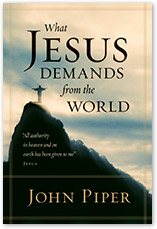
If anyone would come after me, let him deny himself and take up his cross and follow me. For whoever would save his life will lose it, but whoever loses his life for my sake will find it. (Matt. 16:24-5)
Follow me, and I will make you become fishers of men. (Mark 1:17)
I am the light of the world; he who follows me will not walk in darkness, but will have the light of life. (John 8:12)
Follow me, and leave the dead to bury their own dead. (Matt. 8:22)
If you would be perfect, go, sell what you possess and give to the poor, and you will have treasure in heaven; and come, follow me. (John 8:31)
Following Jesus means Fulfilling Jesus’ Mission.
Jesus came to “seek and to save the lost” (Luke 19:10). And he did this ultimately through his suffering on our behalf on the cross. Jesus’ mission was “to gather a people in allegiance to himself for the glory of his Father” as Piper puts it. And following Jesus is joining Him in that mission, or helping Him fulfill that mission. This is why Jesus said “Follow me, and I will make you fishers of men.” (Mark 1:17)
Following Jesus is Painful.
Jesus promised us, “If they persecuted me, they will also persecute you.” (Jn. 15:20) Jesus did not promise us a rosy life. He promised us suffering. This is why he calls his followers to first “take up their cross” and then to “follow” Him. In Matt. 16:24 “Jesus put the emphasis on self-denial and cross-bearing”.
The suffering we are called to endure creates ruptures in our relationships with people, wealth, and our occupation. We are to hate our most intimate family members, even our own selves, in comparison to our devotion to Jesus (Luke 14:26). And we are to “renounce all that [we have]” if we want to be a true disciple (Luke 14:33). This results in a liberal approach to giving, such that Jesus can say to the rich young ruler “sell what you possess and give to the poor, and you will have treasure in heaven; and come, follow me”. (Matt. 19:21) Piper points out that many of the disciples had to leave their occupations, and many times Jesus will move his people to leave their good jobs, pack their bags, and head off to Africa or Asia, or go into ministry here in America. Not everyone will be called to leave, but all are called to follow which will change your perspective on your job, your money, and your family.
Following Jesus is “Worth It”.
The suffering we are called to endure as we follow Jesus will be worth it. Jesus promises that if we hold on to our life we’ll lose it, and if we lose our life we will save it. (Mk. 8:35) And He constantly declares that following Him is a wise and exceedingly beneficial choice. Consider Jesus’ stress on our eternal reward to be received through this suffering/following in the following verses Jn. 12:25; Matt. 19:27, 29; Luke 14:14; Matt. 5:12. So while the suffering is only temporary the pleasure is eternal.
Yet the pleasure is not only future. Following Jesus brings joy now. It can make the persecuted “leap for joy” (see Demand #10 and Luke 6:22-23). This kind of faithful following even through suffering—the kind that rejoices to suffer for Jesus’ name—brings great glory to our Savior. A sad, somber, doleful “suffering for Jesus” will not necessarily glorify Him. But the kind of triumphant joy which smiles in the midst of tragedy, that points to the incomparable worth of Jesus Christ and properly displays His value to a watching world. Consider Piper, finally, on this point.
If you follow Jesus only because he makes life easy now, it will look to the world as though you really love what they love, and Jesus just happens to provide it for you. But if you suffer with Jesus in the pathway of love because he is your supreme treasure, then it will be apparent to the world that your heart is set on a different fortune than theirs. This is why Jesus demands that we deny ourselves and take up our cross and follow him. [emphasis added]
—See all posts on, the Demands of Jesus
Friday, December 08, 2006
D.A. Carson on the “Domesticated” Gospel
I would like to buy about three dollars worth of the gospel, please. Not too much—just enough to make me happy, but not so much that I get addicted. I don’t want so much gospel that I learn to really hate covetousness and lust. I certainly don’t want so much that I start to love my enemies, cherish self-denial, and contemplate missionary service in some alien culture. I want ecstasy, not repentance; I want transcendence, not transformation. I would like to be cherished by some nice, forgiving, broad-minded people, but I myself don’t want to love those from different races—especially if they smell. I would like enough gospel to make my family secure and my children well behaved, but not so much that I find my ambitions redirected or my giving too greatly enlarged. I would like about three dollars worth of gospel, please”
(D.A. Carson, Basics for Believers: An Exposition of Philippians, pp. 12-13).
Monday, November 27, 2006
WJDW-What Jesus Demands from the World-Demand #7 — Abide in Me
By Bob Hayton @ http://fundyreformed.wordpress.com/
Abide in me, and I in you. As the branch cannot bear fruit by itself, unless it abides in the vine, neither can you, unless you abide in me. I am the vine; you are the branches. Whoever abides in me and I in him, he it is that bears much fruit, for apart from me you can do nothing. (John 15:4-5)
As the Father has loved me, so have I loved you. Abide in my love. (John 15:9)
If you abide in my word, you are truly my disciples, and you will know the truth, and the truth will set you free. (John 14:11)
Jesus said to the Jews who had believed in him, “If you abide in my word, you are truly my disciples, and you will know the truth, and the truth will set you free.” (John 8:31)
What abiding is.
To abide, is to stay, continue, or dwell. So Piper says, “Jesus meant: ‘Stay in me. Continue in me. Keep me for your dwelling.’” With the figure of the vine, we understand a little better what “abiding” is. Piper says it best: “Abiding in Jesus means staying vitally connected to the life-giving, power-giving, fruit-producing branch, namely, Jesus.”
What abiding produces.
Piper claims abiding is the “moment-by-moment cause of every good thing in our lives”. Of course, he gets this from Jesus’ statement “Apart from me you can do nothing”. So in John 15, abiding in Jesus results in fruit. No fruit without abiding. So Piper again states that abiding means “staying vitally connected, hour by hour, to the one who alone produces in our lives everything he demands.”
What abiding isn’t.
Abiding produces fruit, so abiding cannot be that very fruit. It is wrong to think we are obeying Christ’s demand to abide if we are just “bearing fruit” or “keeping Jesus’ commandments”. That is the fruit of abiding. Maybe we don’t have abiding quite pigeonholed yet. So…
How do we abide?
Jesus says abide “in me” (Jn. 15:4) and “in my love” (Jn. 15:9). He also says to abide “in my word” (Jn. 14:11). All of this points toward “abiding as continual trust in the truth of Jesus’ words and in the certainty of his love.” We would not be abiding in Jesus’ love if we stopped beleiving that we are loved by him. We would not be abiding in Jesus’ word, if we ceased believing in the truth of that word. Abiding is a continual trust in Jesus’ love and in His words, in other words, a continual trust in Him as a person.
Piper concludes that “abiding in Jesus—in his love and in his word—is trusting that he really is loving us at every moment and that everything he has revealed about himself and his work for us and our future with him is true.”
A warning.
Jesus’ demand that we abide in Him is a warning. In Jn. 8:30-31 (quoted above), Jesus ties abiding in with being a “true” disciple. In John 15, Jesus speaks of the utter destruction of those who, in the words of Piper, “appear to be truly in the vine, but are not”. All of this is to warn us that if we are not abiding, if our lifestyle is one that consistently does not trust in Jesus’ love and in Jesus’ Word continually, then we might very well not be genuinely born again. We may still be on our way to hell.
Such warnings do not prove that we can actually lose our salvation. 1 Jn. 2:19 teaches that those who fall away were never truly saved, they just seemed to be. These warnings should also not cause us to try to earn our salvation by working real hard. No, they are what God uses to prod us onward along that straight and narrow way—the hard way. At times we will need to be warned that our lifestyle is not matching our profession. And they ultimately remind us that it is only God’s free grace given to us because of Jesus Christ’s perfect life, death, and resurrection, that gives us a secure place in heaven. The very warnings to continue believing will help us believe and call us to find refuge in Jesus Christ through ongoing faith and trust. [See this post for more on this point.]
Encouragement.
Piper stresses that ultimately we cannot “abide” on our own. God keeps us in the vine. He does not let us slip through His hand (Jn. 10:27-29). Jesus prays for us and sovereignly determines that our faith will not fail (cf. Luke 22:31-32).
So with all this in mind, let us purpose to abide, moment by moment, in a vibrant trust in Jesus—His love and His Word. Let us seek to put His Word in front of our eyes, so that reading it faithfully, we will be nourished and abide in the vine. Let us use the means of grace in our lives and take advantage of our church and our relationships with other believers, so that we keep on keeping on. Let us press on to higher ground!
—See all posts on, the Demands of Jesus
∼striving for the unity of the faith for the glory of God∼ Eph. 4:3,13 • Rom. 15:5-7
Friday, November 17, 2006
WJDW: What Jesus Demands from the World: #6: Listen to Jesus
 Posted by fundyreformed @http://fundyreformed.wordpress.com/
He called the people to him again and said to them, “Hear me, all of you, and understand.” (Mark 7:14)
As he said these things, he called out, “He who has ears to hear, let him hear.” (Luke 8:8)
Take care how you hear. (Luke 8:18)
Whoever is of God hears the words of God. The reason why you do not hear them is that you are not of God. (John 8:47)
Jesus’ Words are Special
No one ever spoke like Jesus did — Jn. 7:46
Jesus’ words were given Him by God — Jn. 14:24, 12:49
Jesus’ words are powerful — (all the miracles in response to Jesus’ spoken words)
Jesus’ words lead to eternal life — Jn. 6:68, 63
Jesus’ Words and Faith
Jesus’ words are said to give eternal life, yet faith is the condition for eternal life. How are these two concepts, faith and words, related? Jesus’ words awaken faith and thus result in eternal life. Ro. 10:17 says that faith comes from hearing the Word of God. And, the parable of the sower in Luke 8 presents the word of Jesus as the seed from which faith sprouts and flourishes in the hearts of those whose hearts are good ground. Further, Jn. 5:24 says you must hear and believe.
Jesus’ words awaken faith because they declare Who He is, and what He is going to (or has) accomplish, namely His atoning work for us on the cross. In short, Jesus’ words are the Gospel. They describe what He came to testify to — the truth (cf. Jn. 18:37a).
This point is important. God only saves by means of the spoken word of the Gospel. We must take the Gospel to the lost for them to become saved. More than this, the words of Jesus in and of themselves are not magical. They carry a message. And it is the message that saves and awakens faith. The message comes to us in words, but nonetheless it is the message that saves.
Jesus’ Words — Rejected or Received
Yet just because Jesus’ words are shared, does not mean faith is awakened. Jesus’ words are either received or rejected.
Why is it that some do not receive those words? Jesus tells us this much in the following verses.
You seek to kill me because my words find no place in you. (Jn. 8:37)
…Everyone who is of the truth listens to my voice. (Jn. 18:37b)
Whoever is of God hears the words of God. The reason you do not hear them is that you are not of God. (Jn. 8:47)
Some have no place for truth. They are not “of the truth” or “of God” and thus do not receive God’s words are hear the message of Christ. Piper comments on these verses as follows:
This is a sobering revelation. It means that our condition as fallen sinners unfits us for hearing the truth—especially as it comes from Jesus….When Jesus speaks, unless God acts to give us ears to hear and eyes to see, there will be no place in us for the words of Jesus.
Piper then quotes Luke 10:21-22
I thank you, Father, Lord of heaven and earth, that you have hidden these things from the wise and understanding and revealed them to little children; yes, Father, for such was your gracious will. All things have been handed over to me by my Father, and no one knows who the Son is except the Father, or who the Father is except the Son and anyone to whom the Son chooses to reveal him. [cf. Luke 8:8]
Those who are graciously given the new birth and granted repentance and faith, they are Jesus’ sheep and thus “hear his voice”, Jn. 10:27.
Jesus’ Words and Me
In application of this chapter, a particular sentence jumped out at me.
The entire life and work of Jesus is one great argument why we should listen to his word. Page after page of the New Testament Gospels pile up reasons to turn off the television and listen to Jesus.
Ponder that sentence with me, will you? Let us purpose to feast on the glories of Jesus rather than the fleeting and often sinful distractions of this world.
—See all posts on, the Demands of Jesus
∼striving for the unity of the faith for the glory of God∼ Eph. 4:3,13 • Rom. 15:5-7
WJDW: What Jesus Demands from the World: #3: Come to Me
 Posted by Eric Zeller @http://www.foolishblog.com/
This post is part of a series of reflections on John Piper’s book What Jesus Demands from the World.
Jesus says,
Come to me, all who labor and are heavy laden, and I will give you rest. Take my yoke upon you, and learn from me, for I am gentle and lowly in heart, and you will find rest for your souls. ( Matthew 11:28-29)
The Son of God did not come into the world as a dictatorial ruler to issue tyrannical demands to make us all strive harder. Rather, he came as a gentle and lowly servant who came to offer free salvation to make us cease striving. Jesus offers “rest for your souls” for those of us whose souls are burdened by endless striving for self-justification.
There are a lot of people who think Christianity should not be difficult at all. But Jesus said “the gate is narrow and the way is hard that leads to life” (Matt. 7:14). It is not hard because Jesus is a harsh dictator, it is hard because “the world is a hard place to enjoy Jesus above all” (Piper, 45).
But a lot of Christians I know are on the other end of the spectrum, always emphasizing the cost and difficulty of Christianity. Jesus says to them “my yoke is easy, and my burden is light” (Matt. 11:30). The followers of all other religions are laboring under heavy loads to win the approval of their false deities. But we who have come to Jesus, the true God, already have his approval. We need not strive. God does not approve us based on our striving; he approves us based on the righteousness and sacrifice of Christ.
Jesus said “I am the bread of life; whoever comes to me shall not hunger” ( John 6:35) and “whoever drinks of the water that I will give him will never be thirsty forever” ( John 4:14). Coming to Jesus should satisfy all of our soul’s hungering and thirsting forever. Yet so many of us Christians continue to strive and labor and hunger. This is another case of “already but not yet.” Just as we are “dead to sin” yet still sin; we are completely satisfied in Christ yet we still hunger and thirst. Since sanctification is the process of becoming even more what we are in Christ, as we grow in Christ we should see our hungering and thirsting for anything besides him lessen.
Let's be thankful for the one who offers us what we could never attain for ourselves: rest for our souls. Come to Jesus, and find that rest.
Wednesday, November 15, 2006
WJDW-What Jesus Demands from the World- # 5 Love
Posted by fundyreformed @http://fundyreformed.wordpress.com/
Note: these are devotional posts based on John Piper’s new book What Jesus Demands from the World.
Whoever loves father or mother more than me is not worthy of me, and whoever loves son or daughter more than me is not worthy of me. (Matt. 10:37)
Jesus said to them, “If God were your Father, you would love me, for I proceeded and came forth from God.” (Jn. 8:42)
If you love me, you will keep my commandments. (Jn. 14:15)
Love your enemies…and you will be sons of the Most High… (Luke 6:35)
The nature of love
Many have used Jn. 14:15 and other Biblical descriptions of love to conclude that love is an “act of will”. We simply determine to love. Love is an action not a feeling they conclude. Piper argues that while love is certainly more than a feeling, it is definitely a feeling. He describes the feelings inherent in love with this repeated phrase:
….deep feelings of admiration for his attributes and enjoyment of his fellowship and attraction to his presence and affection for his kinship….
In Matt. 10:37, love for Jesus is compared to love for father, mother, son, or daughter. And while love for family members is an action and a determination, it is also very much a feeling. Since Jesus commands us to rejoice and obey from the heart, Jesus is not averse to commanding feelings. Piper in a footnote gave a very good quote from a new book by Matthew Elliott entitled Faithful Feelings: Emotion in the New Testament from which I would like to quote one sentence here: “Not only do Christians live the ethics of the kingdom, they also feel the attitudes and emotions of the kingdom.”
The wellspring of love
So if we grant that love is a feeling, we then find ourselves responsible to love Jesus deeply and truely. How can we who are such diehard sinners do this? Piper stresses that such love flows from our new nature given us in regeneration (new birth — demand #1). Let us quote from Jn. 8:42 again, “…If God were your father, you would love me….” Piper gives a paraphrase of what Jesus is communicating here.
The reason you do not love me is that you are not in the family of God. You don’t have the family nature—the family spirit, the family heart, preferences, tendencies, inclinations. God is not your Father.
Piper also stresses that love for Christ flows from a deep appreciation of the forgiveness of sins Christ provides for us (cf. Luke 7:36-48).
The impact of love
Such a love for Christ results in obedience (Jn. 14:15) and a longing for Christ to be honored and blessed (Jn. 14:28, 5:23) among other things. Such love will also motivate us to forsake sin.
It is at this point that I should stress this love is the immediate fruit of conversion. It is necessary for ultimate salvation. It must be present in our lives. But like all the demands so far, it is a gift of God. It flows from our graciously imparted new heart and new spirit—indeed our new nature.
So, I ask myself. “Am I really loving Christ?” Sure in many ways I obey him. But do I experience in the words of Piper: “deep feelings of admiration for his attributes and enjoyment of his fellowship and attraction to his presence and affection for his kinship”? Am I “in love” with Him? When I read His Word and see His glory revealed, do I treasure that? Do I meditate enough on the glories of His infinite perfections? Does Jesus satisfy my soul?
Oh may the love of Jesus grow deeper and deeper in us as we live life in a constant awareness of our spiritual union in Him. May God graciously enable us to see and appreciate and love Jesus more and more each day. May we be convicted anew of our obligation and our privelege of loving Jesus. May we be challenged to pursue a greater love and at the same time to depend upon God to graciously change our hearts into hearts that love Jesus supremely! And all this for God’s glory. Amen.
—See all posts on, the Demands of Jesus
Motivating Obedience
By Mark Lauterbach @ http://mrlauterbach.typepad.com/gospeldrivenlife/2006/11/peter_and_gospe_1.html#more
How do you motivate people to obedience? Is it rooted in faith toward Christ or in moralistic, self-improvement? Do you give people hope or do they leave feeling heavy hearted? Peter has a great deal to teach us in his method and perspective.
God be merciful to me and the people to whom I have preached for years. I wish I could go back and erase so many sermons (and even so many exhortations to my children -- but I would do the same again in the same circumstances). My preaching and parenting and counseling were so often telling people to do something -- and to do the right thing. "Do this. Work on this. Stop it!" It has been a list of commands, rooted in Scripture. But my exhortations have not been blood stained, rooted in the Gospel.
God began to change me years ago -- that story is attached to one of my earliest blogs. And I keep wondering how I missed it, for the NT is anything but moralistic. A friend of mine used to say there is NOTHING distinctive about the ethics of the NT compared to the moral philosophers of the day -- what is distinctive is the death, burial, and resurrection of Jesus Christ.
Peter is a lead example in this. After setting their suffering into the story of the Gospel in 1:1-12, he turns to a series of commands. But they are not the commands I would give nor the way I would give them. From 1:13-2:10 there are five commands.
That, in itself, makes me ask: How much time does it take to give five commands? Why so many sentences to tell people what to do?
Then I look at the commands and I am more baffled: here they are:
- fix your hope
- be holy
- live in fear
- love from the heart
- be hungry
What????!!!!
They address the heart, not their hands. He is leading them to heart godliness, not just behavioral modification. He takes so much time doing so because the commands are rooted in Gospel realities and the Gospel story. They are applications of the Gospel (not just commands).
- Fix your hope of the end of the story -- the revealing of Jesus at the end of the age. That is now your story.
- You were ignorant and in bondage -- the holy God called you to himself -- live in light of his gracious calling.
- You were rescued from everlasting ruin by the blood of Christ -- this is not a trivial matter, but glorious and infinitely significant -- its cost the blood of God's Son, it was determined to happen in eternity past -- live in wondrous fear and trembling that you came so close to hell.
- You have been born of everlasting seed -- into the family of God which will last forever -- you have been made part of that family and by the Spirit you love each other -- do not let that love become hypocritical, love from the heart and intensely.
- Your conversion is not some moralistic reform, it is tasting God himself by the new birth -- remove those things that corrupt that new life and be hungry for God.
Then he goes on with no further commands until 2:11. He tells them again of their part in God's great purposes in making his dwelling with man, his people as his temple through Christ; his people as priests before Him.
He wants them to live by faith in the finished work of Christ. He knows that mere commands do not give hope. He is not opposed to specific obedience. He is opposed to self-sufficient obedience.
This takes me back to this point in Gospel-centrality. The Gospel is not the entry to the Christian life -- it is all of the Christian life. It is not the ABC's but the A to Z (to quote Keller). I can find no other NT method or model for ministry. I find myself asking this -- do I lead my people and my family and myself FIRST in fresh faith toward the Savior and all that he has won; and only SECOND to the specifics of application?
Can Christians Participate in Civil Disobedience?
By John MacArthur @ http://www.sfpulpit.com/2006/11/15/can-christians-participate-in-civil-disobedience/#more-269
We believe the Scripture teaches that we are to submit to government even if that government
That is a fine distinction, but it is precisely where the issue lies. If we say that Christians are only required to obey their government when it is functioning by scriptural principles, we then nullify the teaching of Romans 13:1-7 and 1 Peter 2:13-17 in just about any age of history–especially the time during which those passages were written! The Roman government was as corrupt and godless as any in history, and yet Paul and Peter told Christians to “live in subjection,” “submit to every ordinance,” and “honor the king.”
So we believe that civil disobedience is justified only when government compels us to sin, or when there is no legal recourse for fighting injustice. The reason we draw the line there is simply because all the scriptural examples of civil disobedience fall squarely into those two situations. Any other kind of activism has no precedent in the Word of God and violates the spirit of Romans 13 and 1 Peter 2.
Monday, November 13, 2006
WJDW: What Jesus Demands from the World: #4 — Believe
From Bob Hayton@ http://fundyreformed.wordpress.com/
Demand #4 — Believe
For God so loved the world, that he gave his only Son, that whoever believes in him should not perish but have eternal life. For God did not send his Son into the world to condemn the world, but in order that the world might be saved through him. Whoever believes in him is not condemned, but whoever does not believe is condemned already, because he has not believed in the name of the only Son of God….Whoever believes in the Son has eternal life; whoever does not obey the Son shall not see life, but the wrath of God remains on him. (John 3:16-18, 36)
Let not your hearts be troubled. Believe in God; believe also in me (John 14:1)
Believe me that I am in the Father and the Father is in me, or else believe on account of the works themselves. (John 14:11)
While you have the light, believe in the light, that you may become sons of light. (John 12:36a)
Then he said to Thomas, “Put your finger here, and see my hands; and put out your hand, and place it in my side. Do not disbelieve, but believe.” (John 20:27)
Why must we believe?
We are to believe in Jesus, because only he can rescue us. Only he can save us from the danger of perishing under God’s wrath forever in Hell. Let me quote Piper’s illustration here.
Jesus is the only one who can save us from this danger….It is as though a fireman finds you almost unconscious in a burning building that is about to collapse, throws his insulated tarp over you, picks you up, and says, “Hold still as I carry you. Don’t move. Don’t try to help me. I will get you out. You must let me do it. Trust me.”
Just like the fireman, Jesus has done everything to save us. He does not demand “heroic acts of penance but [rather] that we trust him.” Jesus has purchased us through his Cross-work on our behalf. And on that basis He calls us to believe in Him.
What is it to believe?
There are three indispensable elements to belief. Saving faith includes all three points.
- We must believe that the facts about Jesus and the Gospel are true. (Jn. 20:27)
- We must trust Jesus as a “living person for who he really is”. We need to believe “in him”. (Jn. 14:1)
- We must be satisfied with All God is for us in Jesus. (Jn. 6:35)
The “1-2-3 repeat after me” approach to evangelism hones in on the first aspect of belief. They try to get people to pray a quick prayer upon assenting to a short Gospel fact list. But saving faith is much more than that.
We must trust Jesus as our Lord and Savior. But not merely our Lord and Savior, but as our Supreme Treasure. Piper loses people at this point, but regardless God’s Word clearly teaches that saving faith is the kind of faith that savors Jesus and enjoys Him. Let me showcase the Scriptural proof that Piper offers here.
- “Jesus offers himself to us not merely as a rescuer to be trusted but as living water to be drunk….” And as a Shepherd (Matt. 26:31), Bridegroom (Matt. 9:15), Treasure (Matt. 13:44), King (John 18:36), and more.
- John 6:35 shows the relationship between belief and drinking or coming to Jesus: “I am the bread of life; whoever comes to me shall not hunger, and whoever believes in me shall never thirst“. To believe is to drink deeply from the “wells of salvation” (Is. 12:3).
So Piper rightly argues that believing that water gives life doesn’t cut it. You must drink the water. ”Jesus gives life by being trusted. Trusting Jesus as water, therefore, means drinking the water.” It means “receiving” Jesus and all the “life-giving grace of God that comes to us in him”.
You don’t have to receive a fireman, just his aid. Jesus is not like that:
[The fireman] doesn’t ask you to believe in him for all that he is, or to receive him, or to savor his life. But Jesus does. He is so much more than a rescuer. Therefore, believing in him is more than trusting in his rescue skills.
In thinking through these thoughts, I couldn’t help but wondering how much I really am presently savoring Christ. I mean, most of my readers, like myself, have already believed. But are we truly continuing to believe? Is Jesus giving us true life? Are we entranced with the glory of Jesus as so much MORE than merely our Delivering Fireman? Are we daily growing in our love for and appreciation of our Lord and Savior Jesus Christ? Is He truly our Supreme Treasure?
We’ll consider more along this line of thinking in the next post on Demand #5, Love.
—See all posts on, the Demands of Jesus
Friday, November 10, 2006
WJDW: What Jesus Demands of the World # 2: Repent
 posted by Heather @ http://www.foolishblog.com/
 Why does Jesus demand repentance? Because we are sinners. All of us. And sin is “an assault on God” (p41).
As a believer, this chapter served to remind me of how serious my sins and my need of repentance were and are. In a world that downplays sin and requires nothing more than trite apologies that seem to have more to do with being sorry about being caught than truly mourning over one’s actions, we as Christians need to be reminded often that our sin is a terrible thing and that God’s provision of repentance and salvation are amazing.
“Jesus’ view of sin is that it dishonors God and puts us in debt to restore the divine honor we had defamed by our God belittling behavior or attitudes ” (p41-42). Wow! How often do we think of our sin as something that has belittled God? My two year old can tell you that sin is disobedience of God, but to take that a step further and see that my disobedience dishonors and belittles God allows me to see my sin in an even more serious light.
So what am I to do when I have dishonored God and am in debt to restore the divine honor I have defamed? The answer is repent. If I truly repent, I will experience “a change of mind so that (I) can see God as true and beautiful and worthy of all (my) praise and all (my) obedience” (p42).
“Repent. Be changed deep within. Replace all God-dishonoring, Christ-belittling perceptions and dispositions and purposes with God-treasuring, Christ-exalting ones” (p43). This is the fruit of true repentance. Without the work of the Holy Spirit in my life leading to repentance I would never see my sin as God-dishonoring and Christ-belittling and I most definitely would not have any God-treasuring or Christ-exalting purposes in my life. How amazing that God would make a way for me, the one who belittled and dishonored Him, to repent and be forgiven by Him! May I never take this for granted, but instead use my experience of repentance and forgiveness as a way to teach transgressors God’s way, sing of God’s righteousness, and declare God’s praise ( Ps 51).
Tuesday, November 07, 2006
WJDW Demand #1: You Must Be Born Again
posted by Gunner at http://www.foolishblog.com/
What Jesus Demands from the World - Demand #1
There are only two kinds of people in the world: the living and the dead. And there is only one kind of person in the world without the work of the Holy Spirit: the dead. Not the dying, but the dead. Not the almost-dead, but the dead. Not the mostly-dead, but the dead. If this is not true, then Jesus was a lunatic when He said to Nicodemus, “You must be born again” ( John 3:3).
That people are dead in sin is hard to believe in America where we doctor our bodies and worship our youth and hide the elderly and paint our corpses. We can’t stand to think of physical death. And we are even more intensely opposed to the thought of spiritual death. So we doctor our souls with self-esteem and worship our hip new ways of doing religion and muzzle those who speak the truth and put on the make-up of morality. But underneath it all we are hauntingly, miserably, biblically dead.
The fact that it’s so hard for us to accept this reality is evident in the dichotomy we often create between 3rd-world missions and ministry in our own backyards. Starving children in Ethiopia look more dead than self-proclaimed metrosexuals earning six-figure incomes from 65th-story corner offices downtown. Therefore we often have more of a passion to take the gospel to the jungles and villages than to the sidewalks and the skyscrapers. Yet people in both places are dead. This is not to say that God doesn’t have a special love for the poor and the destitute and the afflicted and the oppressed. Scripture is bursting at the seams with examples of His unique love for those whose present lives are pounded with a louder echo of death than others. There is no shame in having a heart for the most-afflicted and the least-reached. But still, all who are without Christ are dead, whether it feels like they are or not. Therefore, everyone who would enter the kingdom of God “must be born again.” Piper writes, “No one is excluded [from Jesus’ call to be born again]. No ethnic group has a greater bent toward life. Dead is dead–whatever our color, ethnicity, culture, or class” (WJDW, 39).
The frightening thing about this is that Jesus calls us to do something that we cannot do. He commands us to be born again, to be made alive, to be spiritually resurrected. If you think you already have spiritual life apart from God’s sovereign work, this command isn’t intimidating. But to those whose eyes are opened to see their deathly depravity, such a command is stunning. It leaves you utterly helpless and absolutely dependent on the only giver of new life. Anything less than salvation His way through His Son in His power is still death, no matter how religious or spiritual it sounds.
Understanding Jesus’ command to be born again also makes you realize that all those to whom God gives new life are entirely different than they were before. As D. A. Carson has said, “God doesn’t do touch-ups; He does transformations.” Or as Paul wrote, “If anyone is in Christ, he is a new creation” (2 Corinthians 5:17). Conversion is not simply a verbal change of allegiances. It is not just mental tweaking. It’s not based on moral resolutions or spiritual self-help or heart-felt human reformation.
Conversion is a fundamental identity-shift from dead to alive. It is a reality-shift. It is spiritual resurrection from the dead based on the perfect person and atoning work of Christ ( Colossians 2:13-14), fueled by the power of the Holy Spirit ( John 3:8), and appropriated through faith ( Ephesians 2:8-9). And it is manifested by radical and joyful obedience to the commands and the mission of Jesus.
Consider the first time you were conceived and born. You went from not existing to existing. You had nothing to do with your birth. And your entire identity is based on that birth. The same is true spiritually. I was dead, and I am now alive. God was the sole cause of my spiritual birth. And my identity is bound up in Christ in whom I was made alive. Christianity is not a religion or a way of thinking or a category or a priority. It is spiritual resurrection. It is new life. It is new birth. This is why Jesus said, “You must be born again.”
Thursday, November 02, 2006
WJDW Demand #1: You Must Be Born Again
Posted by Gunner @ http://www.foolishblog.com/
What Jesus Demands from the World - Demand #1
There are only two kinds of people in the world: the living and the dead. And there is only one kind of person in the world without the work of the Holy Spirit: the dead. Not the dying, but the dead. Not the almost-dead, but the dead. Not the mostly-dead, but the dead. If this is not true, then Jesus was a lunatic when He said to Nicodemus, “You must be born again” ( John 3:3).
That people are dead in sin is hard to believe in America where we doctor our bodies and worship our youth and hide the elderly and paint our corpses. We can’t stand to think of physical death. And we are even more intensely opposed to the thought of spiritual death. So we doctor our souls with self-esteem and worship our hip new ways of doing religion and muzzle those who speak the truth and put on the make-up of morality. But underneath it all we are hauntingly, miserably, biblically dead.
The fact that it’s so hard for us to accept this reality is evident in the dichotomy we often create between 3rd-world missions and ministry in our own backyards. Starving children in Ethiopia look more dead than self-proclaimed metrosexuals earning six-figure incomes from 65th-story corner offices downtown. Therefore we often have more of a passion to take the gospel to the jungles and villages than to the sidewalks and the skyscrapers. Yet people in both places are dead. This is not to say that God doesn’t have a special love for the poor and the destitute and the afflicted and the oppressed. Scripture is bursting at the seams with examples of His unique love for those whose present lives are pounded with a louder echo of death than others. There is no shame in having a heart for the most-afflicted and the least-reached. But still, all who are without Christ are dead, whether it feels like they are or not. Therefore, everyone who would enter the kingdom of God “must be born again.” Piper writes, “No one is excluded [from Jesus’ call to be born again]. No ethnic group has a greater bent toward life. Dead is dead–whatever our color, ethnicity, culture, or class” (WJDW, 39).
The frightening thing about this is that Jesus calls us to do something that we cannot do. He commands us to be born again, to be made alive, to be spiritually resurrected. If you think you already have spiritual life apart from God’s sovereign work, this command isn’t intimidating. But to those whose eyes are opened to see their deathly depravity, such a command is stunning. It leaves you utterly helpless and absolutely dependent on the only giver of new life. Anything less than salvation His way through His Son in His power is still death, no matter how religious or spiritual it sounds.
Understanding Jesus’ command to be born again also makes you realize that all those to whom God gives new life are entirely different than they were before. As D. A. Carson has said, “God doesn’t do touch-ups; He does transformations.” Or as Paul wrote, “If anyone is in Christ, he is a new creation” (2 Corinthians 5:17). Conversion is not simply a verbal change of allegiances. It is not just mental tweaking. It’s not based on moral resolutions or spiritual self-help or heart-felt human reformation.
Conversion is a fundamental identity-shift from dead to alive. It is a reality-shift. It is spiritual resurrection from the dead based on the perfect person and atoning work of Christ ( Colossians 2:13-14), fueled by the power of the Holy Spirit ( John 3:8), and appropriated through faith ( Ephesians 2:8-9). And it is manifested by radical and joyful obedience to the commands and the mission of Jesus.
Consider the first time you were conceived and born. You went from not existing to existing. You had nothing to do with your birth. And your entire identity is based on that birth. The same is true spiritually. I was dead, and I am now alive. God was the sole cause of my spiritual birth. And my identity is bound up in Christ in whom I was made alive. Christianity is not a religion or a way of thinking or a category or a priority. It is spiritual resurrection. It is new life. It is new birth. This is why Jesus said, “You must be born again.”
Tuesday, October 31, 2006
WJDW: How do you know if you are a parrot?
Posted by Scott Zeller at Foolishblog

You can teach a parrot all of Jesus’ commandments. But you cannot teach a parrot to observe them. Parrots will not repent, and worship Jesus, and lay up treasures in heaven, and love their enemies, and go out like sheep in the midst of wolves to herald the kingdom of God. (p. 18)
This simple comment immediately made me ask a simple question of myself, “Am I a parrot?” I have been studying God’s word for years (in the middle of my sixth year in theological higher education), am I observing the commandments I know so well or do I simply parrot them back to those interested in hearing such things? “No, no Scott, you are a quite the observer,” is my minds immediate thought. “You go to church, you love people, you do plenty of commandmentish stuff!” But do I really? As someone who wants to be a missionary, am as I passionate about observing all Jesus commanded of me as I am about going and making disciples?
Not wanting to be a parrot - one who can repeat things back but not actually do them, I came up with a couple questions to ask myself to reveal the parrot inside that needs to be rejected:
1. When you receive God’s truth (for example in a sermon or in your own personal bible reading), how much time do you spend considering what action this truth is demanding in your life?
I need to actively combat my parrot-tendencies at the front lines by not letting truth enter my mind without asking whether or not that truth demands an action on my part. How many times have I heard a sermon on God’s love without taking the time to consider how I could better reflect that characteristic of in my own life?
2. Do I spend more time talking (teaching, preaching, blogging, conversating, counseling) then I do living?
Ezra 7:10 tells us of the Godly lifestyle of that man saying, “For Ezra had set his heart to study the Law of the LORD, and to do it and to teach his statutes and rules in Israel.” That verse should haunt me every time I go to teach, every time I go to blog, every time I go to counsel someone else about their junk. If I do not first live it, if I do not first observe, then whatever teaching I do is parroting. It is not real or genuine, it is parrot talk.
3. Do I actively pursue the insights of my Christian friends on whether or not I am a parrot?
I don’t dare attempt to try and assess my own life in isolation (especially on this topic!). With planks of pride in my eyes, how can I go there alone? I need the honest perspectives of others into my life if I am going to adequately pursue not only knowing the commands of Jesus but also observing them in my daily life.
I’m sure there are many more and better questions to ask to guard against the tendency to be Jesus Parrots (if you’ve got some ideas, share them in the comments!). However, I think the principle is that we had better be aware that there is a big difference between knowing what Jesus says and living what he commands!
Piper closes the Introduction saying,
[Jesus’] aim is God-glorifying obedience to all that he commanded. The kind of obedience that glorifies God is free and joyful, not constrained and cowering. Even when the cost is supreme, the joy is triumphant, because the cause of Jesus cannot fail. “Blessed are you when others revile you and persecute you and utter all kinds of evil against you falsely on my account. Rejoice and be glad, for your reward is great in heaven” (Matt. 5:11-12). It is a costly mission, but a joyful one. (p. 27)
It is a costly mission, but a joyful one. Jesus equated the mission of observing his commands to taking up a cross… daily. But there is no more worthwhile pursuit in all of life. Let us press on to observe with all our strength and encourage that pursuit in each other.
Scott Zeller is a brother, a son, a friend, a future husband (accepting applications), a reader, an amateur musician, a film aficionado, a meat-eater, a blogger, a closet activist, a world traveler, and a coffee adict. He loves reading books that he doesn’t agree with, has tuberculosis, his idea of paradise is going without a shower for six weeks in darkest Africa, he is a terrible driver and a worse ping-pong player (but delights in both), and his life goal is to write the book for adolescents. But before all that Scott is a Christian, saved by grace through Christ Jesus from a miserable life lived in selfishness and eternity apart from God. He earned his bachelor’s degree in Theology from The Master’s College and is currently attending Dallas Theological Seminary pursuing an M.A. in Cross-Cultural Ministry. Scott is actively
Subscribe to:
Posts (Atom)