7. These truths make me see everything in the light of God’s sovereign purposes – that from him and through him and to him are all things, to him be glory forever and ever.
9. These truths reminds me that evangelism is absolutely essential for people to come to Christ and be saved, and that there is great hope for success in leading people to faith, but that conversion is not finally dependent on me or limited by the hardness of the unbeliever.
John Piper reflects on the nature of sin and Psalm 51, as David laments and repents of his adultery with Bathsheba and his murder of Uriah. David confesses at least five ways that his sin is extremely serious.
1. He says that he can’t get the sin out of his mind.
It is blazoned on his conscience. Verse 3:
For I know my transgressions, and my sin is ever before me.
2. He says that his exceeding sinfulness is only against God.
Nathan had said David despised God and scorned his word. So David says in verse 4,
Against you, you only, have I sinned and done what is evil in your sight.
3. He doesn't justify himself.
David vindicates God, not himself. There is no self-justification. No defense. No escape. Verse 4:
…so that you may be justified in your words and blameless in your judgment.
4. He intensifies his guilt by drawing attention to his inborn corruption.
Verse 5:
Behold, I was brought forth in iniquity, and in sin did my mother conceive me.
5. He admits that he sinned not just against external law but against God’s merciful light in his heart.
Verse 6:
Behold, you delight in truth in the inward being, and you teach me wisdom in the secret heart.
From the conclusion:
God had been his teacher. God had made him wise. David had done so many wise things. And then sin got the upper hand. For David, this made it all the worse. “I have been blessed with so much knowledge and so much wisdom. O how deep must be my depravity that it could sin against so much light.”
So in those five ways at least David joins the prophet Nathan and God in condemning his sin and confessing the depths of his corruption.
John Piper lists 9 Ways to Know the Gospel of Christ Is True @ www.desiringgod.org.
Brief explanations follow the points:
1. Jesus Christ, as he is presented to us in the New Testament, and as he stands forth from all its writings, is too single and too great to have been invented so uniformly by all these writers.
2. Nobody has ever explained the empty tomb of Jesus in the hostile environment of Jerusalem where the enemies of Jesus would have given anything to produce the corpse, but could not.
3. Cynical opponents of Christianity abounded where claims were made that many eyewitnesses were available to consult concerning the resurrection of Jesus from the dead.
9. When we see and believe the glory of God in the gospel, the Holy Spirit is given to us so that the love of God might be "poured out in our hearts" (Romans 5:5).
Pastor Mark Driscoll continues his teaching in the book of Luke. This clip is taken from part 6 of the Luke series from the sermon entitled: The Birth of John the Baptizer
Scripture reveals that the great business of life is to glorify God by enjoying Him forever. In this paradigm-shattering classic, newly revised and expanded, John Piper reveals that the debate between duty and delight doesn't truly exist: Delight is our duty.
Type "NOV2009" in the "coupon code" box for the FREE DOWNLOAD
You may also be interested in the other John Piper audiobooks on christianaudio. Take advantage of their special price of only $4.98 each, only until November 21st!
In this book John Piper describes his own journey in discovering this great, single passion. And He pleads that at all costs we pursue our joy in the crucified Christ, who is the glory of God.
What do you do when you discover that you're not satisfied in God the way he wants you to be? Joy is more than an afterthought of the Christian life; it is the sustaining fruit of a relationship with God. With a radical passion for Christ's glory, John Piper helps you find the joy God wants you to have.
The weight of glory is a happy burden. Thus God is the happiest Being in the Universe. To know Him in His pleasures is to see Him as He is- and to have a fresh encounter with His transforming presence.
Do you have a hunger for God? There is an appetite for God. And it can be awakened. Piper invites us to turn from the dulling effects of food and the dangers of idolatry, and to say with a simple fast: "This much, O God, I want you."
Christian History has posted a helpful background paper by Dt. Eric W. Gritsch on the 1517 event of Luther Posting the 95 Theses: "An obscure monk invited debate on a pressing church issue—and touched off a history-shattering reform movement".
Sometime during October 31, 1517, the day before the Feast of All Saints, the 33-year-old Martin Luther posted theses on the door of the Castle Church in Wittenberg. The door functioned as a bulletin board for various announcements related to academic and church affairs. The theses were written in Latin and printed on a folio sheet by the printer John Gruenenberg, one of the many entrepreneurs in the new print medium first used in Germany about 1450. Luther was calling for a "disputation on the power and efficacy of indulgences out of love and zeal for truth and the desire to bring it to light." He did so as a faithful monk and priest who had been appointed professor of biblical theology at the University of Wittenberg, a small, virtually unknown institution in a small town.
Some copies of the theses were sent to friends and church officials, but the disputation never took place. Albert of Brandenburg, archbishop of Mainz, sent the theses to some theologians whose judgment moved him to send a copy to Rome and demand action against Luther. By the early months of 1518, the theses had been reprinted in many cities, and Luther's name had become associated with demands for radical change in the church. He had become front-page news.
The article also coversthe Issue of Indulgences and the Message of Martin Luther
It is this simple reaffirmation of the ancient Christian "good news," the gospel, that created in the church catholic the reform movement that attracted legions in Germany and other European territories. The movement was propelled by slogans stressing the essentials of Christianity: faith alone (soia fides), grace alone (sola gratia), Christ alone (solus Christus). Many joined because Luther criticized the papacy, which had claimed to have power over every soul. "Why does not the pope whose wealth today is greater than the wealth of the richest Crassus (a wealthy Roman nicknamed "Fats," who died in 53 B.C.) build this one basilica of St. Peter with his own money rather than with the money of poor believers?" (Thesis 87).
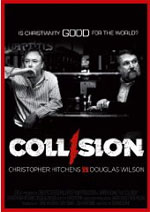
An interisting new release comes out today. It is based on a debate between the Athiest Christopher Hitchens and Douglas Wilson who is a senior fellow at New St. Andrew's College. The exchanges are also recorded in the book: Is Christianity Good for the World?
Synopsis:
The documentary COLLISION pits leading atheist, political journalist and author Christopher Hitchens (God Is Not Great: How Religion Poisons Everything) against fellow author and evangelical theologian Pastor Douglas Wilson on a debate tour arguing the topic “Is Religion Good For The World?”. Lives and worldviews collide as Hitchens and Wilson wittily and passionately argue the timeless question, proving to be perfectly matched intellectual, philosophical, and cinematic rivals. COLLISION is directed by prolific independent filmmaker Darren Doane (Van Morrison: To Be Born Again, The Battle For L.A., Godmoney).
Chrristopher Hitchens makes some complementary comments in today's National Post (cited below from Slate):
Ever since I invited any champion of faith to debate with me in the spring of 2007, I have been very impressed by the willingness of the other side to take me, and my allies, up on the offer.
I have discovered that the so-called Christian right is much less monolithic, and very much more polite and hospitable, than I would once have thought, or than most liberals believe.
Hitchens makes a tremendous complement to Wilson, reflecting on Wilson's belief system and apologetic style. It is a statement that relects a great complement on how we should stand for what we say we believe:
Wilson isn't one of those evasive Christians who mumble apologetically about how some of the Bible stories are really just "metaphors." He is willing to maintain very staunchly that Jesus of Nazareth was the Christ and that his sacrifice redeems our state of sin, which in turn is the outcome of our rebellion against God. He doesn't waffle when asked why God allows so much evil and suffering—of course he "allows" it since it is the inescapable state of rebellious sinners. I much prefer this sincerity to the vague and Python-esque witterings of the interfaith and ecumenical groups who barely respect their own traditions and who look upon faith as just another word for community organizing.
In the late afternoon of April 18, 1521, in the city of Worms, Germany, Martin Luther, a 37 year-old Catholic monk was called to defend himself before Charles the Fifth, the Holy Roman Emperor. The speech he delivered that day, Here I Stand, marked the beginning of the Reformation, a critical turning point in Christian history, that decisively altered the spiritual map of the world.
In this recording, Max McLean introduces the events leading up to the Diet of Worms: Martin Luther’s prayer the night before he delivered his speech; Luther's stirring defense; the Catholic church’s rebuttal; and, Luther’s final heartfelt response.
Recovering the treasures of the past is a marvelous gift to the church. I love these presentations of the classics given by Max McLean. However, Martin Luther’s Here I Stand is my favorite.R. C. Sproul
Redeemer Presbyterian Church in New York has opened up a new free sermon resource, starting with 150 of Pastor Tim Keller’s sermons, all categorized, labeled, and downloadable, at this site:
Redeemer’s Sermon Ministry has been faithfully recording, cataloging and reproducing all of our sermons for the past 20 years. To celebrate all 20 years of our history, and to meet the growing demand for our church’s teaching in New York City and around the world, we have created this resource of 150 sermons and lectures covering a broad array of topics, completely free to download and share.
The recordings chosen for the Free Sermon Resource were culled from classic sermon series as well as lectures and seminar addresses delivered to various Redeemer ministry gatherings, and are intended to present to the listener the full scope of teachings they would receive over several years of active involvement at Redeemer.
This is an amazing new resource, and there will be more content getting added regularly, so tell all your friends: Redeemer Free Sermon Resource.
A massive battle that many true Christians face is getting joy from their performance and not from Christ... this is something that only leads to misery and failure. By God's Grace alone may we all be truly, fully satisfied on what Christ has done, and stop focusing on ourselves.
"The salvation from sin and death and judgment that Christ brings is received by faith. Paul illustrates this faith with the case of Abraham in Romans 4:20 and shows how it relates to the glory of God: "No distrust made him waver concerning the promise of God, but he grew strong in his faith as he gave glory to God [literally, giving glory to God]." In other words, one reason that faith is the way God saves us is that faith gives glory to God. That is, faith calls attention to and magnifies the glory of God. Faith puts us in the position of weak and dependent and puts God in the position of strong and independent and merciful. So faith is essential to displaying the glory of God."
Someone asks a question about birth control and if it is biblical. Some people may not realize it, but there are some sorts of birth control that are a form of abortion and therefore the people are committing murder.
Yesterday, the Federation des Medecins Specialistes du Quebec (FMSQ) released results of a survey of their membership in which 3/4 of respondents indicate support for the concept of euthanasia. The FMSQ is a collective of 35 different specialists organizations, interestingly none of them being palliative care specialists.
A story in today's National Post accurately quotes Don Hutchinson of the Evangelical Fellowship of Canada as comparing euthanasia with capital punishment, however the analogy is not completed in the text.
"The laws in our country don't forbid suicide but they do forbid helping someone to take someone's life and there's good reason for that," he said. "An individual may have a moment of expression about dying without a genuine desire to really do so. Look at the number of people who have been let out of prison because we found out they didn't commit a crime. If we had the death penalty, we wouldn't be able to do that."
The completed analogy is that just as a momentary decision on capital punishment can have irrevocable consequences, so to would such a decision in regard to euthanasia or assisted suicide. [MORE]
In reality, life concentrates on every person standing at a crossroad. This should not surprise us because this is not only true of the most important decision, that eternal decision, but its just a way of life lived out every day. We are confronted through all of our lives with decisions from the trivial ones about what we might wear today or what me might eat, to the more important ones about who we might marry or where we might live, or significant purchases we might make to the greatest of all decisions, the spiritual decisions that effect our eternity far beyond this life. It has always been the function of the servants of God, the ministers of God, the messengers of God to confront people with that most critical of all decisions.
The biggest question that will ever be answered is the question...Which way to heaven? The most important decision that anybody will ever make is the decision that they make regarding their eternal destiny. Life here, says the Bible, is a vapor that appears for a little time and vanishes away. It is like steam off a cup of coffee, nothing more, compared to eternity. Everyone will live somewhere forever without end. Where you live forever is absolutely critical. There are two options: hell and eternal punishment, or heaven and eternal joy. The question then is...which way to heaven?
We've all seen on television the vestiges of a coronation. And we have seen what a grand event it is in the most austere and magnificent building available to a people with the most lavish kinds of clothes, attended by the most erudite and significant and important of all people. These are all signs of the power and signs of the privilege and signs of the authority. These are the magnificent emblems of what it means to be the monarch, to have absolute supremacy and absolute sovereignty in a nation.