Monday, December 26, 2011


Sunday, December 25, 2011
Saturday, December 24, 2011
Charles Spurgeon Sermon - Joy Born at Bethlehem (Part 1 of 3)
Charles Spurgeon Sermon playlist: http://www.youtube.com/view_play_list?p=CDB844A9113F938C
Sermon text: http://www.biblebb.com/files/spurgeon/1026.htm
Charles Haddon (C.H.) Spurgeon (June 19, 1834 January 31, 1892) was a British Reformed Baptist preacher who remains highly influential among Christians of different denominations, among whom he is still known as the "Prince of Preachers." In his lifetime, Spurgeon preached to around 10,000,000 people, often up to 10 times a week at different places. His sermons have been translated into many languages. Spurgeon was the pastor of the New Park Street Chapel in London for 38 years. In 1857, he started a charity organization called Spurgeon's which now works globally. He also founded Spurgeon's College, which was named after him after his death.
Spurgeon was a prolific author of many types of works including sermons, an autobiography, a commentary, books on prayer, a devotional, a magazine, and more. Many sermons were transcribed as he spoke and were translated into many languages during his lifetime. Arguably, no other author, Christian or otherwise, has more material in print than C.H. Spurgeon.
Friday, December 23, 2011
Greg Koukl - Messianic Prophecies
Thursday, December 22, 2011
Other Prophecies that show that Jesus is the Messiah? With Dr. Michael Brown.
With Special Guest Dr. Michael Brown of askdrbrown.org
Wednesday, December 21, 2011
Is Jesus Christ the Messiah of Isaiah 53? With Dr. Michael Brown
With Special Guest Dr. Michael Brown of askdrbrown.org
Saturday, December 17, 2011
Sermon Outline: "Peace on Earth" Isaiah 52 7-10
1) The Peaceful Reign (Isaiah 52:7 )
2) The
Peaceful Return (Isaiah 52:8-9 )
·
Psalm 98:1-3
·
Romans 10:8-17
·
Isaiah 49:9-13
3) The
Peaceful Reveal (Isaiah 52:10 )
Saturday, December 10, 2011
Sermon Outline: "Rejoice in the Lord" Psalm 97:1-12
1) Let the Earth be Joyful (Psalm 97:1–6 )
3) Let the Righteous be Joyful (Psalm 97:10–12)
- Isaiah 11:1-5
3) Let the Righteous be Joyful (Psalm 97:10–12)
- Psalm 30:1-7
Urgent letter from Dr. Charles McVety for the Citizens of Ontario
Last week Ontario’s
Premier Dalton McGuinty siezed the opportunity to write his radical six gender
sex education in the new ant-bullying law.
Everyone agrees that bullying is a serious threat to children and must be
combated with strong, stiff programs and penalties. Children’s lives depend on it. Unfortunately the Premier is using everyone’s
good will to advance his agenda.
The Anti-bullying Bill
13 uses the force of law to make teachers in both Public and Catholic
to:
· Teach Radical Six Gender
Curriculum - Equity and Inclusive
Education
Bill 13 Section 2. (1) Paragraph 29.1 of subsection 8 (1) of the Act is repealed and
the following substituted: equity and
inclusive education
29.1 require boards to develop and implement an equity and inclusive
education policy, and, if required by the Minister, submit the policy to the
Minister and implement changes to the policy as directed by the
Minister;
· Support Homosexual Clubs in all Public and Catholic
Schools
Bill 13 Section 9. Board support for certain pupil activities and
organizations
303.1 Every board shall
support pupils who want to establish and lead,
(a) activities or organizations that promote gender equity;
(b) activities or organizations that promote anti-racism;
(c) activities or organizations that promote the awareness and
understanding of, and respect for, people with disabilities; or
(d) activities or organizations that promote the awareness and understanding
of, and respect for, people of all sexual orientations and gender identities,
including organizations with the name gay-straight alliance or another
name.
· Force Churches
Renting School Property to Follow Province’s Radical Agenda.
Bill 13 Section 7
(2) Agreements with third parties re use of schools
(3.1) If a board enters into
an agreement with another person or entity, other than a board, respecting the
use of a school operated by the board, the board shall include in the agreement
a requirement that the person or entity follow standards that are consistent
with the code of conduct.
It is egregious to
impose, with the force of law, this bizarre social engineering experiment on
Ontario’s children under the pretence of protecting children from bullying. There is no proof that forcing all schools,
Public and Catholic, to teach this material and host gay clubs will stop
bullying. This guise doesn’t hold water
with standard pedagogical practices. Our
schools don’t have to teach the intricacies of every element of difference to
combat bullying. Teachers don’t need a
219 page curriculum guide extolling the virtues of being short, overweight,
Christian, Jewish, Muslim or any other identifying factor. They simply need to
combat bullying.
Think of the millions of
small, innocent children who will be subjected to this agenda if we do nothing.
Last year tens of thousands of parents spoke out, the Premier heard our cries
and cancelled a similar program.
Please act to protect
children and do the following:
1. Call Premier McGuinty at
416-325-1941
2. Send Premier
McGuinty an email by clicking here. A copy will
be sent to every Ontario MPP.
CLICK
HERE TO EMAIL YOUR MP (If this doesn’t work with your system go to www.stopcorruptingchildren.com
and click on Email Premier McGuinty)
Please make your voice known.
If not you, then who? If not now,
when?
I want to thank you for protecting children from this hostile,
confusing, radical experiment.
Merry Christmas and
May 2012 See Protection for Children.
Dr. Charles
McVety
President, Institute
for Canadian Values
Link to Equity and
Inclusive Curriculum http://word.ca/TDSB%20Equity%20%20Inclusive%20Curriculum%20-%20See%20page%2010%20!.pdf
Friday, December 09, 2011
Should I Marry Someone Because of Outward Beauty? - Paul Washer & Tim Conway
If your a young person and thinking about marriage, then please hear this clip and don't make a wrong turn and pursue outward beauty, instead of pursuing someone who fears the Lord.
MP3: http://illbehonest.com/Should-I-Marry-Someone-Because-of-Outward-Beauty-Paul-...
Thursday, December 08, 2011
Greg Koukl - Final Judgment?
Taken from Greg Koukl of "Stand to Reason" who discusses the purpose of the Final Judgment.
For more information, visit http://www.str.org.
Wednesday, December 07, 2011
Tuesday, December 06, 2011
Richard Baxter - Time-Wasting Thieves
Richard Baxter - Time-Wasting Thieves
Colossians 4:5 Be wise in the way you act toward outsiders; make the most of every opportunity.
Ephesians 5:16 making the most of every opportunity, because the days are evil.
Richard Baxter playlist: http://www.youtube.com/view_play_list?p=353D9FC6791C59E2
Richard Baxter - English puritan divine (1615-1691) was a prominent English churchman of the 1600s. He was a peacemaker who sought unity among Protestants, and yet he was a highly independent thinker and at the center of every major controversy in England during his lifetime.
Born in Rowton to parents who undervalued education, Baxter was largely self-taught. He eventually studied at a free school, then at royal court, where he became disgusted at what he saw as frivolity. He left to study divinity, and at age 23, he was ordained into the Church of England. Within the Anglican church, Baxter found common ground with the Puritans, a growing faction who opposed the church's episcopacy and was itself breaking into factions. Baxter, for his part, did his best to avoid the disputes between Anglicans, Presbyterians, Congregationalists, and other denominations, even convincing local ministers to cooperate in some pastoral matters. "In necessary things, unity; in doubtful things, liberty; in all things, charity," he was fond of saying.
The interest in cooperation was not due to a lack of conviction. On the contrary, Baxter was opinionated in his theology, which was not quite Separatist and not quite Conformist. Among his more than 200 works are long, controversial discourses on doctrine. Still, he believed society was a large family under a loving father, and in his theology, he tried to cut between the extremes. He eventually registered himself as "a mere Nonconformist" ("Nonconformist" was a technical term meaning "not Anglican"), breaking with the Church of England mainly because of the lack of power it gave parish clergy.
Baxter also found himself as a peacemaker during the English Civil Wars. He believed in monarchy, but a limited one. He served as a chaplain for the parliamentary army, but then helped to bring about the restoration of the king. Yet as a moderate, Baxter found himself the target of both extremes. He was still irritated with the episcopacy in 1660, when he was offered the bishopric of Hereford, so he declined it. As a result, he was barred from ecclesiastical office and not permitted to return to Kidderminster, nor was he allowed to preach. Between 1662 and 1688 (when James II was overthrown), he was persecuted and was imprisoned for 18 months, and he was forced to sell two extensive libraries. Still, he continued to preach: "I preached as never sure to preach again," he wrote, "and as a dying man to dying men."
Baxter became even better known for his prolific writing. His devotional classic The Saints' Everlasting Rest was one of the most widely read books of the century. When asked what deviations should be permitted from the Anglican Book of Common Prayer, he created an entirely new one, called Reformed Liturgy, in two weeks. His Christian Directory contains over one million words. His autobiography and his pastoral guide, The Reformed Pastor, are still widely read today.
Monday, December 05, 2011
Greg Koukl - Trust or Faith?
Greg Koukl of Stand to Reason discusses why he prefers the word "trust" to "faith". For more information, visit http://www.str.org.
Friday, December 02, 2011
True Forgiveness
We cannot ask God to forgive us and refuse to forgive other people. Are you withholding forgiveness for someone? If you do, you're denying someone what was freely given to you. That's hypocritical and sinful, and we have no right to do so.
This clip is from the sermon "Kiss the Feet," preached by Pastor Mark Driscoll at Mars Hill Church Ballard in Seattle, Washington on November 20, 2011. This is the 100th and final sermon in our sermon series on the Gospel of Luke.
To watch the full sermon, visit:
http://marshill.com/media/luke/kiss-the-feet
Thursday, December 01, 2011
True Repentance
Do you really repent? Do you only talk to God about other people's sin but not your own? Jesus commands us to preach repentance, and parents need to model it for their children so that there's a culture of repentance in the house.
This clip is from the sermon "Kiss the Feet," preached by Pastor Mark Driscoll at Mars Hill Church Ballard in Seattle, Washington on November 20, 2011. This is the 100th and final sermon in our sermon series on the Gospel of Luke.
To watch the full sermon, visit:
http://marshill.com/media/luke/kiss-the-feet
Wednesday, November 30, 2011
The Gospel
We murdered the beloved Son, Jesus Christ. His blood is on our hands. And the gospel, the good news, is that then the Father looks at us and says, "If you will take that kind offer from my Son, I'll adopt you into my family called the church. I'll give you my name, the family name of Christian. And I'll call you my beloved son as well."
This clip is taken from the sermon "The Father of a Murdered Son," preached by Pastor Mark Driscoll at the Mars Hill Church Ballard campus in Seattle, Washington, on July 10, 2011. It is the 82nd sermon in our sermon series on the Gospel of Luke.
To watch the full sermon, visit http://www.marshillchurch.org/media/luke/the-father-of-a-murdered-son
Tuesday, November 29, 2011
Yes, Use Words When You Preach the Gospel
"Preach the gospel, and when necessary use words"? No. Use words. Jesus commands us to tell everyone about him, because everyone needs to know him.
This clip is from the sermon "Kiss the Feet," preached by Pastor Mark Driscoll at Mars Hill Church Ballard in Seattle, Washington on November 20, 2011. This is the 100th and final sermon in our sermon series on the Gospel of Luke.
To watch the full sermon, visit:
http://marshill.com/media/luke/kiss-the-feet
Saturday, November 26, 2011
Sermon Outline: "The Blessed Hope": Titus 2:11-14
1) Salvation
From the Penalty of Sin (Titus 2:11 ),
2) Salvation
From the Power of Sin (Titus 2:12
3) Salvation
From the Presence of Sin (Titus 2:13
4) Salvation
From Possession by Sin (Titus 2:14
Friday, November 25, 2011
Other Prophecies that show that Jesus is the Messiah? With Dr. Michael Brown
Thursday, November 24, 2011
How Do We Detect Design in Nature? With Wiliam Dembski
Wednesday, November 23, 2011
Why can I trust the Bible? With Frank Turek
Tuesday, November 22, 2011
Book Review: "The Road to Missional: Journey to the Center of the Church" by Michael Frost
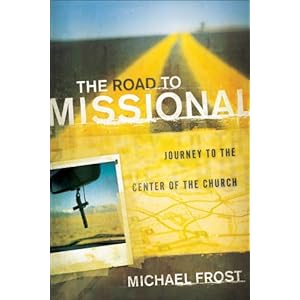
He spends a great deal of time describing what a
missional Church is and his not. A missional church then, is a church that realises this Missio Dei and has a
"wholesale and thorough reorientation of the church around mission"
(p16). “Mission is both the announcement and the demonstration of the reign of
God through Christ . "It is our automatic response to God's reign and rule, proven through Christ , revealed through the Spirit. Therefore,
any collective of believers set free from the disorder of this present age, who
offer themselves in service of the mission of their God to alert people to the
new unfolding order of things, can rightly be called a missional church."
(38)
To contrast, he makes it clear that mission is not primarily concerned with church
growth. It is primarily concerned with the reign and rule of the
Triune God. If the church grows as a result, so be it.” (p24). It "is not
about evangelism, It is not about sending, but being sent. Missional is like
slow cooking, where disciples incarnate deeply within the communities they are
in or called to be in. No quick fix. No rush to pile up numbers of conversions.
No snappy 'four spiritual laws.' " (46).
Since he recognizes that God reigns and rules through Christ ,
whatever you do that alerts people to the fact of the rule of God, is
missional. The strength and problem with many of these contrasts is that there
is a lot of room for action. While he affirms this action by both ‘announcement
and demonstration’ (p35) almost all the focus and the examples are on
‘demonstration’. It would be best to look elsewhere for much of the "announcement" or content of the
message. Although Frost
quotes quite extensively from various missional authors, his treatment of the
Scriptural message of the "announcement" is infrequent. You need to
go though twenty-five pages before the first text is cited. Interesting Biblical treatment such as "The Cross as
Metaphor/Paradigm" (p. 90ff) are few and far between. Taking concepts like
the incarnation by quoting The Message
that "The Word became flesh and blood and moved into the neighbourhood"
(Jn. 1:14) is so offensive, that his argument for moving into the neighbourhood
(proximity) (p. 123) is undermined.
The missional approach often seems to be living
out a "lordship" of Christ 's
self-sacrificial life, but it is often not
careful in what it advocates. One, for example sees a renewal of
"monastic practices-confession, repentance, Bible reading, prayer..."
(p.79). Calling these spiritual disciplines "monastic" contradicts a missional connection with the
community. Likewise, the trend to define one's self on what you don't do (don't
drink/smoke/gamble/hang out with people who do) sounds more like old school
"fundamentalism" than "pietism".
Yet, I would agree with Frost that this kind of spirituality "outsources
the need to do the daily work of keeping in step with the Spirit of the
God" (p.85). Again a good point is made with a poor choice of terms:
"Church people worry that the
world might change the church, Kingdom people work to see the church change the
world" (p.103). Perhaps using a term like "religious" would have
been preferable for Christ came to establish a
"church", or called out people for Himself to be agents of His
Kingdom.
There seems to be a very "grass roots" feeling to the work
of mission. Things like structure, leadership, doctrinal standards and
accountably are woefully lacking.
Seeing congregations "led by humble men and women" (p.79) perhaps
even hints at the author's desire for "egalitarian" leadership.
I found myself laughing in chapter four on
"triumphant Humiliation" in the description of false persecution that some feel: "Maybe when your neighbor
ignores you, it's not because he hates the light of the Lord that shins from
you. Maybe he just thinks you're a jerk. Maybe we get most of the rejection we
do because, well, we deserve it" (p.83). This is a much needed wake up
call for contemporary Christianity.
Yet, it does no good to try to do the
"mission" of Christ and not proclaim His words while
doing do. Our message may counteract our methods. This work is helpful in
suggesting ways to live out the message of Christ . Yet, I fear
we may quickly forget and get side-tracked if we do not continue to learn about
the person and words of Christ in order to check our actions
to His mission.
Rating: 2.5 stars of 5.
Product Details
- Paperback: 160 pages
- Publisher: Baker
Books (
- Language: English
- ISBN-10: 0801014077
- ISBN-13: 978-0801014079
- Product Dimensions: 22.6 x 15.2 x 1.3 cm
- Shipping Weight: 227 g
"Book has been provided courtesy
of Baker Publishing Group and Graf-Martin Communications, Inc.
Available at your favourite bookseller
from Baker Books, a division of Baker Publishing Group".
How Do We Deal with Doubts? With Mike Licona
Special Guest Dr. Mike Licona returns and answers the question "How does a Christian Deal with Doubts?"
Monday, November 21, 2011
Saturday, November 19, 2011
Sermon Outline: "Called But Not Chosen": Matthew 22:1-14
1) The Invitation Rejected
(Matthew 22:1–6
2) The
Rejecters Punished (Matthew 22:7–8
- Isaiah 44:28-45:7
3) The
New Guest Invited (Matthew 22:9–10
4) The
Intruder Expelled (Matthew 22:11 –14
- Isaiah 61:10-11
Friday, November 18, 2011
We're 1st Century Christians Delivered from Suffering? With Gary Habermas
Thursday, November 17, 2011
Does the Bible Always Promise Escape From Suffering? With Gary Habermas
Wednesday, November 16, 2011
Should Christians Be Surprised by Suffering? With Dr. Gary Habermas
Tuesday, November 15, 2011
What is the Fine-Tuning Argument for the Existence of God? (William Lane Craig)
Grab a copy of Dr. Craig's new book "On Guard" to learn more about this and other arguments on how to defend your faith with reason and precision.
Recommended Book: http://www.amazon.com/Guard-Defending-Faith-Reason-Precision/dp/1434764885
One Minute Apologist Interview with William Lane Craig (playlist):
http://www.youtube.com/playlist?list=PL4BA3DD694EE87E80
Related:
More on the Fine-tuning argument here: http://www.youtube.com/view_play_list?p=9A91B68D2FB071C1
Monday, November 14, 2011
Leibniz's Argument for the Existence of God? (William Lane Craig)
Grab a copy of Dr. Craig's new book "On Guard" to learn more about this and other arguments on how to defend your faith with reason and precision.
Recommended Book: http://www.amazon.com/Guard-Defending-Faith-Reason-Precision/dp/1434764885
One Minute Apologist Interview with William Lane Craig (playlist):
http://www.youtube.com/playlist?list=PL4BA3DD694EE87E80
Saturday, November 12, 2011
Sermon Outline: "Victorious in Christ": Revelation 2:1-7
International Day of Prayer for the Persecuted Church
1) The
Church (Revelation 2:1)
- Acts 19:11-19
2) The
Commendation (Revelation 2:2–3, 6)
- Acts 20:28-31
- Galatians 6:1-10
3)
The Concern (Revelation
2:4)
- 2
4) The
Command (Revelation 2:5)
5) The
Counsel (Revelation 2:7)
- 1
Friday, November 11, 2011
Remembrance Day 2011: Canada Remembers
This November, Canadians from coast to coast to coast will come together to mark Veterans' Week.
At hundreds of ceremonies and events, we will remember and recognize the sacrifices and accomplishments of our veterans those of past missions and conflicts, and those who are still returning home today.
So, how will you remember?
Thursday, November 10, 2011
What is the Kalam Cosmological Argument? (William Lane Craig)
Grab a copy of Dr. Craig's new book "On Guard" to learn more about this and other arguments on how to defend your faith with reason and precision.
Recommended Book: http://www.amazon.com/Guard-Defending-Faith-Reason-Precision/dp/1434764885
One Minute Apologist Interview with William Lane Craig (playlist):
http://www.youtube.com/playlist?list=PL4BA3DD694EE87E80
Related:
Defending the Kalam Cosmological Argument:
http://www.youtube.com/view_play_list?p=916E17EE70E98A68
Wednesday, November 09, 2011
Argument Ad Hominem ? (William Lane Craig)
Grab a copy of Dr. Craig's new book "On Guard" to learn more about this and other arguments on how to defend your faith with reason and precision.
Recommended Book: http://www.amazon.com/Guard-Defending-Faith-Reason-Precision/dp/1434764885
One Minute Apologist Interview with William Lane Craig (playlist):
http://www.youtube.com/playlist?list=PL4BA3DD694EE87E80
Tuesday, November 08, 2011
The Genetic Fallacy (William Lane Craig)
http://reasonablefaith.org - Can you invalidate someone's belief by showing how someone came to hold it? Hear special guest Dr. William Lane Craig explain the genetic fallacy.
Grab a copy of Dr. Craig's new book "On Guard" to learn more about this and other arguments on how to defend your faith with reason and precision.
Recommended Book: http://www.amazon.com/Guard-Defending-Faith-Reason-Precision/dp/1434764885
One Minute Apologist Interview with William Lane Craig (playlist):
http://www.youtube.com/playlist?list=PL4BA3DD694EE87E80
Monday, November 07, 2011
We're 1st Century Christians Delivered from Suffering? With Gary Habermas
With Special Guest Dr. Gary Habermas.
Saturday, November 05, 2011
Sermon Outline: "The Time of God's Favor" Isaiah 49:8-16
1) God's Covenant
(Isaiah
49:8-10 )
2) God's Care
(Isaiah
49:11-14 )
3) God's Compassion
(Isaiah
49:15-16 )
Friday, November 04, 2011
James Smith - My Friend, I Know Not What Your Trouble May Be
James Smith was a predecessor of Charles Spurgeon at New Park Street Chapel in London from 1841 until 1850. Early on, Smith's readings were even more popular than Spurgeon's!
From "Daily Bible Readings for the Lord's Household"
The habit of laying up a text of Scripture in the morning, to be meditated upon while engaged in the business of this world through the day—is both profitable and delightful. It is as a refreshing draught to a weary traveler!
James Smith - My friend, I Know Not What Your Trouble May Be
Thursday, November 03, 2011
James Smith - Our Sins Forged the Nails
Luke 23:33 When they came to the place called the Skull, they crucified him there, along with the criminals—one on his right, the other on his left.
John 3:16 For God so loved the world that he gave his one and only Son, that whoever believes in him shall not perish but have eternal life.
James Smith was a predecessor of Charles Spurgeon at New Park Street Chapel in London from 1841 until 1850. Early on, Smith's readings were even more popular than Spurgeon's!
From "Daily Bible Readings for the Lord's Household"
The habit of laying up a text of Scripture in the morning, to be meditated upon while engaged in the business of this world through the day—is both profitable and delightful. It is as a refreshing draught to a weary traveler!
James Smith - Our sins Forged the Nails
Wednesday, November 02, 2011
James Smith - Our Great Lesson
James Smith playlist: http://www.youtube.com/view_play_list?p=096D74E48C1F1243
James Smith was a predecessor of Charles Spurgeon at New Park Street Chapel in London from 1841 until 1850. Early on, Smith's readings were even more popular than Spurgeon's!
From "Daily Bible Readings for the Lord's Household"
The habit of laying up a text of Scripture in the morning, to be meditated upon while engaged in the business of this world through the day—is both profitable and delightful. It is as a refreshing draught to a weary traveler!
Psalm 32:8 I will instruct you and teach you in the way you should go; I will counsel you with my loving eye on you.
Job 36:22 God is exalted in his power. Who is a teacher like him?
James Smith - Our Great Lesson
Tuesday, November 01, 2011
John Newton - He is my Beloved
John Newton - (1725-1807), Evangelical divine and hymn writer
Newton was born in London July 24, 1725, the son of a commander of a merchant ship which sailed the Mediterranean. When John was eleven, he went to sea with his father and made six voyages with him before the elder Newton retired. In 1744 John was impressed into service on a man-of-war, the H. M. S. Harwich. Finding conditions on board intolerable, he deserted but was soon recaptured and publicly flogged and demoted from midshipman to common seaman.
Although he had had some early religious instruction from his mother, who had died when he was a child, he had long since given up any religious convictions. However, on a homeward voyage, while he was attempting to steer the ship through a violent storm, he experienced what he was to refer to later as his "great deliverance." He recorded in his journal that when all seemed lost and the ship would surely sink, he exclaimed, "Lord, have mercy upon us." Later in his cabin he reflected on what he had said and began to believe that God had addressed him through the storm and that grace had begun to work for him.
For the rest of his life he observed the anniversary of May 10, 1748 as the day of his conversion, a day of humiliation in which he subjected his will to a higher power. "Thro' many dangers, toils and snares, I have already come; 'tis grace has bro't me safe thus far, and grace will lead me home." He continued in the slave trade for a time after his conversion; however, he saw to it that the slaves under his care were treated humanely.
In 1750 he married Mary Catlett, with whom he had been in love for many years. By 1755, after a serious illness, he had given up seafaring forever. During his days as a sailor he had begun to educate himself, teaching himself Latin, among other subjects. From 1755 to 1760 Newton was surveyor of tides at Liverpool, where he came to know George Whitefield, deacon in the Church of England, evangelistic preacher, and leader of the Calvinistic Methodist Church. Newton became Whitefield's enthusiastic disciple. During this period Newton also met and came to admire John Wesley, founder of Methodism. Newton's self-education continued, and he learned Greek and Hebrew.
He decided to become a minister and applied to the Archbishop of York for ordination. The Archbishop refused his request, but Newton persisted in his goal, and he was subsequently ordained by the Bishop of Lincoln and accepted the curacy of Olney, Buckinghamshire. Newton's church became so crowded during services that it had to be enlarged. He preached not only in Olney but in other parts of the country. In 1767 the poet William Cowper settled at Olney, and he and Newton became friends.
Cowper helped Newton with his religious services and on his tours to other places. They held not only a regular weekly church service but also began a series of weekly prayer meetings, for which their goal was to write a new hymn for each one. They collaborated on several editions of Olney Hymns, which achieved lasting popularity. The first edition, published in 1779, contained 68 pieces by Cowper and 280 by Newton.
Among Newton's contributions which are still loved and sung today are "How Sweet the Name of Jesus Sounds" and "Glorious Things of Thee Are Spoken," as well as "Amazing Grace." Composed probably between 1760 and 1770 in Olney, "Amazing Grace" was possibly one of the hymns written for a weekly service. The origin of the melody is unknown. Most hymnals attribute it to an early American folk melody. The Bill Moyers special on "Amazing Grace" speculated that it may have originated as the tune of a song the slaves sang.
Newton was not only a prolific hymn writer but also kept extensive journals and wrote many letters. Historians accredit his journals and letters for much of what is known today about the eighteenth century slave trade. In Cardiphonia, or the Utterance of the Heart, a series of devotional letters, he aligned himself with the Evangelical revival, reflecting the sentiments of his friend John Wesley and Methodism.
In 1780 Newton left Olney to become rector of St. Mary Woolnoth, St. Mary Woolchurch, in London. There he drew large congregations and influenced many, among them William Wilberforce, who would one day become a leader in the campaign for the abolition of slavery. Newton continued to preach until the last year of life, although he was blind by that time. He died in London December 21, 1807. Infidel and libertine turned minister in the Church of England, he was secure in his faith that amazing grace would lead him home.
John Newton - He is my Beloved
Subscribe to:
Posts (Atom)