Thursday, June 21, 2007


Tuesday, June 19, 2007
Friday, June 08, 2007
Hitchens Mistaken About a Date, a Name, and the Gospels
Part 3 of series: god is Not Great by Christopher Hitchens: A Response
Warning: Long post to follow!
In yesterday’s post I said that I have found many errors in god in not Great by Christopher Hitchens. These errors have been in the area of my academic expertise: New Testament and New Testament scholarship. I’ll leave it to other experts to evaluate the accuracy of other portions of god is not Great. But I must confess that I was not impressed by Hitchens’s grasp of the material I know well, and that has led me to question his overall reliability as a source of “facts.”
I have found fifteen errors in Hitchens’s treatment of the New Testament, as well as sixteen misunderstandings or distortions. Some of the clear errors are not major in terms of content, but they reveal a kind of sloppiness that is unsettling.
Hitchens Mistaken on the Date of Jesus’s Birth
For example, Hitchens writes:
“This [year 2000 hysteria] was no better than primitive numerology: in fact it was slightly worse in that 2000 was only a number of Christian calendars and even the stoutest defenders of the Bible story now admit that if Jesus were ever born it wasn’t until at least AD 4.” (pp 59-60)
Nobody, to my knowledge, dates the birth of Jesus to AD 4. Every scholar puts his birth earlier than 4 BC (the date of King Herod’s death). The most likely date for Jesus’s birth seems to be around 6 BC. My guess is Hitchens remembered the “4″ correctly but not the era. A minor mistake, but an unsettling one.
Hitchens Gets Bart Ehrman’s Name Wrong
To cite one further example of this sort, Hitchens twice refers to the scholar Bart D. Ehrman as “Barton Ehrman” (p. 120, 142). To my knowledge, “Bart” is Mr. Ehrman’s full first name. So, unless he has a nickname unknown to me, it’s an error to call the man “Barton.” Again, this is not a substantial error, but it does suggest a distressing lack of accuracy. (It also leaves me completely unimpressed with the editing of this book. Authors make mistakes. I’ve certainly made plenty in my time. Good publishers have good editors and fact-checkers who catch mistakes.)
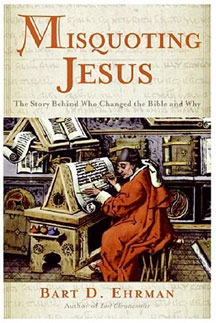 By the way, let me clarify something I said in the debate about Ehrman. He is a highly-regarded New Testament scholar, who has done some fine work. I once used one of his books in a seminary course I was teaching. I disagree with him at many points, but I respect his work. I do believe that Ehrman’s opposition to Christianity does color some of his arguments and conclusions, but no more that my own work reflects my Christianity. If you’re interested, in a new book that refutes Ehrman’s Misquoting Jesus, check out Misquoting Truth: A Guide to the Fallacies of Bart Ehrman’s “Misquoting Jesus” by Timothy Paul Jones. HT: Melinda at Stand to Reason)
At this point my criticis will no doubt say that I’m nit-picking, that the errors in god is not Great are insubstantial. My response, as one who has graded hundreds of graduate school papers over the years, is that you can almost always see the quality of a writer’s thinking in how he or she deals with seemingly insignificant details. ‘A’ papers generally get the names and dates right in addition to the main arguments. Sloppiness in small things is generally an indicator of sloppiness in larger things.
Hitchen’s Gets the Nature of the Gospels Wrong
So now to a larger “fact” that Hitchens gets wrong. He writes:
“However, he [Maimonides, the Jewish rabbi and philosopher] fell into the same error as do the Christians, in assuming that the four Gospels were in any sense a historical record. Their multiple authors–none of whom published anything until many decades after the Crucifixion–cannot agree on anything of importance.” (111)
There are two main problems with this statement. The first problem is calling it an “error” to “assum[e] that the four Gospels were in any sense a historical record.” Even the most skeptical of scholars see the Gospels as a historical record in some sense. Most famously, even the Jesus Seminar, which turned skepticism about the Gospels into a media sensation, gave a historical thumbs up (red beads, actually) to some of the sayings and actions of Jesus in the New Testament Gospels. I don’t know of any credible scholar who claims that there is no historically reliable material in the Gospels. Ancient historians and classicists generally regard the Gospels as substantially historical, and regard the hyper-skepticism of many New Testament scholars as aberrant.
As much as I think Hitchens made a mistake in what he wrote about the Gospels as not being a historical record in some sense, I actually didn’t count this among the fifteen clear errors, because I was giving him a generous benefit of the doubt. However, the next problem in the same excerpt is an indisputable error.
Hitchens writes that the “multiple authors” of the Gospels “cannot agree on anything of importance.” This is plainly wrong, unless, I suppose, we allow Hitchens to fill in the blanks of what counts as important. He might say that nothing of importance at all is addressed in the Gospels. (Later he will say that “Thanks to the telescope and the microscope, [religion] no longer offers an explanation of anything important.” [282]). Be that as it may, his point on page 111 is that the Gospels are full of disagreement, especially about the things that matter about Jesus, as the context makes clear.
This is simply not true. Though it is true that the New Testament Gospels show considerable diversity in their portraits of Jesus, they agree on many, many things, including matters that are most important both to the Gospel writers and to Christian believers.
In my book, Can We Trust the Gospels?, I devote two chapters to this issue. Chapter 8 is called “What Difference Does It Make That There Are Four Gospels?” Chapter 9 is called “Are There Contradictions in the Gospels?” I do not at all try to minimize the genuine differences among the Gospels. Any careful reader can’t help but see them, whether in the stories of Jesus’s birth or in the stylistic differences between Mark and John. In fact, the early Christians celebrated the unique qualities of the different Gospels. But I also show in considerable detail the extent to which all four Gospels agree on much of what pertains to Jesus, including the most important aspects of His ministry and message.
At the end of Chapter 8, I include a list of 33 key facts about Jesus that are found in all four gospels. I’ll mention about half of these points of agreement here:
• Jesus ministered during the time when Pontius Pilate was prefect of Judea (around A.D. 27 to A.D. 37).
• Jesus had a close connection with John the Baptist, and his ministry superseded that of John.
• Jesus’s ministry took place in Galilee.
• Jesus’s ministry concluded in Jerusalem.
• Jesus gathered disciples around him. (This is important, because Jewish teachers in the time of Jesus didn’t recruit their own students, rather the students came to them.)
• Jesus taught women, and they were included among the larger group of his followers. (This, by the way, sets Jesus apart from other Jewish teachers of his day.)
• The ministry of Jesus involved conflict with supernatural evil powers, including Satan and demons.
• Jesus used the cryptic title “Son of Man” in reference to Himself and in order to explain His mission. (Jesus’s fondness for and use of this title was very unusual in his day, and was not picked up by the early church. This is a hugely important point for the one who seeks to understand Jesus.)
• Jesus saw his mission as the Son of Man as leading to his death. (This was unprecedented in Judaism. Even among Jesus’s disciples it was both unexpected and unwelcome.)
• Jesus, though apparently understanding himself to be Israel’s promised Messiah, was curiously circumspect about this identification. (This is striking, given the early and widespread confession of Christians that Jesus was the Messiah.)
• Jesus did various sorts of miracles, including healings and nature miracles.
• Jesus was misunderstood by almost everybody, including his own disciples.
• Jesus experienced conflict with many Jewish leaders, especially the Pharisees and ultimately the temple-centered leadership in Jerusalem.
• Jesus spoke and acted in ways that implied He had a unique connection with God.
• Jesus was crucified in Jerusalem, at the time of Passover, under the authority of Pontius Pilate, and with the cooperation of some Jewish leaders in Jerusalem. (There are quite a few more details concerning the death of Jesus that are shared by all four gospels.)
• Most of Jesus’s followers either abandoned Him or denied Him during His crucifixion.
• Jesus was raised from the dead on the first day of the week.
• Women were the first witnesses to the evidence of Jesus’s resurrection. (This is especially significant, since the testimony of women was not highly regarded in first-century Jewish culture. Nobody would have made up stories with women as witnesses if they wanted them to gain ready acceptance.)
My list of Gospel agreements doesn’t even begin to tally up the less explicit but ultimately crucial agreements in matters of worldview. The Gospel writers share a common view of reality, one that includes a personal, creator God who has been active in human affairs, especially those of Israel, and so forth and so on. Someone from a culture not influenced by Judeo-Christianity would undoubtedly see commonalities that I take for granted.
As I read god is not Great, and as I’ve read other things Christopher Hitchens has written, it’s obvious to me that he has a good bit of familiarity with the New Testament Gospels. I’d even be willing to bet that he knows the Gospels better than many Christians. Thus I am at a loss to explain why he would say that they “cannot agree on anything of importance.” Even allowing for a good bit of polemical freedom, such a statement is so plainly wrong that it cannot but undermine the reader’s confidence in Hitchens’s reliability.
If would be perfectly fair for Hitchens to have said, “The Gospels agree on many things about Jesus, most of which are rubbish.” Of course I’d beg to differ with the rubbish bit, but at least it would be a fair point for him to have made. But it just isn’t correct for Hitchens to say that the four Gospels “cannot agree on anything of importance.”
Thus I come to the end of my long discussion of the first three of Hitchens’s errors concerning the New Testament and New Testament scholarship. The first two are admittedly small, but suggestive. The third error is important enough to have merited lengthy analysis. In subsequent posts I’ll move more quickly through the other errors so as to get through this material in a reasonable number of posts.
Thursday, June 07, 2007
Do Extraordinary Claims Require Extraordinary Evidence?
Extraordinary Evidence
By
Christopher Hitchens asked for extraordinary evidence for the extraordinary claims of the Bible. The philosopher Hume posed this question in his essay "On Miracles" in Dialogues Concerning Natural Religion. Hitchens is very well read so I wouldn't be surprised if he drew this from Hume.
The request actually has an equivocation and can be responded to in two ways. I remembered Dr. Garry DeWeese of Talbot School of Theology answered this in a philosophy class I took from him, so I contacted him to refresh my memory.
"Extraordinary evidence" can be understood in two ways: extraordinary with respect to quality, or quantity.
If the former, then our evidence E is extraordinary, and the obtaining of E itself is an extraordinary event which demands extraordinary evidence, and a vicious regress ensues. But then the condition can never be met, and begs the question against extraordinary events in an unfair manner.
But if the latter, then the question is, how much ordinary evidence is necessary for the total to be considered extraordinary? This is perhaps a sorites problem, where there is no determinate solution (at least epistemically, if not metaphysically determinate).
A second alternative would be to allow that there is some multiple n of the amount of evidence needed for establishing the probability of an ordinary event. But then, the fact that we find n times the ordinary amount of evidence is either a case of evidential over-determination or is itself an extraordinary event.
A third alternative recognizes that very extraordinary events happen all the time, if the co-occurrence of several features in a state of affairs is evaluated probabilistically. (That an American high school kid from Seattle would be at a Halloween party in Tel Aviv and there met an American high school girl from Pensacola and later marry her is highly improbable; in fact, Barb [Mrs. DeWeese] and I might be the only two people in the whole history of the human race who fulfill that description!) So no matter how extraordinary the event, no explanation is needed. (In philosophy of science it has long been recognized that given a relevant law and certain initial conditions gives a high probability to the occurrence of some event is really no explanation; even small probabilities can have explanatory value.)
And I would challenge Hitchens on meeting his own demand because he makes some extraordinary claims of his own.
Non-material properties, such as morality and rationality, which he values, have apparently derived from purely material causes. He's a materialist. He believes something (the physical universe) came from nothing - with no viable scientific explanation. He also believes in evolution, and even committed evolutionists admit to the high odds, the extraordinary nature, of the appearance of biological life. These are extraordinary claims Hitchens himself believes happened I would ask him to offer the extraordinary evidence within his view of reality, materialism and evolution, that can account for them.
I'd say that Christianity has better explanatory resources for his demand than his own view does.
And Amy weighed in on this same challenge at the A-Team blog. Sometimes it becomes evident that there is no evidence, quality or quantity, that can satisfy the challenge because the objection is a guise for a presupposition against such claims.
by Amy @http://ateam.blogware.com
http://ateam.blogware.com/blog/_archives/2007/6/6/3001363.html
In yesterday's debate, Hitchens brought up an oft-cited argument against Christianity, saying that we would need an extraordinary amount of evidence before we could believe that an event as exceedingly improbable as the resurrection actually occurred.
I did a quick search on the internet and brought up a short debate (only 38 pages) between William Lane Craig and Bart D. Ehrman titled Is There Historical Evidence for the Resurrection of Jesus? that addresses this very issue.
Craig first presents four uncontested facts and clarifies the issue:
For now, I want to sketch briefly how a historical case for Jesus' resurrection might look. In constructing a case for Jesus' resurrection, it's important to distinguish between the evidence and the best explanation of that evidence. This distinction is important because in this case the evidence is relatively uncontroversial. As we'll see, it's agreed to by most scholars. On the other hand, the explanation of that evidence is controversial. That the resurrection is the best explanation is a matter of controversy. Now although Dr. Ehrman says that there cannot be any historical evidence for the resurrection, we'll see that what he really means is that the resurrection cannot be the best explanation of that evidence, not that there is no evidence. (pp. 3-4, emphasis mine)
Ehrman dismisses the facts presented by Craig as irrelevant since he has already ruled out the possibility of interpreting them as describing a miracle:
[M]iracles are so highly improbable that they're the least possible occurrence in any given instance.... I wish we could establish miracles, but we can't. It's no one's fault. It's simply that the cannons of historical research do not allow for the possibility of establishing as probable the least probable of all occurrences. For that reason, Bill's four pieces of evidence are completely irrelevant. There cannot be historical probability for an event that defies probability, even if the event did happen. (p. 12)
Therefore, in this debate, Ehrman's position that there is no historical evidence for the resurrection is based on a philosophical objection, not on a lack of available facts.
Since the objection prevents Ehrman (and many people) from ever considering the actual evidence, Craig then confronts the charge that a miracle, by definition, will always defy probability despite any and all evidence. He argues that we must take into account not only the intrinsic probability of the resurrection in light of our general knowledge about the natural world, but also in light of the specific evidence for the resurrection (I would argue that this should also include our evidence for the existence of God as well as any other background factors that make the resurrection more probable). One also has to place the explanatory power of the counter-hypothesis that there was no resurrection into the equation. He then proceeds to give a mathematical formula that will statistically account for all these factors, explaining where Ehrman's mistake lies:
Specifically, Dr. Ehrman just ignores the crucial factors of the probability of the naturalistic alternatives to the resurrection.... If these are sufficiently low, they outbalance any intrinsic improbability of the resurrection hypothesis." (p. 16)
I won't recreate the formula here since it would probably cause many of us to run screaming from our computers. But if you're mathematically or statistically minded, take a look. I heard Richard Swinburne speak about this formula once, and he came up with a probability of .97 for the resurrection (Craig notes this in the Q&A section at the end of the debate).
Is Hitchens a Reliable Source of “Facts”?
Part 2 of series: god is Not Great by Christopher Hitchens: A Response
Few books will divide the house more than god is not Great. Atheists will happily devour it; religious folks will find it most distasteful. My guess is that few books are more polarizing than this particular volume.
Yet I think I can say something about god is not Great that everyone can agree with: It is filled with purported statements of fact. Those who like Hitchens may be unhappy with “purported,” but surely they must understand that by using this word I’m not necessarily denying the truthfulness of Hitchens’s claims. I’m simply noting that god is not Great is filled with thousands of statements that appear to be factual.
The is worth mentioning because many books on religion and philosophy contain endless arguments and ideas, but not many so-called facts. Books like these are valuable, of course, but they are often hard to assess. Arguments and ideas cannot be easily tested as to their truthfulness. Claims of fact often can be check out rather quicly (but not always, of course. It’s a little hard to verify the fact of the Big Bang or the existence of quarks.).
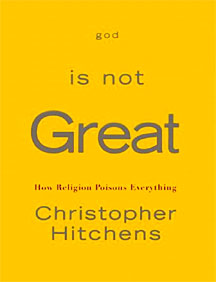 For example, if I were to say that god is not Great offers several arguments that are valid and many that are invalid, which I do in fact believe, this thesis would take quite a bit of effort to demonstrate. That’s the main point of this extended blog series on god is not Great. But if I were to say that the cover of god is not Great is blue, this could be easily checked out. You could quickly disprove my purported statement of fact by comparing it with the data. And this comparison would not bode well for me, since the cover of god is not Great is quite clearly yellow. One might call it mustard or ocher or “bananaish” or some other variety of yellow, but blue simply won’t work.
The obvious fact that god is not Great contains many apparent facts, therefore, gives us an advantage in trying to evaluate its overall truthfulness. If Hitchens tends to get his facts right, then we would do well to pay close attention to his claims, even those that are not factual per se. He will have shown himself to be a reliable witness and a careful thinker. If, on the contrary, he gets many of his facts wrong, then we would rightly be inclined to doubt what he writes about many things and chalk it up to sloppy thinking.
This fact-checking approach seems to provide a fair and rational way forward in our effort to evaluate god is not Great. In fact, it keeps us within the realm of the rational and scientific, a realm that Hitchens almost seems to regard as the kingdom of God. Yet the plethora of purported facts in this book also makes such evaluation difficult. Why? Because this book contains so many different alleged facts concerning so many different subjects. Yes, religion is in the center of Hitchens’s target, but he tends to shoot with buckshot rather than a silver bullet. god is not Great contains page after page of ostensible facts having to do with history, culture, literature, philosophy, theology, and current events, in addition to religion. Thus it would be difficult for the average person to evaluate Hitchens’s claims without doing a whole lot of research for a whole long time.
Christopher Hitchens knows more about many things than I do. Right or wrong, his grasp of history exceeds mine, as does his knowledge of current events and even certain religions, mainly Islam. But there are a few topics in which I have greater expertise than Hitchens. Given his apparently naïve and curiously modernist view of human knowing, (”Our belief is not a belief. Our principles are not a faith.” p. 5), I may know epistemology (the philosophy of knowledge) better than he. Likewise with philosophical ethics. I am quite sure that I have much more knowledge of what it’s like actually to be a Christian than Christopher (whose name in Greek means “Christ-bearer” by the way). I’m sure he’d quite happily grant me this advantage over him. And I’m positive that I know the New Testament and the field of New Testament studies better than Hitchens. This isn’t a matter of boasting. One would hope that somebody with a Ph.D. in New Testament actually had a bit of expertise in the field. While Christopher Hitchens was traveling the world as a journalist, I was burrowed into the library at Harvard, studying ancient languages and documents, and reading more New Testament scholarship than anyone other than a scholar would find valuable.
Therefore, as I read god is not Great, wading through Hitchens’s rhetorically-charged version of many purported facts, I was especially attentive to his statements about the New Testament and related scholarship. Would he get these “facts” right? Would he say things that most honest scholars, no matter their theological persuasion, would affirm? If Hitchens scored relatively high in his truth score when it came to the New Testament, then I’d be inclined to believe him about other things as well. He would have shown himself to be a careful thinker, researcher, and writer. If, however, Hitchens scored low in his New Testament truth score, if he made obvious errors and biased misstatements, then I would tend to question his reliability about other statements of fact as well.
The bad news for Christopher Hitchens is that he gets a low mark for accuracy when it comes to his statements about the New Testament and New Testament scholarship. In fact, I found fifteen factual errors in this material. I also identified sixteen statements that show what I consider to be a substantial misunderstanding or distortion of the evidence, even though a few scholars might agree with Hitchens. That’s why I distinguish between factual errors and misunderstandings/distortions, in an effort to be clear and fair.
If my evaluation is anywhere near correct, this does not reflect well upon god is not Great, since the New Testament material comprises only about 6% of the whole book. How many other errors fill the pages of this book? I’ll let suitable experts answer this question. But the obvious implication of what I discovered is that Christopher Hitchens is not a reliable reporter of facts, probably because has not done his homework adequately. He is, after all, a brilliant man with an inquisitive and well-tuned mind. Given my evaluation of his errors in the field I know best, however, I’m inclined to question his statements of “fact” concerning many other things. And my disbelief is not a belief. It’s a reasonable conclusion based on the facts of Hitchens’s numerous mistakes and misstatements.
Of course for this conclusion to be valid, I need to show specifically where Hitchens makes errors in his treatment of the New Testament and New Testament scholarship. I won’t be able to do this responsibly in this post, since I’ve already put up more words today than most readers prefer in a single blog entry. I’ll begin to examine Hitchens’s mistakes tomorrow.
In the meanwhile, if you own a copy of god is not Great, why don’t you see if you can spot any errors. Most of them can be found in pages 110 through 120.
Wednesday, June 06, 2007
Roberts-Hitchens Debate: Introduction
Part 1 of series: god is Not Great by Christopher Hitchens: A Response
A few hours ago I had the opportunity to debate Christopher Hitchens on the subject of his recent bestseller: god is not Great: How Religion Poisons Everything. For three hours (including commercials) Mr. Hitchens and I stood toe-to-toe (electronically speaking) on the Hugh Hewitt Show, a talk-radio program. (Note: if you missed this program live, it will soon be available on the Internet. Check this website. Picture to the right: Christopher Hitchens holding forth.)
 The specific topics for the debate were selected by Hugh, who moderated the program. Though he and I are friends, he did not tell me what the topics would be in advance. He and I both knew it was important for us to play fair in this debate (which meant, of course, that I way over-prepared, since I needed to be able to cover every possible topic raised by Hitchens’s book). Some of this over-preparation will now pay off as I begin to blog about god is not Great.
To be honest, I felt pretty nervous before the debate. Though I have some expertise in Christianity, and especially in the field of New Testament, and though I have been a pastor and adjunct seminary professor for many years, I am not one who regularly engages in apologetic defenses of Christian faith. Others are much better than I at such efforts (such as Dr. Craig Hazen and his Biola colleagues, including Greg Koukl and Dr. John Mark Reynolds. Prior to my conversation with Hitchens, I spoke with these three brilliant defenders of Christian faith, and am grateful for their counsel. It’s good to have smart, godly friends!)
My pre-debate nervousness was increased by the fact that Christopher Hitchens is a bright, well-educated, quick-thinking, widely-read, rhetorically-brilliant and dagger-tongued debater. Plus, for the last month he’s been going around the country sparing with religious and academic types about his book. By now his attacks and defenses will have been finely tuned for maximum effectiveness. Plus, there’s the fact that Mr. Hitchens speaks with a British accent, which means he’d sound better than I no matter the content of our presentations.
There is also the issue of the format. Talk radio, in most cases, is not well suited to careful, reasoned, extensive discourse. It’s much better for soundbites, which Hitchens cranks out in droves. But this makes it challenging to engage in logical discourse, especially when the issues are complex. One could easily win the argument, logically, but lose the war in terms of the impact on listeners.
I had hoped that both Christopher Hitchens and I would have done the debate from Hugh’s radio studio. I looked forward to the chance to talk with Mr. Hitchens face-to-face. Human communication is usually better this way, even in a debate format. Unfortunately, however, he preferred to call in his part over the telephone, which is common in the radio business. I can imagine that Christopher Hitchens is, by now, pretty tired of debating us religious folk. I don’t blame him for wanting to phone it in.
How did the debate go? Overall, I think it was fair and reasonably informative. As I think over my responses, I’d love to go back and change a few. By far the hardest thing about debating Christopher Hitchens is his tendency to throw out a lot of critical claims all at once. I found myself needing to choose which to pick up and which to leave on the table. This was frustrating, since I feared that one might assume I agreed with things I just didn’t have time to refute. My blog will give me the chance to be both clearer and more complete.
I mentioned a number of resources in the debate, and will put up links to these in case you want to track them down. Then I’ll say a bit more about the last resource on the list:
Richard Bauckham, Jesus and the Eyewitnesses: The Gospels as Eyewitness Testimony
Owen Gingerich, God’s Universe
Francis S. Collins, The Language of God: A Scientist Presents Evidence for Belief
Elaine Howard Ecklund. “Religion and Spirituality among University Scientists”
I did not bring up the Ehrman book. Hugh did, I believe, because it figures prominently in god is not Great. Though there are many fine insights in Misquoting Jesus, I don’t generally recommend it because it has much that is distorted and unhelpful. In fact, I wrote a substantial critique of this book shortly after it was published.
In our conversation about Ehrman, Hitchens mentioned something he said in his book, that he chose Ehrman “on the basis of ‘evidence against interest’: in other words from someone whose original scholarly and intellectual journey was not at all intended to challenge holy writ” (p. 122). Apparently, Hitchens believed that Ehrman was still some sort of Christian or theist, albeit not of the fundamentalist stripe. Hitchens seemed taken aback when I noted that Ehrman is not a believer, but gave up his faith a long time ago. Hitchens said he would check this out.
In my off-the-cuff comments on Ehrman, I was essentially correct, though I got a couple of details wrong. I think I said that he lost his faith in grad school, and has been an atheist for three decades, and has during that time published literature opposing orthodox Christianity. After the debate I checked my facts, and found that Ehrman considers himself an agnostic, not an atheist. Moreover, given that he finished his PhD in 1985, it would be more accurate to say he’s been a non-theist for over twenty years, not thirty. Nevertheless, the fact that he hasn’t been a Christian for his entire professional and publishing life doesn’t make Ehrman a good example of “evidence against interest.” It’s obvious, especially in Misquoting Jesus, that Ehrman has plenty of interest in debunking Christian belief. He isn’t hiding this fact, even as I don’t hide the fact that I am a Christian and that this influences my thinking and writing.
My source of information about Ehrman’s rejection of Christianity is a little essay he wrote called “An Agnostic Reflects on Christmas.” There he explains how, even though he no longer believes in the message of Christmas, he is still touched by Christmas stories and celebrations, especially Christmas trees. Ironically, Bart Ehrman and I agree profoundly on this last point. I am also a big lover of Christmas trees, as I have made abundantly clear in past blogging. I’m happy to say that Ehrman and I part company on the truth of Christmas, however.
In my next post in this series I’ll begin to examine aspects of Hitchens’s case against God and religion, and why I believe this case is less than convincing.
Hewitt-Hitchens Debate
Reflections from
The first question Hugh Hewitt asked Christopher Hitchens was how he derives moral values from a purely material world. Hitchens did what atheists often do, he changed the question. He described how he could and did behave morally; he didn't answer how moral value derives from a material world that has no resources to explain it. It's a feature of the world that is so natural to us, it seems obvious it exists. Hitchens draws from this extensively in his moral tirade against religion in his book. But that something is obvious doesn't mean that it's explained. The question is not why does an atheist behave well? The question is how does morality exist in a material world?
Hitchens also brought up a point he made in the book - that the moral law was created, instituted at Sinai. Of course, that isn't the case. It's the the Biblical teaching. The moral law predates Sinai. It was simply codified for, a government for the people of Israel as a nation.
----------------------------------------------------------------------------------------------
Listening to Hugh Hewitt's program today, here are some comments.
Hitchens makes the claim in his book and in the debate that the graves opened and the dead walking around at the time of the crucifixion reduces the extraordinariness of Jesus' resurrection. First, I'm not sure that's true, but there's a fundamental difference in Jesus' resurrection that he misses: The Scripture says that Jesus raised Himself. No matter how many of us will be raised, none of us will have raised ourselves. We are all dependent on the Lord for that.
I'm not sure why Roberts didn't respond to the dating of the Gospels that Hitchens asserted is quite late, long after the eyewitnesses were gone. That is a contested claim. Just as Hitchens relies on a very narrow slice of New Testament scholarship for his assessments, he has done so here. I think that was a major issue to contest.
Hitchens relies heavily on Bart Ehrman's scholarship and said that he didn't know of any responses to him by conservative scholarship. I don't know why he's not aware of the responses since they can be found quite easily with a Google search. (To find links to some of these, use our search on this blog.) The response might not be as numerous as Hitchens would expect if Ehrman's claims are controversial, but that is likely because most of the evidence Ehrman musters for his thesis is old news, as Roberts identified with one example. What is new is the importance of what he cites and the implications Ehrman draws from the evidence.
I didn't know that Ehrman is an atheist now, as Roberts said. I didn't know he'd completely lost his faith.
Hitchens said that the Gospel of Judas is valuable in that it offered a rationale for Judas' betrayal of Jesus, how we reconcile Judas being held responsible for what he was needed to do for God's plan. I don't know why Roberts seemed to agree, though he did take issue with the historicity of the Gospel of Judas. God worked out His plan for Jesus' crucifixion through Judas' own free actions, so he's responsible for what he did.
Hitchens claimed unchallenged that the canon of the New Testament was debate and decided quite late. That's just not true. The canon was set in practice in the second century. The church used a criteria for determining the books considered authoritative for teaching very early. It wasn't debated at the later council that formalized the canon; they simply recognzied what had been so in practice. F. F. Bruce's book Canon is an excellent resource.
Hitchens pointed to the difficult "immoral" things that are cited in the Old Testament. I agree that many things in the Old Testament are difficult. But an important point Roberts didn't point out that makes the Old Testament coherent is that the nation of Israel, the tribes they fought were guilty and God used the temporal events to issue His just judgment. That may be rejected, but as internal coherence issue that is vital to understanding the difficult things. It may not be our place to judge as the judgment are exacted, but it is God's perogative.
Hitchens, fairly asked, if God does exist then how to we evaluate competing religious claims. As I mentioned in my review of his book, we agree that if there is truth value to religious claims they are objective claims, not subjective. All religious claims can't be true because they contradict and represent very different views of reality.
Hitchens, however, believes there isn't the kind of evidence that would help us do this. First, if he was willing, even for the sake of argument in the debate, to consider that God exists, then that's a major concession on his part that should have been pursued. Second, this is where the historicity and the dating of the Gospels is critical. Very few religions make historical claims. Among those that do, the Bible is unique in the kind of manuscript evidence that makes it a historical document that should be taken seriously. I would contend that there is evidence to adjudicate among all the religious claims and Christianity offers it. No other does. And more so, Christianity, the Bible properly understood, offers a view of reality that can also explain morality and value, is compatible with scientific inquiry, all of which Hitchens values.
Tuesday, June 05, 2007
Saturday, June 02, 2007
"Is Christianity Good for the World?" The conclusion of the debate between Christopher Hitchens and Douglas Wilson.
Douglas Wilson is author of Letter from a Christian Citizen, senior fellow of theology at New Saint Andrews College, and minister at Christ Church in Moscow, Idaho. He is also the editor of Credenda/Agenda magazine and has written (among other things ) Reforming Marriage and A Serrated Edge: A Brief Defense of Biblical Satire and Trinitarian Skylarking. His Blog and Mablog site inevitably makes for provocative reading.
Christopher Hitchens wrote, God Is Not Great: How Religion Poisons Everything(Twelve Books). Hitchens is a contributing editor to Vanity Fair and a visiting professor of liberal studies at the New School. He is the author of numerous books, Thomas Jefferson: Author of America, Thomas Paine's "Rights of Man," Letters To a Young Contrarian, and Why Orwell Matters. He was named, to his own amusement, number five on a list of the "Top 100 Public Intellectuals" by Foreign Policy and Britain's Prospect.
Part 1 | Part 2 | Part 3 | Part 4 | Part 5 | Part 6
From: Christopher Hitchens
To: Douglas Wilson
Part 6, conclusion
Quo warranto is a very ancient question, meaning "by what right?" You ask me for my "warrant" for a code of right conduct and persist in mistaking my answer for an evasion. I in turn ask you by what right you assume that a celestial autocracy is a guarantee of morals, let alone by what right you choose your own (Christian) version of it as the only correct one. All deities have been hailed by their subjects as the fount of good behavior, just as they have been used as the excuse for inexcusable behavior.
My answer is the same as it was all along: Our morality evolved. Just as we have. Natural selection and trial-and-error have given us the vague yet grand conception of human rights and some but not yet all of the means of making these rights coherent and consistent. There is simply no need for the introduction of the extraneous or the supernatural. LaPlace was only one of those who concluded that religion is essentially irrelevant to important questions: an option if you choose it, but only one among many. (I have to say that your account of him makes him sound dangerously like the repulsive Calvin, but even the great Isaac Newton and the even greater Alfred Russell Wallace were prey to all kinds of superstitious delusions as they made their marvelous humanistic discoveries.)
There seems to be no easy way to discuss this other than in personal or individual terms. You and I have no idea what it is like to be a sociopath—someone who does not care about other people except inasmuch as they serve his turn—or a psychopath—someone who derives actual delight from inflicting misery on others. But we know that such people exist, and that they must be guarded against. I regard their existence as part of our haphazard evolution and our kinship with a nature that often favors the predator. You do not. Indeed, you apparently adopt the immoral and suicidal doctrine that advocates forgiveness for those who would destroy us. Please take care not to forgive my enemies, or the enemies of society. If I have to call such people "evil" (and I find I have no alternative), I do not deduce peaceful coexistence from that observation and do not want you being tender to them when it is my or my family's life that is at stake.
Turning from this to the surprising amount of virtue that can be found in humans, I again choose not to confect a mystery where none exists. Leaving ordinary sins to one side—I do not steal other people's property, for example, and hope for a reciprocal restraint on their part, and do not pardon such offenses when they occur—I could mention something that is particular to our discussion. Every now and then, in argument, I find myself glib enough to make a cheap point or a point that might evoke instant applause from an audience. But I am always aware of doing so, or if you like of the temptation to do so, and I strive (not always with success) to resist the tactic, and rather dislike myself when I give in to it. Why do I do this? Socrates called this restraint the daemon: an inner voice that helps us toward self-criticism. Many later thinkers have defined it in discrepant ways, but a definition is something short of an understanding.
I am content to regard it as indefinable, which is where we part company. My own inclination is to regard it as a human faculty without which we could not have—I shan't say "evolved" yet again—made the smallest progress as homo sapiens. You believe that I owe this inner prompting to the divine, and you further assert that a heavenly intervention made in the last two thousand years of human history (a microsecond of evolutionary time) is the seal on the deal. You will have to excuse me when I say that I think such a belief is, as well as incredible, immoral. It makes right action dependent on a highly improbable wager on the supernatural. To state the case in another way, it suggests that without celestial sanction, you yourself would be unrestrained in your appetites and careless of other people. Awful though many of your opinions are to me, I decline to believe that you would, if you lost your faith, become base and self-centered. It is, rather, religion that has made many morally normal people assent to appalling cruelties, including the mutilation of children's genitalia, the institution of slavery, the revulsion from female sexuality, and many other crimes from which an average infidel would, without any heavenly prompting, turn away. Ask yourself this question. Can you name one moral action, or moral utterance, performed or spoken by a believer that could not have been performed or spoken by an atheist? My email is available to any reader who is willing to accept this challenge.
I like your joke about the reduction of mirth to a spasm (there was a solemn critic of P.G. Wodehouse who defined the smile in terms of "naso-labial" contractions), but I think you let yourself down a bit with your Hallmark conclusion. I dare say that I could add to the list of joys and even include one or two subjects which Christianity and other religions have made difficult to discuss in public. However, I shall select my own recent investigation of my DNA, which can now be sequenced and analyzed. I was perfectly happy with the "revelation" of my own kinship with other species and quite overwhelmed by the skill and precision of those who allowed me to do it. A lot of wit and beauty and intelligence had to go into the confirmation of my status as an evolved animal, just as a great deal of dullness and stupidity is required for the continuing denial of it.
I think we shall do better if we do not resist evidence that may at first sight appear unwelcome or unsettling, just as we shall do better if we refuse conclusions for which there is no evidence at all.
CH
* * * |
From: Douglas Wilson
To: Christopher Hitchens
Part 6, conclusion
Let me begin my final installment with my thanks to you for agreeing to this debate, as well as my thanks to Christianity Today for being such an amiable host.
Turning to our discussion, I would like to begin by noting several points of minor agreement. First, I do enjoy our shared appreciation of Wodehouse—although I have to say I was disappointed with your failure to pick up the Wodehousian echoes in my "Hallmark" conclusion.
Secondly, I quite agree with you that we ought not to "resist evidence that may at first sight appear unwelcome or unsettling." But this is not really a deep agreement, for we immediately go on to differ over which one of us is failing to honor this quite obvious principle. I have shown that you refuse to consider evidence for the fact that your assumption of what the universe actually is does not allow for valid descriptions of that universe to arise from within it. If one were to spill milk accidentally on the kitchen floor, and someone else came in and wanted to know what had happened, the one thing we can be sure of is that such an inquiring mind wouldn't ask the milk. The milk wouldn't know. It's the accident.
On the question of morality, you again attempt an answer: "My answer is the same as it was all along: Our morality evolved." There are two points to be made about this reply. The first concerns evolved morality and the future, and is a variation on my previous questions. If our morality evolved, then that means our morality changes. If evolution isn't done yet (and why should it be?), then that means our morality is involved in this on-going flux as well. And that means that everything we consider to be "moral" is really up for grabs. Our "vague yet grand conception of human rights" might flat disappear just like our gills did.
Our current "morals" are therefore just a way station on the road. No sense getting really attached to them, right? When I am traveling, I don't get attached to motel rooms. I don't weep when I have to part from them. So, in the future, after every ferocious moral denunciation you choose to offer your reading public, you really need to add something like, "But this is just a provisional judgment. Our perspective may evolve to an entirely different one some years hence," or "Provisional opinions only. Morality changes over time"—POOMCOT for short. It would look like this: "The Rev. Snoutworthy is an odious little toad, not to mention a waste of skin, and his proposal that we prosecute the brassiere editors of the Sears catalog on pornography and racketeering charges is an outrage against civilized humanity. But … POOMCOT."
This relates to the second point, which concerns evolved morality and the past. When dealing with people whose moral judgments have differed from yours, do you regard them as "immoral" or as "less evolved?" The rhetoric of your book, your tone in these exchanges, and your recent dancing on the grave of the late Jerry Falwell would all seem to indicate the former. In your choice of words, the people you denounce are to be blamed. The word fulminations comes to mind. You write like a witty but acerbic tenth-century archbishop with a bad case of the gout. But this is truly an odd thing to do if "morality" is a simple derivative of evolution. Are you filled with fierce indignation that the koala bear hasn't evolved ears that stick flat to the side of his head like they are supposed to? Are you wroth over the fact that clams don't have legs yet? When you notice that the bears at the zoo continue to suck on their paws, do you stop to remonstrate with them?
Your notion of morality, and the evolution it rode in on, can only concern itself with what is. But morality as Christians understand it, and the kind you surreptitiously draw upon, is concerned with ought. David Hume showed us that we cannot successfully derive ought from is. Have you discovered the error in his reasoning? It is clear from how you defend your ideas of "morality" that you have not done so. You are a gifted writer, and you have a flair for polemical voltage. But strip it all away, and what do you have underneath? You believe yourself to live in a universe where there is no such thing as any fixed ought or ought not. But God has gifted you with a remarkable ability to denounce what ought not to be. And so, because you reject him, you have great sermons but no way of ever coming up with a text. When people start to notice the absence of texts, the absence of warrant, the absence of reasons, you adjust and compensate with rhetorical embellishment and empurpled prose. You are like the minister in the story who wrote in the margin of his notes, "Argument weak. Shout here."
Your invitation to us to try to "name one moral action … that could not have been performed or spoken by an atheist" shows that you continue to miss the point. We have every reason to believe that such atheists, performing such deeds, will be as unable as you have been to give an account of why one deed should be seen as good and another as evil. You say you have no alternative but to call sociopaths and psychopaths "evil." But you surely do have an alternative. Why not just call them "different"?
A fixed standard, grounded in the character of God, allows us to define evil, but this brings with it the possibility of forgiveness. You reject forgiveness, but at the end of the day this means that you don't believe there is anything that needs forgiveness. This means you have destroyed the idea of evil, regardless of what you might "call" behaviors that happen to be inconvenient for you.
I noted from your book that you are a baptized Christian, so I want to conclude by calling and inviting you back to the terms of that baptism. Everyone who has been baptized into the name of the Father, Son, and Holy Spirit is carrying in their person the standing obligations of repentance, belief, and continued discipleship. Your Christian name Christopher means "bearer of Christ," your baptism means the same thing, and the Third Commandment requires you not to bear or carry that name in vain. Some, as you have done, revolt against the terms of this discipleship, but it does not mean that the demands of discipleship are somehow negated or revoked. I do not bring this up in order to upbraid you. I do not know if you departed from the faith because you drifted from it, bolted from it, or were chased out by hypocritical Christians. Regardless, the kindness of God is revealed to all of us in Christ, and everyone, whatever their story, has to come to terms with this kindness.
Jesus was not just one more character in history, however important—rather, he was and is the founder of a new history, a new humanity, a new way of being human. He was the last and true Adam. But before this new humanity in Christ could be established and begin its task of filling the earth, the old way of being human had to die. Before the meek could inherit the earth, the proud had to be evicted and sent away empty. That is the meaning of the Cross, the whole point of it. The Cross is God's merciful provision that executes autonomous pride and exalts humility. The first Adam received the fruit of death and disobedience from Eve in a garden of life; the true Adam bestowed the fruit of his life and resurrection on Mary Magdalene in a garden of death, a cemetery. The first Adam was put into the death of deep sleep and his wife was taken from his side; the true Adam died on the cross, a spear was thrust into his side, and his bride came forth in blood and water. The first Adam disobeyed at a tree; the true Adam obeyed on a tree. And everything is necessarily different.
Christ told His followers to tell everybody about this—about how the world is being moved from the old humanity to the new way of being human. Not only has the world been born again, so must we be born again. The Lord told us specifically to preach this Good News to every creature. He has established his great but welcoming household, and there is room enough for you. Nothing you have ever said or done will be held against you. Everything will be washed and forgiven. There is simple food—bread and wine—on the table. The door is open, and we'll leave the light on for you.
Friday, June 01, 2007
Saturday, May 26, 2007
"Is Christianity Good for the World?"Part 5 of the ongoing debate between Christopher Hitchens and Douglas Wilson.
Douglas Wilson is author of Letter from a Christian Citizen, senior fellow of theology at New Saint Andrews College, and minister at Christ Church in Moscow, Idaho. He is also the editor of Credenda/Agenda magazine and has written (among other things ) Reforming Marriage and A Serrated Edge: A Brief Defense of Biblical Satire and Trinitarian Skylarking. His Blog and Mablog site inevitably makes for provocative reading.
Christopher Hitchens wrote, God Is Not Great: How Religion Poisons Everything(Twelve Books). Hitchens is a contributing editor to Vanity Fair and a visiting professor of liberal studies at the New School. He is the author of numerous books, Thomas Jefferson: Author of America, Thomas Paine's "Rights of Man," Letters To a Young Contrarian, and Why Orwell Matters. He was named, to his own amusement, number five on a list of the "Top 100 Public Intellectuals" by Foreign Policy and Britain's Prospect.
Part 1 | Part 2 | Part 3 | Part 4 | Part 5
From: Christopher Hitchens
To: Douglas Wilson
Part 5
If you insist, I shall concede that the significance of the Samaritan lies in his ethnicity. It's not a very impressive parable to begin with, though when I was taught it first in Sunday school, it was held up as an example of universal charity (with the added implication, not strange to us for some reason, that pious people are no more likely to behave with love and compassion than are others). Incidentally, what do we know about the ethnicity of the man who fell among thieves, or of the tribal character of those thieves if it comes to that? Surely you should be able to pronounce with authority on those details, too?
I agree that the origins of the cosmos are obscure—mysterious, if you like—to both of us. It's still you who makes the mystery, though, by insisting that very recent developments on this tiny speck of a planet on the edge of a galaxy are what impart significance to the entire "Big Bang" or divine first cause. To ask what caused either is to invite, as you are aware, an infinite regression of questions about what caused either of those causes. In my book I cite the great [Pierre-Simon, Marquis de] LaPlace, who opened the modern era by saying that accounts of the cosmos and its workings were now complete, or incomplete, on their own terms. They did not require a "god." Belief in a deity has been optional ever since. Believe it if you choose, but be aware that it raises more questions than it answers (actually it doesn't answer any important questions) and is thus highly vulnerable to Ockham's trusty edge. Deists used to agree with you about a Creator but were not religious in that the assumption of such an entity did not license the further assumption that he or she desired to intervene in human affairs, let alone the assumption that the torture and death of a single individual in a backward part of the Middle East was the solution that we had been awaiting for tens of thousands of years of brutish Homo sapiens existence.
Apply something of the same reasoning to the origins of morality. I say that our "innate" predisposition to both good and wicked behavior is precisely what one would expect to find of a recently-evolved species that is (as we now know from the study of DNA) half a chromosome away from chimpanzees. By the way, do not take that as a denigration of humankind. Primate and elephant and even pig societies show considerable evidence of care for others, parent-child bonding, solidarity in the face of danger, and so on. As Darwin put it:
Any animal whatever, endowed with well-marked social instincts, the parental and filial affections being here included, would inevitably acquire a moral sense or conscience, as soon as its intellectual powers had become as well-developed, or nearly as well-developed, as in man.
We can now observe this to be the case. But animal and human "altruism" is contradicted by the way in which species are also designed to fight with, kill, dominate, and even consume each other. Humans are capable of even greater cruelty because only they have the imagination to inflict it. I do not think that this indicts the Creator who made them this way, because I long ago dispensed with the assumption that there is any such entity. Thus, it is you and not I who are left with the questions about God's coexistence with evil. See where your talent for needless complexity has left you.
The fluctuations between social and anti-social conduct are fairly consistent across time and space: some societies have licensed cannibalism but they tend to die out, and others have licensed human sacrifice and infanticide (usually under the influence of some priesthood). But I answer your question by making the pragmatic observation that, if we surrendered to our lower instincts all the time, there would be no language in which to write this argument between us and no society in which we could find an audience. The struggle to assert what is positive in our human capacity—I don't mind Lincoln's metaphor of our "better angels" if you promise not to take it too literally—is arduous enough. If I take myself, I find that I can derive pleasure from giving blood for free and also from contemplating the deaths of my clerical-fascist enemies in the ranks of Al Qaeda and even from the misfortunes of others who do not threaten me. I am sure you could give parallel examples of your own. But telling us that we are created sick and then ordered to be well is no help in clarifying this problem. And telling us that the solution to it only became available some two thousand years ago, according to some highly discrepant and self-contradictory accounts, cannot strike me as anything but absurd. What on earth is proven—except your own vulnerability to making tautologous statements—by the claim that "Jesus Christ is good for the world because he came as the life of the world"? You cannot possibly "know" this. Nor can you present any evidence for it. And its corollary—that without Jesus we are abandoned to wickedness in all its forms—has the horrible implication that worthy actions are pointless unless accompanied by your own rather ill-grounded faith. As I say, believe it if it helps you. But do not insult the millions of people who have done the right thing without requiring any such supernatural authority. And do not tell me that I must be in love with death if I dissent from your view. That's too much. Your Christianity, in case you have not noticed, has actually made you a less compassionate and thoughtful person than, without its exorbitant presumptions, you would otherwise be.
CH
* * * |
From: Douglas Wilson
To: Christopher Hitchens
Part 5
I am afraid your argument is tangled up with greater difficulties than the ethnicity of the Samaritan, and so that issue really need not detain us any longer. I have been asking you to provide a warrant for morality, given atheism, and you have mostly responded with assertions that atheists can make what some people call moral choices. Well, sure. But what I have been after is what rational warrant they can give for calling one choice "moral" and another choice "not moral." You finally appealed to "innate human solidarity," a phrase that prompted a series of pointed questions from me. In response, you now tell us that we have an innate predisposition to both good and wicked behavior. But we are still stuck. What I want to know (still) is what warrant you have for calling some behaviors "good" and others "wicked." If both are innate, what distinguishes them? What could be wrong with just flipping a coin? With regard to your retort that my "talent for needless complexity" has simply gotten me "God's coexistence with evil," I reply that I would rather have my God and the problem of evil than your no God and "Evil? No problem!"
After this many installments, I now feel comfortable in asserting that I have posed this question to you from every point of the compass and have not yet received anything that approaches the semblance of an answer. On this question I am tempted to quote Wyatt Earp from the film Tombstone—"You gonna do something or just stand there and bleed?"—but I think I'll pass. Earp was not very much like the Good Samaritan.
But it is interesting that the same thing happens to you when you have to give some warrant for trusting in "reason.". I noted your citation of LaPlace in your book and am glad you brought him up here. LaPlace believed he was not in need of the God hypothesis, just like you, but you should also know he held this position as a firm believer in celestial and terrestrial mechanics. He was a causal determinist, meaning that he believed that every element of the universe in the present was "the effect of its past and the cause of its future."
So if LaPlace is why you think belief in God is now "optional," this appeal of yours actually turns into quite a fun business. This doctrine means (although LaPlace admittedly got distracted before these implications caught up with him) that you, Christopher Hitchens, are not thinking your thoughts and writing them down because they are true, but rather because the position and velocity of all the atoms in the universe one hundred years ago necessitated it. And I am not sitting here thinking my Christian thoughts because they are the truth of God, but rather because that is what these assembled chemicals in my head always do in this condition and at this temperature. "LaPlace's demon" could have calculated and predicted your arguments (and word count) a century ago in just the same way that he could have calculated the water levels of the puddles in my driveway — and could have done so using the same formulae. This means that your arguments and my puddles are actually the same kind of thing. They are on the same level, so to speak.
If you were to take a bottle of Mountain Dew and another of Dr. Pepper, shake them vigorously, and put them on a table, it would not occur to anyone to ask which one is "winning the debate." They aren't debating; they are just fizzing. You refer to "language in which to write this argument," and you do so as though you believed in a universe where argument was a meaningful concept. Argument? Argument? I have no need for your "argument hypothesis." Just matter in motion, man.
You dismiss the idea that the death of Jesus—the "torture and death of a single individual in a backward part of the Middle East" — could possibly be the solution to the sorrows of our brutish existence. When I said that Jesus is good for the world because he is the life of the world, you just tossed this away. You said, "You cannot possibly 'know' this. Nor can you present any evidence for it."
Actually, I believe I can present evidence for what I know. But evidence comes to us like food, and that is why we say grace over it. And we are supposed to eat it, not push it around on the plate—and if we don't give thanks, it never tastes right. But here is some evidence for you, in no particular order. The engineering that went into ankles. The taste of beer. That Jesus rose from the dead on the third day, just like he said. A woman's neck. Bees fooling around in the flower bed. The ability of acorns to manufacture enormous oaks out of stuff they find in the air and dirt. Forgiveness of sin. Storms out of the North, the kind with lightning. Joyous laughter (diaphragm spasms to the atheistic materialist). The ocean at night with a full moon. Delta blues. The peacock that lives in my yard. Sunrise, in color. Baptizing babies. The pleasure of sneezing. Eye contact. Having your feet removed from the miry clay, and established forever on the rock. You may say none of this tastes right to you. But suppose you were to bow your head and say grace over all of it. Try it that way.
You say that you cannot believe that Christ's death on the Cross was salvation for the world because the idea is absurd. I have shown in various ways that absurdity has not been a disqualifier for any number of your current beliefs. You praise reason to the heights, yet will not give reasons for your strident and inflexible moral judgments, or why you have arbitrarily dubbed certain chemical processes "rational argument." That's absurd right now, and yet there you are, holding it. So for you to refuse to accept Christ because it is absurd is like a man at one end of the pool refusing to move to the other end because he might get wet. Given your premises, you will have to come up with a different reason for rejecting Christ as you do.
But for you to make this move would reveal the two fundamental tenets of true atheism. One: There is no God. Two: I hate Him.
Saturday, May 19, 2007
"Is Christianity Good for the World?"Part 4 of the ongoing debate between Christopher Hitchens and Douglas Wilson.

 From http://www.christianitytoday.com
Theologian Douglas Wilson and atheist Christopher Hitchens, authors whose books are already part of a larger debate on whether religion is pernicious, agreed to discuss their views on whether Christianity itself has benefited the world. Below is their exchange, one in a series that will appear on our website over the course of this month.
Douglas Wilson is author of Letter from a Christian Citizen, senior fellow of theology at New Saint Andrews College, and minister at Christ Church in Moscow, Idaho. He is also the editor of Credenda/Agenda magazine and has written (among other things ) Reforming Marriage and A Serrated Edge: A Brief Defense of Biblical Satire and Trinitarian Skylarking. His Blog and Mablog site inevitably makes for provocative reading.
Christopher Hitchens wrote, God Is Not Great: How Religion Poisons Everything(Twelve Books). Hitchens is a contributing editor to Vanity Fair and a visiting professor of liberal studies at the New School. He is the author of numerous books, Thomas Jefferson: Author of America, Thomas Paine's "Rights of Man," Letters To a Young Contrarian, and Why Orwell Matters. He was named, to his own amusement, number five on a list of the "Top 100 Public Intellectuals" by Foreign Policy and Britain's Prospect.
Part 1 | Part 2 | Part 3 | Part 4
From: Christopher Hitchens
To: Douglas Wilson
Part 4
Here is the reason why I lay so much stress in my book on the importance of William of Ockham and his justly celebrated razor. Why on earth—if you excuse the impression—do the faithful spend so much time creating a mystery where none exists? And why do they insist on inserting unwarrantable assumptions?
I take the plain meaning of the passage in Luke (in a section that is clotted with stories about the casting out of devils and other embarrassing sorceries) to be the duty to others in distress. Surely it loses much of its force if the lesson is about discrepant ethnicities of which we cannot in any case be certain? Nothing can "invert" the message to emulate the Samaritan and to go "and do thou likewise."
You dilute the purity of this—which is morally intelligible to any atheist or humanist—by saying that there is a millennium and a half delay between the "revelation" of this simple act of charity and its anecdotal fulfillment. You also appear to find no distinction between the intelligible injunction to "love thy neighbor" and the impossible order to love another "as thyself." We are not so made as to love others as ourselves: This may admittedly be a fault in our "design," but in such a case the irony would be at your expense. The Golden Rule is to be found in the Analects of Confucius and in the motto of the Babylonian Rabbi Hillel, who long predate the Christian era and who sanely state that one should not do to others anything that would be repulsive if done to oneself. (Even this strikes me as either contradictory or tautologous, since surely we agree that sociopaths and psychopaths actually deserve to be treated in ways that would be objectionable to a morally normal person.)
When you say that men have never known nor yet understood the essential principle, however, you speak absurdly. Ordinary morality is innate in my view. But if, in yours, it is still not known, then centuries of divine admonition have also gone to waste. You are trapped in a net of your own making. Take a look at the list of actual or potential crimes that you mention. Genocide is not condemned by the Old Testament and neither (as you well know and have elsewhere conceded) is slavery. Rather, these two horrors are often positively recommended by holy writ. Abortion is denounced in the Oath of Hippocrates, which long predates Christianity. As for capital punishment and unjust war, the secular and the religious are alike at odds on the very definitions that underpin any condemnation. (When you include "stem-cell research," by the way, I assume that you unintentionally omitted the word "embryonic.")
To your needlessly convoluted subsequent question: Atheists are by no means "coy" on the question of evil or on the possibility of non-supernatural derivation of ethics. We are simply reluctant to say that, if religious faith falls—as we believe it must and to some extent already has—then the undergirding of decency falls also. And we do not fail to notice that a corollary is in play: The manner in which religion makes people behave worse than they might otherwise have done. Take a look at today's paper if you do not believe me: See what the parties of God are doing in Iraq. Or notice the sordid yet pious tradesmanship of Ralph Reed, Jack Abramoff, and the late Jerry Falwell. The latter's bedside is the one at which you should be asking your question—do you dare to say that a follower of Albert Einstein or Bertrand Russell would be gloating in the same way at their last hour? In either case—an atheist boaster and braggart or a hypocritical religious one—I trust that both of us would know enough to be quite "judgmental." I would differ from you only in not requiring any supernatural sanction or in claiming to be smug enough to possess such a power.
I am sorry to see that you sarcastically refer to Thomas Jefferson as "my" beloved. Do you not respect him also? And why can you not summon enough charity to believe that a non-believer can give blood, say, for no return, out of the sheer satisfaction of doing a service that involves only a benefit and no loss? According to you, my doing this is pointless unless I accept the incredible idea that, after hundreds of thousands of years of human life and suffering, God chose a moment a few thousand years ago to finally mount an intervention. You will have to accept sooner or later that a good person can be born who cannot force his mind to believe such a fantastic thing. At that point, you will see that your strenuous conditions are surplus to requirements.
In closing, I reply to your clumsy observation about my motor vehicle by citing Heine, who said:
In dark ages people are best guided by religion, as in a pitch-black night a blind man is the best guide; he knows the roads and paths better than a man who can see. When daylight comes, however, it is foolish to use blind old men as guides.
The argument that you have been making was over long before either of us was born. There is no need for revelation to enforce morality, and the idea that good conduct needs a heavenly reward, or that bad conduct merits a hellish punishment, is a degradation of our right and duty to choose for ourselves.
* * * |
From: Douglas Wilson
To: Christopher Hitchens
Part 4
You refer to the faithful "creating a mystery where none exists." May I get you to agree that the question "Why is there something here rather than nothing at all?" does not fall into that category? If you and I were standing on a little thought-experiment balcony watching either the moment when the cosmic boilers blew, giving us the Big Bang, or watching the first glorious creational response to God's fiat lux, can we agree that at that moment Ockham's razor would be of absolutely no use to either of us?
If Jesus had told a story about a black man stopping to help a beat-up white guy in Mississippi in the 1950's, and you retold the story later with the merciful one now suitably white, I think it would be appropriate for me to point out the inversion, and that the story had been significantly changed and weakened. And when I said that the Good Samaritan fulfilled an ancient law, I did not say that obedience to this law was dormant during the intervening time. Of course it was not. But neither was disobedience dormant, and Jesus was confronting a particular form of institutionalized disobedience—religious hypocrisy.
On the question of morality, you say that you are "simply reluctant" to say that if religious faith falls, then the undergirding decency must fall also. But your behavior goes far beyond a mere "reluctance to concede." Your book and your installments in this debate thus far are filled with fierce denunciations of various manifestations of immorality. You are playing Savonarola here, and I simply want to know the basis of your florid denunciations. You preach like some hot gospeler—with a floppy leather-bound book and all. I know the book is not the Bible and so all I want to know is what book it is, and why it has anything to do with me. Why should anyone listen to your jeremiads against weirdbeards in the Middle East or fundamentalist Baptists from Virginia like Falwell? On your terms, you are just a random collection of protoplasm, noisier than most, but no more authoritative than any—which is to say, not at all.
You say that I need to admit that a "good person can be born" who can't get his mind around what I am saying about Jesus. But my initial claim has been far more modest. I am simply saying that a good person needs to be able, at a minimum, to define what goodness is and tell us what the basis for it is. Your handwaving—"ordinary morality is innate"—does not even begin to meet the standard.
There are three insurmountable problems for you here. The first is that innate is not a synonym for authoritative. Why does anyone have to obey any particular prompting from within? And which internal prompting is in charge of sorting out all the other competing promptings? Why? Second, the tangled skein of innate and conflicting moralities found within the billions of humans alive today also has to be sorted out and systematized. Why do you get to do it and then come around and tell us how we must behave? Who died and left you king? And third, according to you, this innate morality of ours is found in a creature (mankind) that is a distant blood cousin of various bacteria, aquatic mammals, and colorful birds in the jungle. Your entire worldview has evolution as a key foundation stone, and evolution means nothing if not change. You believe that virtually every species has morphed out of another one. And when we change, as we must, all our innate morality changes with us, right? We have distant cousins where the mothers ate their young. Was that innate for them? Did they evolve out of it because it was evil for them to be doing that?
Now this is how all this relates to the assigned topic of our debate. We are asking if Christianity is good for the world. As a Christian discussing this with an atheist, I have sought to show in the first place that atheism has nothing whatever to say about this topic—one way or the other. If Christianity is bad for the world, atheists can't consistently point this out, having no fixed way of defining "bad." If Christianity is good for the world, atheists should not be asked about it either because they have no way of defining "good." Think of it as spiking your guns—so that I can talk about Jesus. And I want to do that because he is good for the world.
Jesus Christ is good for the world because he came as the life of the world. You point out, rightly, that loving our neighbor as we love ourselves is impossible for us, completely out of our reach. But you take this inability as a state of nature (which the commandment offends), while the Christian takes it as a state of death (which life offers to transform). Our complete inability to do what is right does not erase our obligation to do what is right. This is why the Bible describes the unbeliever as a slave to sin or one who is in a state of death. The point of each illustration is the utter and complete inability to do right. We were dead in our transgressions and sins, the apostle Paul tells us. So the death and resurrection of Christ are not presented by the gospel as medicine for everyone in the hospital, but rather as resurrection life in a cemetery.
The way of the world is to abide in an ongoing state of death—when it comes to selfishness, grasping, treachery, lust, hypocrisy, pride, and insolence, we consistently run a surplus. But in the death of Jesus that way of death was gloriously put to death. This is why Jesus said that when he was lifted up on the cross, he would draw all men to himself. In the kindness of God, the Cross is an object of inexorable fascination to us. When men and women look to him in his death, they come to life in his resurrection. And that is good for the world.
Wilson & Hitchens, Part 4
The fourth installment of the debate is online here. This debate is getting rather frustrating. In my opinion [I am a Christian and a presuppositionalist-so take the opinion with that in mind], Hitchens has not taken the time to move past his own approach to “religion” or Christianity to even consider what Wilson is doing or how he is arguing. Setting aside whether Wilson is actually giving too much ground [which I have read from some analytical philosophers], Wilson is dealing with the issue of presuppositions, or to use an analytical term, “warrant.” I am beginning to wonder if Hitchens will give any warrant for his belief.
Look in this current installment. At one point Hitchens comes close to answering Wilson’s question about mortality by saying, “When you say that men have never known nor yet understood the essential principle, however, you speak absurdly. Ordinary morality is innate in my view.” Hitchens completely missed the point. First, Wilson didn’t say that mankind doesn’t know how to live. Instead, he said that mankind cannot provide a basis for morality given their own worldview [an unbelieving worldview]. Second, Hitchens actually says that “Ordinary morality is innate in my view.” This is what Wilson goes back to deal with, and this is at the heart of the issue.
First, Wilson reminds him that he [Hitchens] has been something of a moralistic prophet against religion:
Your book and your installments in this debate thus far are filled with fierce denunciations of various manifestations of immorality…Why should anyone listen to your jeremiads against weirdbeards in the Middle East or fundamentalist Baptists from Virginia like Falwell? On your terms, you are just a random collection of protoplasm, noisier than most, but no more authoritative than any—which is to say, not at all.
So the problem is that Hitchens wants to denounce certain types of immorality and religious commitment. Why should I listen to him? What is his basis for telling me to stop behaving this way?
Wilson outlines Hitchens three problems.
- Innate does not equal authoritative; Why does anyone have to obey any particular prompting from within?
- Millions of humans have a different innate and conflicting morality than that of Hitchens. Why does Hitchens speak of his convictions and tell us how we must behave?
- The issue of change within creatures as connected to Hitchens own view of evolution.
Here is Wilson’s quote for the third issue:
You believe that virtually every species has morphed out of another one. And when we change, as we must, all our innate morality changes with us, right? We have distant cousins where the mothers ate their young. Was that innate for them? Did they evolve out of it because it was evil for them to be doing that?
This is an important point. If morality is innate, and if we believe in evolution [which Hitchens does], then what about when that innate sense changes. Is it ok for a mother to eat her young if our innate sense changes again?
Wilson then closes the exchange with a reminder of the purpose of this debate and the hope found in the gospel. Is Christianity good for the world? Wilson’s point has been to show that an atheist cannot speak to whether something is good or not. Here is the statement:
If Christianity is bad for the world, atheists can’t consistently point this out, having no fixed way of defining “bad.” If Christianity is good for the world, atheists should not be asked about it either because they have no way of defining “good.”
This however is not the case for Christians. We believe in goodness because God has revealed it to us, and “goodness” is bound up in God’s nature. God reveals this to us through Jesus Christ. In Wilson’s words, Jesus Christ is good for the world because he came as the life of the world.