Showing posts with label Apologetics-Islam. Show all posts

Thursday, June 23, 2011

Tips to Share Gospel with Muslims? With Guest Simon Brace


Bringing a vast knowledge to the subject, special guest Simon Brace from Ratio Christi shares his tips on how to share the Gospel with Muslims.

Recommended Book: "Reasoning from the Scriptures with Muslims" by Ron Rhodes.
http://www.amazon.com/Reasoning-Scriptures-Muslims-Ron-Rhodes/dp/0736910107

Wednesday, June 22, 2011

Simple Strategy to Evangelize to a Muslim? With Guest Simon Brace.


Special Guest Simon Brace returns with a simple strategy on how to evangelize to a Muslim in a conversation.

Recommended Book: "Reasoning from the Scriptures with Muslims" by Ron Rhodes.
http://www.amazon.com/Reasoning-Scriptures-Muslims-Ron-Rhodes/dp/0736910107

Wednesday, July 29, 2009

Muslim misunderstandings of Christianity

Communication means comming to an understandig of actual events. Many of the accusations against Christianity by Muslim's are based on misunderstandings. Kevin Williams helpfully lists some of the comman misunderstandings:

Pharaoh becomes a Muslim and is now in paradise:
(10:90-92) "We took the Children of Israel across the sea: Pharaoh and his hosts followed them in insolence and spite. At length, when overwhelmed with the flood, he said: "I believe that there is no god except Him Whom the Children of Israel believe in: I am of those who submit (to Allah in Islam). (It was said to him): "Ah now!- But a little while before, wast thou in rebellion!- and thou didst mischief (and violence)! This day shall We save thee in the body, that thou mayest be a sign to those who come after thee! but verily, many among mankind are heedless of Our Signs!".

Seven chapters later Pharaoh is in Hell:
(17:102-103) "Moses said, "Thou knowest well that these things have been sent down by none but the Lord of the heavens and the earth as eye-opening evidence: and I consider thee indeed, O Pharaoh, to be one doomed to destruction!" So he resolved to remove them from the face of the earth: but We did drown him and all who were with him,".

Wife Beating:
(4.34): Men are the maintainers of women because Allah has made some of them to excel others and because they spend out of their property; the good women are therefore obedient, guarding the unseen as Allah has guarded; and (as to) those on whose part you fear desertion, admonish them, and leave them alone in the sleeping-places and beat them; then if they obey you, do not seek a way against them; surely Allah is High, Great.

Sun sets in a muddy pool (scientific misunderstanding):
18:83 They ask thee concerning Zul-qarnain. Say, "I will rehearse to you something of his story."
84. Verily We established his power on earth, and We gave him the ways and the means to all ends.
85. One (such) way he followed,
86. Until, when he reached the setting of the sun, he found it set in a spring of murky water: Near it he found a People: We said: "O Zul-qarnain! (thou hast authority,) either to punish them, or to treat them with kindness."

Sperm from backbone (scientific misunderstanding):
Surah 86:6-7 He is created from a drop emitted-
Proceeding from between the backbone and the ribs:

Muhammad Wrongly Thought That Christians Believe That God Had Sexual Intercourse With Mary:
Surah 6:101 To Him is due the primal origin of the heavens and the earth: How can He have a son when He hath no consort? He created all things, and He hath full knowledge of all things.
19:34. Such (was) Jesus the son of Mary: (it is) a statement of truth, about which they (vainly) dispute.
35.It is not befitting to (the majesty of) Allah that He should beget a son. Glory be to Him! when He determines a matter, He only says to it, "Be", and it is.

Muhammad Wrongly Thought That The Jews believed Ezra Was The Son of God.
Surah 9:30 The Jews call 'Uzair a son of Allah, and the Christians call Christ the son of Allah. That is a saying from their mouth; (in this) they but imitate what the unbelievers of old used to say. Allah.s curse be on them: how they are deluded away from the Truth!

Mohamed wrongly thought that the Christians believe the trinity is three Gods.
Surah 5:73
They do blaspheme who say: Allah is one of three in a Trinity: for there is no god except One Allah. If they desist not from their word (of blasphemy), verily a grievous penalty will befall the blasphemers among them.
74. Why turn they not to Allah, and seek His forgiveness? For Allah is Oft- forgiving, Most Merciful.
75. Christ the son of Mary was no more than an apostle; many were the apostles that passed away before him. His mother was a woman of truth. They had both to eat their (daily) food. See how Allah doth make His signs clear to them; yet see in what ways they are deluded away from the truth!

Allah's Three Daughters Are Mentioned. (Both Allah and his three daughters (Lat, Uzzah, Manat) are actually all Pagan deity's, all to do with moon worship, hence the symbol of Islam)
(53:19.) Have ye seen Lat. and 'Uzza,
20.And another, the third (goddess), Manat?

Verse 20 was once followed by what is now known as the deleted 'Satanic verse'
These are the exalted cranes (intermediaries) Whose intercession is to be hoped for.
21. What! for you the male sex, and for Him, the female?
22. Behold, such would be indeed a division most unfair!

Listen to this Sermon or download mp3:
John 8:13-20 - Jesus Is The Truth-Either Submit To Him Or Perish-Kevin Williams -49 min


Friday, March 06, 2009

Who is the Greatest Prophet According to the Qur’an?

The following thought provoking piece was taken from What Does the Qur’an Teach About Jesus?

While Islamic teaching holds that Jesus was merely a prophet, the witness of the Qur’an itself is that Jesus is an exceptional prophet. Amar Djaballah explains:

In summary, the titles of the Quranic Jesus show him to be a highly esteemed prophet and apostle, with a uniqueness that Muslim tradition is not able to explain satisfactorily.*

Djaballah is referring to the different texts in the Qur’an which point to Jesus as being in a special class of prophet, a class that Mohammed himself does not seem to attain. For instance, the Qur’an testifies to the following regarding Jesus:

  • Jesus was born a virgin (Surah 3:45-50).
  • Jesus is sinless (Surah 6:85).
  • Jesus is the Messiah (Surah 3:45).
  • Jesus performed miracles (Surah 3:49).
    • One of these miracles is especially interesting (although only attested elsewhere in the Gospel of Thomas). Surah 3:49 and 5:110 teach that Jesus created a bird out of clay while He was upon this earth.
  • Jesus ascended into heaven in bodily form (Surah 3:55).
  • Jesus spoke at his birth (Surah 19:27-35).
  • Jesus raised the dead (Surah 3:49).**

Question for Muslims: since none of the above is true of Muhammed, how can he be called the greatest prophet?

*See Amar Djaballah, “Jesus in Islam,” SBTJ 8:1 (2004), 14-26.

**Whole list taken from Norman Geisler, “Jesus and Muhammed in the Qur’an: A Comparison and Contrast,” SBJT 8:1 (2004), 50-58.

Thursday, April 17, 2008

Wednesday, November 14, 2007

Our Muslim Neighbors: Witnessing without Compromise


By Chuck Colson @ www.breakpoint.org

When a Muslim family moved in down the street, Katie Jackman, a Christian woman, decided to reach out to them. When she knocked on their door and introduced herself, the family seemed delighted. They invited her in for tea and later invited her whole family to come for dinner, which they did.

But no matter how many times Katie invited her Muslim neighbors to have dinner at her house, and no matter how often they promised to do so, they never actually came.

Although Katie did not know it, there was a religious reason behind this family's refusal to enter her house.

Patrick Sookhdeo, a Muslim convert to Christianity who is also an Anglican priest, is the author of Islam: The Challenge to the Church. Dr. Sookhdeo writes that many Christians are confused by the seemingly capricious way in which their Muslim neighbors relate to them. This is because they are unaware of the many Koranic teachings that regulate relations with those outside the faith.

For example, hospitality and the exchange of gifts is the linchpin of relationships among Muslims, and many Muslims also invite Christians into their homes and give them gifts. But this seldom works in reverse. This is more than simply a concern about eating non-halal food, Sookhdeo writes. "There is also the cultural concept of Christians as being religiously 'unclean,' arising from the discriminatory laws against them in sharia. There's also the fact that accepting a meal means owing a favor to the host."

Another problem may be your family pet. Religiously observant Muslims may refuse to enter a home that contains a dog, since dogs are considered unclean.

As for gifts—many Muslims will be eager to give a copy of the Koran to Christian neighbors, but they will refuse to accept a copy of the Bible in return. "Muslims are always on the alert for opportunities for mission," Sookdeo says, "but they guard themselves against anything that might serve to deflect them from the way of Islam, such as the scriptures of another faith."

In their efforts to reach out to Muslims, Christians must beware of taking part in one-sided events that benefit Islam at the expense of Christianity. For instance, a Christian pastor may invite a local imam to speak from the pulpit as part of a cultural exchange. But all too often, Sookhdeo says, "the pattern is that the imam preaches in the church and the minister merely prays in the mosque." Muslims view this as a victory. As with the attempted exchange of scriptures, Sookhdeo writes, "Muslims will use every opportunity to promote their faith and to prevent the similar promotion of Christianity." Christians end up doing all the learning while Muslims do all the teaching.

When Jesus sent His disciples out into the world, He warned them, in Matthew 10, to be as wise as serpents and innocent as doves. This is clearly the approach we need to take as we interact with the Muslims among us. Patrick Sookhdeo's book, Islam: The Challenge to the Church, will help you reach out to Muslims without compromising your faith.

Because lovingly reaching out is something we must do. We are to preach the saving knowledge of Christ to all the world—including, maybe especially, our Muslim neighbors. But beware of all that may hinder you as you witness.

Wednesday, October 24, 2007

Does Allah Mean God? What’s the Difference?

From Living Waters Canada @ http://www.livingwaterscanada.com

BIBLICAL HEBREW NAMES OF GOD.

Elohim = Derived from the most distinct and revered Hebrew name for God. It s actually the plural expression of the word “El”, meaning Eternal Creator and Judge of The Universe (God). Elohim (the plural form of El) represents the plurality of God in Genesis, identifying the Godhead as Trinitarian.

Yahweh (”Jahweh”) = the name of the God of Israel, as preserved in the original consonantal Hebrew Bible text.

Jehovah = “He is”, meaning that God is the One who is self-existent; that is, eternal and dependent on no one and nothing else for His existence. Derived specifically from “I AM WHO I AM” (’ehyeh asher ‘ehyeh). Also, He Who Was. He Who Is. He Who Is To Come. This name best describes His Omnipotent Eternal Nature.

Adonai = The Lord Our Sovereign. The name Adonai, translated “Lord” (only the “L” capitalized), occurs approximately 300 times in the Old Testament. It’s interesting to note that it is almost always used in the plural possessive form meaning “My Lords”. This, once again, confirms the concept of The Trinity as found in the name “Elohim”.

MUSLIM / ISLAMIC NAME IN CONTRAST:

Allah = Modern day Muslims have claimed the word “Allah” means “The One True God”. They claim this term is consistent with the Christian and Jewish reference to God. The truth is that “Allah” is the Islamic distinction of the word for “god” or “a god of many gods” and is therefore a ‘false god’ which carries with it entirely opposing characteristics and attributes to the God of Israel as described in the Bible. There is no Aramaic or Arab construct for the same word meaning “God” in relation to the Hebrew (Yahweh, Jehovah, Elohim, Adonai) because the Arabs have altogether rejected any existence of the Jewish God or the God of Israel. Due to the fact that Muslims declare Ishmael to be the chosen son of Abraham over Isaac, they altogether deny the existence of the Jewish God of Abraham Isaac and Jacob, and therefore have created their own concept of a god. They also reject the Davidic line and priesthood leading to Jesus Christ. In the Islamic mind, there is no other name for God but “Allah”. So there is absolutely no comparison between the Jewish and Muslim terms.

Allah was, in fact, the name of the chief god in the Kaabah, the pagan temple that Muhammad “purged” by destroying the more than 300 idols contained in it.

“Allah is a generic title for whatever god was considered the highest god. Different Arab tribes used “Allah” to refer to its personal high god. “Allah” was being worshipped at the Kaa’ba in Mecca by Arabs prior to the time of Mohammed. It was formerly the name of the chief god among the numerous idols (360) in the Kaaba in Mecca before Mohammed made them into monotheists. Historians have shown that the moon god called “Hubal” was the god to whom Arabs prayed at the Kaa’ba and they used the name “Allah” when they prayed.”

Muhammad likely kept the name of this ancient pagan moon god and the symbol of the crescent moon because it would be easier to convert idolaters to his new religion if he could offer something with which they were familiar. Muslims see no contradiction in this strategy, nor even in keeping the chief object of worship in the ancient Kaabah, the black stone that Muslims kiss and revere today, even as idolaters did before Muhammad incorporated it into Islamic religious practice.

Yahweh (Jahweh) of the Bible and Allah of the Qur’an are not the same. Twelve times Jahweh calls himself, or is referred to as, “the God of Abraham, of Isaac, and of Jacob.” An overwhelming 203 times in 201 verses (from Ex 5:1 to Lk 1:68), Jahweh is called “the God of Israel”—never the God of Ishmael. Muslims of course reject any reference to the God of Israel and the God of Abaham, Isaac, and Jacob.

In contrast, Islam and Allah express hatred for Israel and all Jews. That fact alone is enough to distinguish Jahweh from Allah. The Qur’an and authoritative Islamic tradition cited in the hadith vilify the Jews repeatedly…

The History springs from the birth of Isaac and Ishmael. Isaac is the only authentic first-born son to both Abraham and Sarah. Sarah was the one through whom God’s promises of the land and of the Messiah would be fulfilled. Isaac is the one whose descendants would possess the promised land. On the other hand, Ishmael was the illegitimate son born to a concubine. That is so clearly and repeatedly declared in Scripture that it cannot be honestly disputed. Yet the Arabs, who claim to be descended from Ishmael, lay claim to the promises given by God to Isaac and through him to the Jews. Islam’s claim that Ishmael was the son of promise not only contradicts Scripture but irrationally gives an illegitimate son priority over his half-brother, the true heir.

Distinguishing Isaac beyond dispute from the other sons born to Abraham, God called Isaac the “only son” of Abraham and commanded that he be sacrificed on Mount Moriah (Gn 22:2). It was Isaac who, in submission to God’s command, willingly allowed his father to bind him upon the altar, and whom God delivered at the last moment when He had proved the complete obedience of both father and son, thus representing a type of Christ and the sacrifice provided by the Father (Gn 22:1-14). This is the testimony of Scripture from the God who “cannot lie” (1 Sm 15:29; Ps 89:35; Ti 1:2, etc.) and whose “gifts and calling…are without repentance” (Rom 11:29).

Isaac had twin sons, Esau and Jacob. Contrary to custom of the time, instead of Esau, the firstborn, God chose Jacob, the younger son, through whom His promises would be fulfilled. Before these twins were born, God specifically revealed to their mother, Rebecca, the destiny of their descendants: “Two nations are in thy womb, and two manner of people…and the elder shall serve the younger” (Gn 25:23). The prophecy did not pertain to Jacob and Esau as individuals (Esau never served Jacob in his lifetime) but to the nations that would descend from them. The Arabs come from both Ishmael and Esau because the latter and his descendants intermarried with the descendants of Ishmael (Gn 28:9). The descendants of Jacob became known as the Nation of Israel.

The Jews, (isolated in Egypt for 400 years and brought as an identifiable ethnic group into the promised land), are the descendants of Abraham through his son Isaac and grandson Jacob, whose name God changed to Israel. The promise of the land and of the Messiah was renewed by God to Isaac: “Unto thee, and unto thy seed, I will give all these countries,…in thy seed shall all the nations of the earth be blessed…” (Gn 26:3,4). Also, to Jacob (Israel) God said, “…the land whereon thou liest, to thee will I give it, and to thy seed;…and in thy seed shall all the families of the earth be blessed” (Gn 28:13,14).

Indisputably, the land of Israel (”from the river of Egypt unto the great river…Euphrates” - Gn 15:18-21) was given to the Jews forever. God declared, “The land shall not be sold for ever: for the land is mine…” (Lv 25:23). Their right to this Land in its entirety is steadfast, inalienable and eternal….This right…cannot be forfeited under any circumstance…[Israelis] have neither the power nor the jurisdiction to negate it for future generations to come….And until the coming of the Great Redemption, they will never yield this historic right.

The Rise of Islam was an attempt by the descendants of Ishmael and Esau to steal Israel’s birthright. It is a false religion with a false god and a pile of false claims all designed to fuel its ancient hatred towards the chosen people of God, the Jews. This is why there continues to be such a dispute in the middle East. All that to say that the word “Allah” is not synonymous to the God of the Universe, creator of mankind, as described in the Bible or referred to by Evangelical Christians.

Rev Chris Curry
Living Waters Canada

Some sources:

http://www.biblebelievers.org.au/moongod.htm

http://www.jewishencyclopedia.com/view.jsp?artid=52&letter=N

http://www.hebrew4christians.com/Names_of_G-d/names_of_g-d.html

http://www.biblecodedigest.com/page.php/434

http://www.truthnet.org/islam/whatisislam.html

Tuesday, September 25, 2007

Understanding Islam

By John MacArthur @http://www.sfpulpit.com

artistic depiction of a mosqueWith all that is going on today, can you help me gain a basic understanding of Islam? How does it differ from biblical Christianity?

Islam is actually a word that means “surrender” or “submission.” Islam claims to be fully surrendered to the will of Allah. And the will of Allah, Muslims believe, was revealed through his prophet Mohammed. The revelation is written down in the Muslim holy book, the Koran.

There are six basic articles of faith in Islam and five duties. A simple Islamic doctrinal statement would look something like this:

Muslims believe that Allah alone is the one true deity. He has neither mother nor father; similarly, he has no sons or daughters. He is not a Trinity; he is not the God of the Old Testament; and he is not the God of Christianity. Allah, according to Islam, is the god of all humanity.

Muslims believe in all the “Messengers and Prophets of Allah.” According to Islamic literature, Allah sent thousands of prophets (Jesus being one), but Mohammed is the greatest of them all.

Muslims believe in “the Revelations and the Koran.” They believe the Koran is the most holy book. Islam also recognizes other sacred writings, including the original manuscripts of the Bible. But Muslims claim that all other holy writings have been corrupted and tainted by translation and copyist errors. Only the Koran is pure, and every word of the Koran is the word of Allah, as given directly to Mohammed.

Muslims believe in the angels of Allah. They believe angels are created beings that have no material or physical needs. Angels require neither food nor drink. The angels are inferior to Allah but superior to humans, and they may be either good or evil.

Muslims believe in a day of judgment. Muslims believe all the dead will be raised to stand trial before Allah, and they will be judged according to their works. It is hoped by most Muslims that if a person follows Islam and does enough good deeds to outweigh the bad, Allah may allow such a person to enter paradise rather than sending that person to hell. But there are no guarantees of this. One’s ultimate destiny is subject solely to the will of Allah. In Islam, there is no atonement for sin or promise of forgiveness, and no assurance of any kind — except for those who die in jihad. Those people, martyrs, are guaranteed eternal life in paradise.

Muslims believe in “Qadaa and Qadar.” These Arabic words signify Allah’s timeless knowledge and power to execute his plans. Islamic determinism goes far beyond the biblical doctrine that God is ultimately sovereign over all, working all things together for good. Instead, Islamic predestinarianism amounts to a kind of fatalistic determinism, where everything that occurs — both good and evil — is thought to come directly from the hand of Allah.

Muslims also have five duties, known as the pillars of Islam. Islam itself is said to be built on these five “pillars”:

1. The first duty is the recitation of the Islamic declaration of faith, known as the Shahadah.

2. The second duty is prayer five times a day.

3. A third duty is charity (known as Zakat).

4. A fourth duty is the annual fast — actually a month of fasting — called Ramadan.

5. A fifth duty, required of every Muslim at least once in his life (unless it is utterly impossible by some restraint), is a pilgrimage to Mecca, called the hajj.

Islam is fundamentally and irreconcilably opposed to biblical Christianity. Islam teaches that Jesus Christ was a mere man–a prophet, and not God incarnate. Islam also denies that Jesus died on a cross. Obviously, if Christ did not die on the cross, He did not have to rise from the dead; so Islam denies the resurrection, too.

Islam further teaches that no one can have salvation but a Muslim. Even though a Muslim can never know whether he has salvation, only Muslims can have it in the end.

Much more could be said, but clearly, Islam and Christianity are mutually exclusive. Both claim to be the only true way to God. Both cannot be right.

Monday, September 24, 2007

The Gospel According to Islam

A photo from MeccaBy John MacArthur @http://www.sfpulpit.com

Ever since the terrorist attacks of September 11, 2001, the already ecumenical climate in America has reached new heights. In an effort to distinguish between the extremist Muslim terrorists and the mainstream Muslim population, the media has called for an even higher level of tolerance and acceptance of the religion of Islam than usual.

In a 2002 issue of Newsweek, for instance, religion editor Kenneth Woodward asserts that “mere tolerance of other religions is not enough” and that “even the acceptance of other religions as valid paths to God is insufficient” (“How Should We Think About Islam?” Newsweek, December 31, 2001 / January 7, 2002, p. 104). According to Woodward, “the most important theological agenda of the new millennium” is for committed Christians, Jews, and Muslims to “find within their own traditions sound theological reasons for valuing other faiths without compromising their own” (ibid., pp. 104-05).

Sadly, the influence of this sentiment can be seen even in the church. In fact, in a relatively recent Christianity Today article, Wheaton College professor James Lewis recommends that Christians “seek Muslim prayer partners and together beseech the true, one and only God to have mercy on us” (“Does God Hear Muslims’ Prayers?” Christianity Today, February 4, 2002, p. 31).

When evangelicals capitulate and attempt to soften the offense of the gospel in this way, they blur the lines between the god of Islam and the God of the Bible. But now is not the time for blurring lines. Now is the time to draw lines—lines between truth and error, and between the one path to heaven and the many paths to hell.

Islam rejects the Trinity and the God of the Bible, insisting instead that Allah alone is the one true deity. It denies that Jesus is God, that He died on the cross, and that He was raised from the dead. Instead, say Muslims, Jesus was but one of thousands of prophets sent by Allah, the greatest of them being Mohammed. In other words, Jesus was merely a man.

Islam rejects the salvation of forgiveness through Christ, teaching that only Muslims can be saved. According to the Koran, if a person follows Islam and does enough good deeds to outweigh the bad, Allah may allow him to enter paradise, but even then he can’t be certain. The only sure pathway to heaven is killing and being killed in jihad, a holy war.

Islam gives lip service to the Bible as a holy book, but it undermines and denies every fundamental doctrine about sin and salvation taught in the Bible. In fact, Islam today is the most powerful system on earth for the destruction of biblical truth and Christianity—thousands of Christians are dying under Islamic persecution, especially in the Middle East, Africa, Indonesia, and other parts of Asia.

Clearly, Islam and Christianity are mutually exclusive. Both claim to be the only true way to God, but both cannot be right. There is no atonement in Islam, no forgiveness, no savior, and no assurance of eternal life. The gospel of Jesus Christ is a message of hope; Islam is a religion of hopelessness.

Making these kinds of distinctions may not be politically correct, but it is critical if the purity of the gospel is to be protected. Put simply, there is no salvation outside of Christ. When this truth is compromised, the gospel is abandoned—and so is the only hope that we can offer to those who are not our enemies, but rather our mission field.

Wednesday, May 23, 2007

Christianity Confronts Islam

WHI Logo
On this edition of the White Horse Inn, Dr. Michael Horton talks with former Muslim and professor of Shari'ah Law, Sam Solomon, about the true nature of Islam and the significant threat it presents, not only to the western world in general, but specifically to all weak and sentimental forms of the Christian faith.

RELATED ARTICLES
Islamization of Europe, by Shane Rosenthal
The Convert, by Cal Thomas

RECOMMENDED BOOKS
Islam & the Cross, by Samuel M. Zwemer
Londonistan, by Melanie Phillips

MUSIC SELECTION
Artist: Roger Hooper, Song: "India Mission"
Album: Unreleased

COMMENTARY
Christianity Confronts Islam (Part 1)

Christianity Confronts Islam (part 2)
COMMENTARY
Christianity Confronts Islam (Part 2)

Thursday, May 03, 2007

Does the Qur’an Incite Violence?

Does the Qur’an Incite Violence?1

Dr. Mark Durie is vicar of St. Mary’s Anglican Church in Caulfield, Melbourne, Australia. He is fellow of the Australian Academy of Humanities and the author of Revelation? Do We Worship the Same God? Jesus, Holy Spirit, God in Christianity and Islam.

Reading the Qur’an poses various challenges. There is, for a start, the thorny problem of context. The Qur’an gives little help with this: it does not mark off specific passages one from another, and its 114 chapters (suras) are not laid out in chronological order.

The keys to unlocking the context for individual passages of the Qur’an can be found in the life of Muhammad, the Sunnah. The sources for the Sunnah are the traditions (hadiths), of which Sunnis recognize six canonical collections and biographies of Muhammad (sira literature). Although the volume of this material is considerable, it is now largely available in English translation, much of it on the Internet.

It is self-evident that some Qur’anic verses encourage violence. Consider for example a verse which implies that fighting is “good for you”: “Fighting is prescribed upon you, and you dislike it. But it may happen that you dislike a thing which is good for you, and it may happen that you love a thing which is bad for you. And Allah knows and you know not” (2:216).

On the other hand, it is equally clear that there are peaceful verses as well: “Invite (all) to the way of your Lord with wisdom and beautiful preaching; and argue with them in ways that are best and most gracious” (16:125).

Resolving apparently contradictory messages presents one of the central interpretative challenges of the Qur’an. Muslims do not agree today on how best to address this. For this reason alone it could be regarded as unreasonable to claim that any one interpretation of the Qur’an is the correct one.

Nevertheless, a consensus developed very early in the history of Islam about this problem. This method relies on a theory of stages in the development of Muhammad’s prophetic career. It also appeals to a doctrine known as abrogation, which states that verses revealed later can cancel out or qualify verses revealed earlier.

The classical approach to violence in the Qur’an was neatly summed up in an essay on jihad in the Qur’an by Sheikh Abdullah bin Muhammad bin Hamid, former chief justice of Saudi Arabia: “So at first ‘the fighting’ was forbidden, then it was permitted and after that it was made obligatory: (1) against those who start ‘the fighting’ against you (Muslims); (2) and against all those who worship others along with Allah.”2

At the beginning, in Muhammad’s Meccan period, when he was weaker and his followers few, passages of the Qur’an encouraged peaceful relations and avoidance of conflict: “Many of the People of the Book (Christians and Jews) wish that they could turn you away as disbelievers. But forgive and overlook, till Allah brings his command” (2:109).

Later, after persecution and emigration to Medina in the first year of the Islamic calendar, authority was given to engage in warfare for defensive purposes only: “Fight in the path of God those who fight you, but do not transgress limits, for God does not love transgressors” (2:190).

As the Muslim community grew stronger, and conflict with its neighbors did not abate, further revelations expanded the license for waging war, until in Sura 9, regarded as one of the last chapters to be revealed, it is concluded that war against non-Muslims could be waged more or less at any time and in any place to extend the dominance of Islam.

Sura 9 distinguished idolaters, who were to be fought until they converted, from “People of the Book” (Christians and Jews), who were to be given a further option of surrendering and living under Islamic rule while keeping their religion. 9:5, the “verse of the sword,” targets the idolaters: “When the sacred months are past, kill the idolators wherever you find them, and seize them, and besiege them, and lie in wait for them in every place of ambush.” 9:29 concerns itself with Christians and Jews: “Fight the People of the Book until they pay the poll tax out of hand, having been humbled.”

The following excerpt from Ibn Kathir (c. 1300–1373), one of the most prominent Qur’anic commentators of all time, whose fourteenth-century commentary is one of the most widely used by Muslims in the West today, illustrates how the doctrine of abrogation can be applied to reconcile the Qur’an’s verses:

But forgive and overlook (2:109) was abrogated by the verse kill the idolators (9:5), and Fight [the People of the Book] (9:29).3

Allah’s pardon for the disbelievers was repealed. It was abrogated by the verse of the sword. The verse till Allah brings His command gives further support for this view. The Messenger of Allah and his Companions used to forgive the disbelievers and the People of the Book, just as Allah commanded until Allah allowed fighting them. Then Allah destroyed those who he decreed to be killed.

The resulting doctrine of war has been elaborated by numerous Muslim scholars, including the great medieval philosopher Ibn Khaldun (1332-1406), who like the Saudi Arabian Grand Mufti, adhered to the “three option” theory: “To discuss or argue with them is not up to us. It is for them to choose between conversion to Islam, payment of the poll tax, or death.”4

While a few brave individual Muslims in the modern day have called for the earlier, more peaceful verses of the Qur’an to be given priority over the later,5 more violent ones, such a call has received little support from the centers of Islamic authority in the Muslim world. Until such time as this approach to the Islamic sacred texts asserts itself, it will always be possible for the old program of military expansion to be resumed if and when it becomes practical to do so. The question of both the Qur’an and the life of Muhammad serving as triggers for violence needs to be openly discussed by Muslim and non-Muslim scholars, without them becoming the target of intimidation, and subjected to accusations of ignorance, incompetence, or racism.

Wednesday, February 14, 2007

Islamic Infrastructure

by Warren Vanhetloo @ http://www.sharperiron.org

A former Muslim wisely observed, “Islam is not just a religion. It is a lifestyle imposed by force.: We in the western world need to comprehend some of the differences of daily life and conduct among those who were brought up as Muslims.

islam.gifInstructions for Muslim social patterns are not set forth in the special “revelation” of the Koran. Most of what Muslim children are taught concerning how they should live is in attempted imitation of the lifestyle of the prophet Mohammed. His life preferences and decisions are considered a model for all Muslims. Written records of his actions and sayings were gathered two centuries after his death in the Hadith, and through the centuries those patterns have been interpreted and declared binding by recognized local religious leaders. The summation of teachings is called Sharia or Sharia law.

As a religious teacher, Mohammed had little success, assembling only 120 followers by the time he was 40. Only after Allah supposedly directed that previous revelations of the Koran, promoting peaceful coexistence with others, were no longer to be followed and that Christians, Jews, and all infidels (non-Muslims) could be killed in jihad (holy war) and that booty could be taken (Sura 9:29) was there real growth in the number of his followers. It appears to us in western culture that their life-model or social model is seriously flawed.

Concepts and patterns of desert tribal life have persisted generation after generation as a result of intensive teaching and strict enforcement. According to Muslim worldview, humankind is divided into two distinct groups, Muslims and infidels. Infidels consist of two kinds, those living apart from Islam and those willing to live among Muslims, usually thought of and treated by Muslims as subordinates or, at times, as slaves.

But there is a more important social division: male and female. Islamic culture is strongly male-dominated. The husband or father forms and controls the family unit. He is permitted to have up to four wives, who must be in subjection to him (Sura 4:3, 34). A man may divorce a wife without reason. He may have concubines, and he may freely visit prostitutes. A woman who has had sexual relations is not fit to be a wife.

Women must keep themselves covered except in the presence of their own families because women possess an attraction men can hardly resist. Women are seen as a major cause of evil. They have less intelligence than men, and a woman’s testimony is worth only half that of a man (Hadith 1:301). Few women will attain paradise: “The Prophet said… ‘I stood at the gate of the Fire and found that the majority of the people entering it were women’” (Hadith 8:555).

Desert tribal concepts divide earth’s territory into two realms, the Abode of Allah, where the people have submitted to Allah, and the Abode of War, where people are still resisting the will of Allah. Smaller communities of Muslims living in an infidel nation are judged to be distinct from that nation, pockets of the Abode of Allah. Twenty square blocks of Detroit, thus, may be considered under the rule of Islamic law, and the government of the United States (based on separation of church and state) should not endeavor to enforce American regulations there. Colonies in Europe, particularly in France, Germany, and England, expect to be allowed to govern their own people according to Islamic patterns, that Muslims should not be subject to national (infidel) governments. So far, only the Netherlands has refused them such self rule. Some Muslims brag of intending to take over European nations through population growth and clever political activity.

A news release from Mogadishu, Somalia, is typical: Islamic militants who want to govern Somalia by the Koran urged foreign Muslims to join their war. “We have a right to call our brothers and sisters to help us in this holy war,” said Sheik Yussuf Indahaadde, national security chairman for the Council of Islamic Courts, which controls much of southern Somalia. Small sectors endeavor to take over entire nations. Those countries under Muslim control are considered entirely within the Abode of Islam.

It is considered the duty of all Muslims to preserve the Abode of Islam from contamination and, if possible, to enlarge it at the expense of the Abode of war where the infidel still rules. Wherever Muslims once lived, even centuries ago, is still considered by many to be “their” land; historically that claim reaches into much of Spain and into Eastern Europe to Vienna. Western attempts in the Crusades and recent establishment of a Jewish state in what they consider to be “their” lands are viewed by many as a noose around the neck of Islam and a basis for calls of jihad (holy war).

A Muslim community (umma) is responsible to discipline and educate people to deal with human weakness, to encourage and enforce sacramental activities, called “good works.” Islam believes that man, by his own efforts, can improve himself; and people of an umma oppose deviation from Sharia law.

The head of an Islamic community is the imam (plural ulama) or mullah, the recognized religious leader who functions as the autocratic voice of God for the people of his area. He usually has greater control than a civil leader. He is the one who can declare a jihad. His teachings of doctrine and life fall into certain “denominational” patterns: Sunni, Shiites, Kurds, and others. It is as these sects forcefully endeavor to control countries that internal wars occur in various Muslim counties.

In Iraq, there has been much greater militant activity of Sunnis against Shiites and Shiites against Sunnis than against U.S. forces. In other countries, one group or the other is in control, and the opposition has learned to submit, at least for a while. Elements from these sectarian communities are using murder and assassination as the means by which to further their political goals.

The Shiite ruler of Iran publicly scorned other nations and the United Nations, saying, “We are guided by what the Hidden Imam tells us, not by what you dictate in your resolutions.” He boasted that the Hidden Imam (an Islamic messiah) gave him the presidency to provoke a “clash of civilizations” in which the Muslim world, led by Iran, will take on the “infidel” West, using hundreds of millions of Muslim ghazis, or holy raiders, keen to become martyrs. The leading opponent in this epic battle is the United States.

Many Muslims consider that democracy is a western intrusion into the infrastructure of Islam. Some were surprised that such a large percentage of Iraqis participated in voting in a democratic election there. The increasing opposition to the democratic government in Iraq may be more religious persuasion to maintain ancient desert tribal patterns than opposition to individuals who hold office. Religious teachings and teachers prevail much more in the Islamic infrastructure than most Americans realize. Politics, as in all of life in Islam, is the outworking of religious teaching. Personal life, family life, community life, national life, even life in a foreign country must all conform to the ancient desert mold.

vanhetloo.jpg

_________

Warren Vanhetloo has A.B., B.D., Th.M., Th.D., and D.D. degrees. He served three pastorates in Michigan, taught 20 years at Central Baptist Theological Seminary (Plymouth, MN), taught 23 years at Calvary Baptist Theological Seminary (Lansdale, PA), and is listed as adjunct faculty at Calvary. Retired, he lives in Holland, Michigan. Since the death of his wife a year ago, at the urging of fellow faculty and former students, he sends an email newsletter called “Cogitations” to those who request it.

Saturday, January 27, 2007

What are we to do about Islam?

By Mike Licona.
Baptist Press News

ALPHARETTA, Ga. (BP)--In the spring of 2006 1,000 British Muslims were polled. The results were alarming:

-- 28 percent wanted to see Great Britain become an Islamic state

-- 68 percent held that Brits who insult Islam should be arrested & prosecuted

-- 25 percent had either never heard of the Holocaust or contended it never happened

-- 45 percent held that 9/11 was a conspiracy between the U.S. & Israel (another 35 percent said “don’t know”)

The objective of many Muslims is to Islamicize the world. When a person or a country stands in the way of Islam’s efforts, these regard it as a “war on Islam.” This does not mean all Muslims hate Christians. For over a thousand years there have been many friendships between Muslims and Christians. However, Muslims who have befriended Christians have disregarded the Koran in the process, since it prohibits such friendships (Q 5:51). So what are Christians to do? I would like to suggest three initial responses by evangelicals to Islam.

-- Understand that we stand in the way of Islam intentionally. We believe that Islam is a religion that promotes false teachings about God. The Apostle Paul wrote, “But even if we (or an angel from heaven) should preach a Gospel contrary to the one we preached to you, let him be condemned to hell!” (Galatians 1:8). Since Islam’s message differs fundamentally from the Gospel, it is clear what Paul taught regarding the fate of Muhammad and those who propagate Islam. A few years later Paul wrote, “We demolish arguments and every pretension that sets itself up against the knowledge of God, and we take captive every thought to make it obedient to Christ” (2 Corinthians 10:5). It is the responsibility of evangelical Christians to promote the Gospel of Christ to the exclusion of the core messages of other religions -- including Islam. In the eyes of Muslim Islamicists, this places evangelical Christians at war with Islam.

-- Love Muslims! Jesus predicted the current dilemma. He warned that false prophets would come (Matthew 16:11-12) and that the day was likewise coming when religious zealots will kill Christians and think they are offering a service to God (John 16:2-4). It is natural to feel anger and hatred toward Muslims who want to kill us. On a national level, we can support politicians who are committed to hunting down and destroying terrorists, upholding free speech, and standing in the way of Muslim thugs who declare war on everything which does not allow Islam to dominate. On a personal level, Jesus tells us plainly what our response should be:

"But I say to you who hear, love your enemies, do good to those who hate you, bless those who curse you, pray for those who mistreat you.... If you love those who love you, what credit is that to you? For even sinners love those who love them. If you do good to those who do good to you, what credit is that to you? For even sinners do the same. ... But love your enemies, and do good ... and your reward will be great, and you will be sons of the Most High; for He Himself is kind to ungrateful and evil men" (Luke 6:27-35).

Jesus calls us to a "holy war" -- the difference is that our holy war actually involves, well, holiness, and does not involve weapons and violence. These words of Jesus were not easy to hear for the early Christians who were persecuted and killed by Jewish and Roman authorities. It will not be easy for us either. However, this is a day when cooler heads must prevail and holiness is our goal.

-- Know that God is bringing Muslims to Christ. A few years ago, Al-Jazeera reported that roughly six million Muslims are leaving Islam and becoming followers of Jesus every year in Africa. In 2005, roughly 250,000 Muslims converted to Christianity in Iran. Between 2003-2005, roughly 1 million Muslims converted to Christianity in Arab countries. Muslims are coming to Christ in North America, too, although not to the same extent as in Muslim countries. Ergun Caner came to North America in order to build Mosques and Islamicize the U.S. A persistent evangelical Christian led him to Christ. Ergun then led his entire family to Christ, with the exception of his father who disowned him. He is now the president of Liberty Theological Seminary and his brother Emir is the dean of The College of Southwestern.

Abdu Murray is an attorney in the Detroit area who became a Christian after wrestling with the preponderance of evidence in its favor. He is now active in sharing the Gospel with Muslims. Nabeel Qureshi was a committed Muslim whose father is a Muslim leader in Virginia. In 2005 Nabeel became a Christian. After being shaken by the evidence for the truth of Christianity, Nabeel traveled to Europe and Canada and met with Muslim leaders in search of answers to his questions. In both cases, he returned unsatisfied with the answers he was given. Wanting Islam to be true, Nabeel prayed that God would give him three dreams that would provide guidance. His prayer was answered. Against what Nabeel had hoped for, God confirmed the truth of Christianity to him. Nabeel is now in medical school and is simultaneously completing a master’s degree in Christian apologetics, and has already engaged in a public debate with a Muslim Imam.

In “Me and Becky,” Christian artist Chris Rice challenges believers to get out of their comfort zone. He sings about a girl who has a home on Abundant Life Blvd., butterflies in her yard and a fish on her car. She tears up in church and sings her harmonies loud. She reads her Bible, keeps a prayer journal, and is careful to give thanks before meals in restaurants. But is that enough?

There’s a world out there that we left behind

Full of souls as important as yours and mine.

Looks like a reckless road and a sacrifice

And I’m crazy scared it may cost our lives

But then I remember Jesus died

So come on Becky. Let’s go for a ride.

We may also remember Paul’s words: “For to me to live is Christ and to die is gain” (Philippians 1:21). Now is the time for Christians to begin serious dialogue concerning how we may be used by God to get His glorious Gospel to Muslims in North America, a people whom God loves passionately.

Licona is director of apologetics and interfaith evangelism at the North American Mission Board.

Qur'an 101: the Uthmanic Revision

By James White @ http://www.aomin.org

Sometimes just having a small number of specific vocabularly terms mastered will help you feel more at home in a conversation or discussion. This is especially the case when it comes to Islam. For regular readers of this blog, you have undoubtedly heard me make reference to the "Uthmanic Revision." It is best to give you the direct statement from "official" Muslim sources. Here is the relevant material from the Hadith literature as recorded in Sahih Al-Bukhari, 6.507, 509-510:
(The Caliph 'Uthman ordered Zaid bin Thabit, Said bin Al-As, 'Abdullah bin Az-Zubair and 'Abdur-Rahman bin Al-Harith bin Hisham to write the Qur'an in the form of a book (Mushafs) and said to them, "In case you disagree with Zaid bin Thabit (Al-Ansari) regarding any dialectic Arabic utterance of the Quran, then write it in the dialect of Quraish, for the Qur'an was revealed in this dialect." So they did it.
Abu Bakr As-Siddiq sent for me when the people of Yamama had been killed (i.e., a number of the Prophet's Companions who fought against Musailama). (I went to him) and found 'Umar bin Al-Khattab sitting with him. Abu Bakr then said (to me), "Umar has come to me and said: 'Casualties were heavy among the Qurra' of the Qur'an (i.e. those who knew the Quran by heart) on the day of the Battle of Yalmama, and I am afraid that more heavy casualties may take place among the Qurra' on other battlefields, whereby a large part of the Qur'an may be lost. Therefore I suggest, you (Abu Bakr) order that the Qur'an be collected." I said to 'Umar, "How can you do something which Allah's Apostle did not do?" 'Umar said, "By Allah, that is a good project." 'Umar kept on urging me to accept his proposal till Allah opened my chest for it and I began to realize the good in the idea which 'Umar had realized." Then Abu Bakr said (to me). 'You are a wise young man and we do not have any suspicion about you, and you used to write the Divine Inspiration for Allah's Apostle. So you should search for (the fragmentary scripts of) the Qur'an and collect it in one book)." By Allah If they had ordered me to shift one of the mountains, it would not have been heavier for me than this ordering me to collect the Qur'an. Then I said to Abu Bakr, "How will you do something which Allah's Apostle did not do?" Abu Bakr replied, "By Allah, it is a good project." Abu Bakr kept on urging me to accept his idea until Allah opened my chest for what He had opened the chests of Abu Bakr and 'Umar. So I started looking for the Qur'an and collecting it from (what was written on) palmed stalks, thin white stones and also from the men who knew it by heart, till I found the last Verse of Surat At-Tauba (Repentance) with Abi Khuzaima Al-Ansari, and I did not find it with anybody other than him. The Verse is:
"Verily there has come unto you an Apostle (Muhammad) from amongst yourselves. It grieves him that you should receive any injury or difficulty...(till the end of Surat-Baraa' (At-Tauba). (9.128-129) Then the complete manuscripts (copy) of the Qur'an remained with Abu Bakr till he died, then with 'Umar till the end of his life, and then with Hafsa, the daughter of 'Umar.
Hudhaifa bin Al-Yaman came to Uthman at the time when the people of Sham and the people of Iraq were waging war to conquer Arminya and Adharbijan. Hudhaifa was afraid of their (the people of Sham and Iraq) differences in the recitation of the Qur'an, so he said to 'Uthman, "O chief of the Believers! Save this nation before they differ about the Book (Qur'an) as Jews and the Christians did before." So 'Uthman sent a message to Hafsa saying, "Send us the manuscripts of the Qur'an so that we may compile the Qur'anic materials in perfect copies and return the manuscripts to you." Hafsa sent it to 'Uthman. 'Uthman then ordered Zaid bin Thabit, 'Abdullah bin AzZubair, Said bin Al-As and 'Abdur-Rahman bin Harith bin Hisham to rewrite the manuscripts in perfect copies. 'Uthman said to the three Quraishi men, "In case you disagree with Zaid bin Thabit on any point in the Qur'an, then write it in the dialect of Quraish, the Qur'an was revealed in their tongue." They did so, and when they had
written many copies, 'Uthman returned the original manuscripts to Hafsa. 'Uthman sent to every Muslim province one copy of what they had copied, and ordered that all the other Qur'anic materials, whether written in fragmentary manuscripts or whole copies, be burnt. Said bin Thabit added, "A Verse from Surat Ahzab was missed by me when we copied the Qur'an and I used to hear Allah's Apostle reciting it. So we searched for it and found it with Khuzaima bin Thabit Al-Ansari. (That Verse was): 'Among the Believers are men who have been true in their covenant with Allah.' " (33.23)


Here we have the traditional Islamic statement of the Uthmanic Revision, that point in time where Uthman, prompted, according to this form of the tradition, by others, and by the death of a number of the Qurra (those who knew the Quran by heart), gathered up the Qur'an from various sources and compiled an "authoritative" version. Note that part of the concern was so that the Muslims would not argue over the text of the Qur'an "as Jews and the Christians did before." This is vitally important (I have often made reference to the same concept in KJV Onlyism: exchanging truth for certainty, an issue I will address in the upcoming series on textual criticism). But note especially the destruction by fire of "all other Qur'anic materials, whether written in fragmentary manuscripts or whole copies." Given the reference to differing recitations based, clearly, upon different readings in the collections that had already come into existence, we have here evidence of textual variation in the pre-Uthmanic Qur'anic manuscripts. Uthman's action, then, destroys the very means that could have been used to arrive at a far clearer picture of the original compilation and reading of the Qur'an.

However, in 1972, fragments of what may well be a pre-Uthmanic compilation of the Qur'an were found in Sana'a, Yemen. The picture above comes from the same manuscript find, specifically, from what is today Surah 5, with part of ayah 60, 61, and part of 62.

So when you hear someone speaking of the "Uthmanic Revision," this is what they are referring to. Of course, there is much discussion concerning just how accurate this tradition itself is, and what truly prompted Uthman's actions, etc. But even from the most conservative Islamic perspective, there is clear evidence of pre-Uthmanic textual variation in the text of the Qur'an.

The Gospel and Islam

From http://christianresearchnetwork.com/

Here is an interesting 9 Marks Interview audio message by “Pastor and author Thabiti Anyabwile [who] describes the beliefs and history of Islam, his own experience as a Muslim, the contradictions in the Koran, as well as the way for churches to approach evangelism with Muslims, which he calls an amazing, God-given opportunity the church has today.”

Thursday, January 18, 2007

Islamic Ideology

By Warren Vanhetloo @ http://www.sharperiron.org/2007/01/18/islamic-ideology/#more-1112

Americans are meeting Muslims around the world; Muslim communities are forming in several parts of the United States. It is important for Americans to recognize that the Muslim mindset is radically different from the mental patterns of the western world. Muslims think differently, they reason differently, they use words differently, and their world and life views are allah_low.jpgradically different. The desert tribal mentality of Mohammed is deeply instilled in early years, and advanced education does little to correct or improve their ideas. A few characteristic concepts are presented here and others in later posts, the Lord enabling.

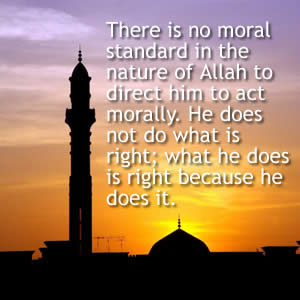
Americans who fail to acknowledge God nonetheless accept an orderly, dependable universe. Christians consider that the attributes of God, including love, holiness, justice, right/wrong, etc., undergird the universe. Muslims posit Allah as indescribable, inscrutable, without attributes or personality, merely mind, eternally existent, absolute will, incapable of non-existence. They do not perceive of Allah as immutable, unchangeable, or wise but only as supremely volitional. There is no moral standard in the nature of Allah to direct him to act morally. He does not do what is right; what he does is right because he does it. What he might do tomorrow may not be the same as he does today.

While within the trinity there was eternal expression of love, Muslims stress the absolute singularity of Allah: “He is Allah, Singular. Allah the Absolute. He begetteth not nor was begotten, and to him have never been one equal” (Sura 112). Most Muslims mistakenly believe that the Christian trinity is God, Mary, and Jesus (Sura 5:116). Allah is declared to be neither a person nor a spirit (Sura 42:11). Allah is close to us by his knowledge but not as a person; he is completely “other.”

Muslims make five assertions concerning their deity: 1) There is only one god. 2) That god is only supreme will, a force, not a person; his choices are totally arbitrary. 3) His name is Allah. He also has nearly a hundred other names, none of which suggest love, compassion, or grace. 4) Allah has communicated with mankind through prophets, the final prophet being Mohammed. 5) The Koran revealed to Mohammed existed with Allah eternally, with the words and letters set as dictated.

Islam is fatalistic and deterministic. Allah determines all things, good and bad. He formed some men and spirits only to send them to hell: “that I will fill hell with the jinn [demons] and mankind together” (Sura 32:13). The Koran states that Allah is the author of and a participant in both good and evil. Orthodox Islam asserts that all human thoughts, speech, and behavior, either good or evil, were predetermined by the Irresistible. Allah can and does change his mind: “And when we put a revelation in place of [another] revelation—and Allah knowest best what he revealeth” (Sura 16:101). In effect, what he said in some parts of the Koran is later declared to be untrue; thus, it is customary for Allah to lie and not always wrong for Muslims to lie.

Americans should be aware of instructions to terrorists who have infiltrated the United States government: a Muslim has a positive duty to protect his fellow Muslims from unbelievers, and he is instructed to lie in their defense. This has involved deliberate mis-translations, favored treatment, inaccurate investigations, and loss of critical evidence. They tend to judge Americans as gullible, easy to deceive.

Muslims scoff at the notion of a deity who is subject to an absolute law. What Allah as supreme decrees is law. An earthy ruler similarly sets the law for those under his rule, and law may be changed as he wishes. The “justice” conceived by a Muslim is best understood as retribution; anger is predominant, and often the retribution exceeds the claimed offense.

The “theology” of Islam engenders fear, not love. A Muslim fears what an unpredictable Allah might do to him. He fears what a fellow Muslim might do. A Muslim who slightly deviates from prescribed ritual or custom fears his neighbors. These are fatalistic fears, well expressed as “Inshallah” (”If Allah wills”)—it has been predetermined by Allah.

Muslims consider that there are major and minor sins. Major sins include abandonment of the Islamic faith, refusal to be converted to Islam, declaring Mohammed to be a liar, adultery, murder, mistreatment of one’s parents, and desertion during jihad [holy war]; minor sins include lying, deception, anger, and lust (Sura 4:31; Hadith 4:28). Even a Muslim infant not yet able to recite “Allah is one god and Mohammed is his prophet” is a major sinner.

To Muslims, man is not sinful by nature, but only ignorant; he is really good by nature and needs only proper instruction to do good works. “Doing good” to a Muslim is neither doing something morally correct instead of what is wrong, nor performing in a way that benefits society. Performing the five “pillars” of Islam, the specified rituals, constitutes good works: orally declaring there is one god and Mohammed is his prophet, praying five times a day, fasting during the daylight hours of Ramadan, giving alms to the poor, and, for some, making the journey to Mecca. Jihad (holy war) is incumbent only when declared by an imam.

Muslims are not much influenced by education or by arguing. The gospel is, for them as for others, the power of God unto salvation. For pastors and those genuinely interested, I recommend Islam and the Bible: Why Two Faiths Collide by David Goldman (Moody Publishers, 2004). It is clearly organized and well-documented, contains a helpful chapter on how to reach Muslims, and has a good glossary.

vanhetloo.jpgMany of the paragraphs included in this essay appeared in “Cogitations” (cbsvan@sbcglobal.net) during the summer and fall of 2006.

_________

Warren Vanhetloo has A.B., B.D., Th.M., Th.D., and D.D. degrees. He served three pastorates in Michigan, taught 20 years at Central Baptist Theological Seminary (Plymouth, MN), taught 23 years at Calvary Baptist Theological Seminary (Lansdale, PA), and is listed as adjunct faculty at Calvary. Retired, he lives in Holland, Michigan. Since the death of his wife a year ago, at the urging of fellow faculty and former students, he sends an email newsletter called “Cogitations” to those who request it.

Wednesday, December 13, 2006

Witnessing to Muslims

Thabiti Anyabwile's profile says, "I was once a Muslim, and by God's grace I have been saved through faith in Jesus Christ." He has a series on things to do/say/etc. "when witnessing to Muslims."


Thabiti Anyabwile has also done an interview on The Gospel and Islam.

John Piper summarizes an illustration from that interview. The illustration concerns whether Muslims and Christians worship the same God under different names.
He said that we should picture two old classmates from college discussing a common friend from thirty years ago. They begin to wonder if they are talking about the same person. One of them is convinced they are, and the other keeps thinking this is not quite the way he remembers the friend. Finally, they decide to dig out an old yearbook and settle the issue. They open the book, and as soon as they see the picture of their classmate, one says, “No, that’s not who I am talking about.” So it was not the same person after all.

Mark said that Jesus, as he is revealed in the Bible, is the picture in the yearbook. When a Muslim and a Christian, who have been discussing whether they are worshiping the same God, look at God in the yearbook, it settles the matter: “No,” says the Muslim, “that’s not who I am talking about.”

But that is who the Christian is talking about. John 1:18 says, “No one has ever seen God; the only God, who is at the Father's side, he has made him known.” Jesus makes known the invisible God for us to see. In John 14:8, Philip said, “Lord, show us the Father, and it is enough for us.” To this Jesus responded, “Have I been with you so long, and you still do not know me, Philip? Whoever has seen me has seen the Father. How can you say, ‘Show us the Father’” And Paul said in 2 Corinthians 4:6, “God, who said, ‘Let light shine out of darkness,’ has shone in our hearts to give the light of the knowledge of the glory of God in the face of Jesus Christ.”

In other words, Jesus is the yearbook picture that settles the issue of who is worshiping the true God and who is not. If a worshiper of God does not see in Jesus Christ the person of his God, he does not worship God.

Tuesday, December 12, 2006

Islam & Victory

By Darrell Brooker @ http://drbrooker.net/

We recently had someone from Arab World Missions come and teach our Adult Sunday School class about Islam for several weeks. It was interesting for a few reasons, but a point he made in one of the earlier sessions stuck with me. I had never heard it said before and as a concept, it is one that is quite foreign to Christianity.

When trying to explain why Muslims fight so hard and resort to the unthinkable when they attack (suicide bombings, etc.), he told us that one of the chief proofs of the truth of Islam is victory against their enemies. In other words, when Muslims win, it is proof that Allah is the one true God for he has given them the victory. From the 7th century onwards, Islam has spread by the sword and its ability to conquer all those who have crossed its path is proof that it was the religion of the true God. I completely understand why they would think this, but it also highlights how Christianity is different from the various false religions of the world.

That brings us to the present day and the Middle East struggle of the last century or so. The fact that the tiny nation of Israel has been able to dominate the Arab world, which out-numbers it about 50:1, is a real blow to the ego of most Muslims. Yesterday I read an interview with the Editor-In-Chief of Al-Jazeera Television and he admitted that this is indeed how Muslims in general feel about the ongoing conflicts with Israel. Israel appears to be the reason for every failure that happens in Muslim society. The whole interview can be read here and is worth the time. This is the most telling part:

Do you mean to say that if Israel did not exist, there would suddenly be democracy in Egypt, that the schools in Morocco would be better, that the public clinics in Jordan would function better?

I think so.

Can you please explain to me what the Israeli-Palestinian conflict has to do with these problems?

The Palestinian cause is central for Arab thinking.

In the end, is it a matter of feelings of self-esteem?

Exactly. It’s because we always lose to Israel. It gnaws at the people in the Middle East that such a small country as Israel, with only about 7 million inhabitants, can defeat the Arab nation with its 350 million. That hurts our collective ego. The Palestinian problem is in the genes of every Arab. The West’s problem is that it does not understand this.

I think the West may understand this. However, I don’t think the West in general quite grasps the generational hatred that goes back to the time of Isaac and Ishmael. Christians understand that it will always be like this until Jesus returns. (See Genesis 16:12).

Monday, December 11, 2006

Missionary Moments: Muslims Coming to Christ


During a recent ministry trip overseas I was presented with some astounding statistics on Muslims coming to Christ. As the sources are involved in restricted access areas, they do not want their names mentioned as sources, neither can I personally confirm the accuracy of these reports. However, for your interest and information: I’ve been informed that there are now over 50,000 believers in Afghanistan. Before the war there were less than 100 Christians in the country. Today there are more than 400 Christian missionaries in Afghanistan, operating in each of the 34 provinces, for the first time in Afghan history. One of the missions involved in Afghanistan claims that there are today over 50,000 Afghan Christians.

Another mission involved in Iraq claims that, in the year before the war in 2003 there were only 3,000 known evangelical Christians in Iraq, and only six evangelical churches. Today there are more than 25,000 Iraqi believers in 25 churches in Baghdad alone. And hundreds of new churches in other areas of Iraq.

According to Christian author, Dr. Jim Murk (author of Islam Rising – The Never-ending Jihad against Christianity) estimates that 20,000 Muslims convert to Christianity each year in America.

According to Muslim sources, over 6 million Muslims convert from Islam to Christianity each year! This seems to be an incredibly high figure, but perhaps these sources are counting all those lost to Islam as converts to Christianity. It is possible that many are leaving Islam without coming to faith in Christ.

However, there is no doubt that tens of thousands of Muslims are coming to faith in Christ in Nigeria, Sudan, Indonesia, and other parts of the Muslim world.

Does your church have a programme for reaching Muslims for Christ? Are your members well informed on the teachings of Islam and the culture of Muslims? Are they effectively trained in evangelism and prepared for cross-cultural witnessing? If Muslims come to Christ in your area, would your church be able to welcome them into the congregation, and effectively disciple them?

Frontline Fellowship has been revising and refining our Muslim Evangelism Workshop over the last 24 years. We have resources that can assist your church in effectively witnessing to and evangelising Muslims, and discipling converts from a Muslim background.

Frontline Fellowship’s book: “Slavery, Terrorism and Islam – The Historical Roots and Contemporary Threat” (128 pages with 110 pictures and maps), includes the Muslim Evangelism Workshop Manual and many helpful and practical chapters and appendixes to enable your to understand Islam and evangelise Muslims effectively.

Frontline Fellowship also has a number of audio CD lectures from the Muslim Evangelism Workshop including: The Challenge of Islam; Comparing the Bible with the Quran; Challenging Muslims; Guidelines for Muslim Evangelism; The Scourge of Slavery; Uprooting Terrorism; Islam According to the Reformers; Reformation or Islamisation; etc.

Three of the best films produced on Sudan are now available on one DVD (Sudan: The Hidden Holocaust; Terrorism and Persecution – Understanding Islamic Jihad; and Three Days in Sudan).

You will also find useful articles and links on Islam on www.frontline.org.za.

Pray for Africa Poster

Download Pray for Africa poster here.

“The desert tribes will bow before Him and His enemies will lick the dust…all kings will bow down to Him and all nations will serve Him.” Psalm 72:9-11

Saturday, December 09, 2006

Muslim Vs Christian Debate

This is the channel of Pfander Films whose primary interest is the academic study of all issues relevant to Islam and Christianity. Check out their Islamic apologetic video's. Below is one.