Showing posts with label Doctrine-Christ. Show all posts

Tuesday, July 31, 2007

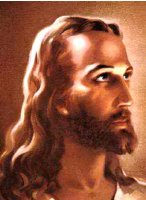
What Color Should Jesus Be?

From http://evangelicaloutpost.com/

"If we have no idea what Jesus looked like, how should he be portrayed?"

It's not often that I disagree with John Piper. But on this question Dr. Piper and I are on opposite sides. Andy Jackson recently pointed to a brief excerpt from one of Dr. Piper's sermons titled "What do you think of pictures of Jesus?". I've transcribed the text from the audio:

I'm a little hesitant about portraits of Jesus at all. There's that argument about whether that's breaking the first Commandment -- don't make any graven images, don't have pictures of Jesus in your house. The reason I'm not a stickler on that is because Jesus became incarnate, therefore we know he had a face. God the father didn't have a face, except insofar as He and the Son are one.


Jesus had a face and even though we don't know what it looked like I think renderings of it to show various things are okay. And if we're going to do that, they should be real diverse. I think they should be real diverse because you lock in on that famous one--I don't know what it's called, the one with the long hair, kind of the idyllic face and the blue eyes---that's absolutely absurd.

But I think they should probably be black portrayals of Jesus, and white portrayals of Jesus, and Chinese portrayals of Jesus. And everybody knows that they're not accurate. There isn't one that's accurate. That's why it's legitimate to do lots of inaccurate works. Because you just say we all know that we don't know what he looked like so what we want to say with our inaccurate Jesus is something true about Jesus. Namely, he's there for everybody.

There are three points in this statement in which I agree. I agree that such images do not break the first Commandment and I agree that Warner Sallman's "Head of Christ" is "absolutely absurd." I also agree that Jesus is there for everyone. Unfortunately, the rest of the passage seems to me to be confused and illogical.

For example, Piper says that the images should be "real diverse." But how much diversity is acceptable? Would he approve of portrayals of Jesus as an elderly man? What about as a woman?

The fact that no particular rendition can be completely accurate does not make it "legitimate to do lots of inaccurate works." Unless the work is intentionally abstract, then a degree of realism is to be expected from the artwork. By offering a portrayal that intentionally veers from the Biblical portrait of Christ, the artist is using Jesus to further a particular racial, ethnic, or political agenda.

Piper is also just flat out wrong in saying that "everybody knows that they're not accurate." Hitler claimed that Jesus was probably Gallic and that "it's certain that Jesus was not a Jew." The view that Jesus has Nordic features is still held today by white supremacists. Similarly, the view that Jesus was black is espoused by syncretic religions, such as Santeria or Voodoo, where African gods were merged with saints of the Roman Catholic Church. The Black Hebrew Israelites (a group that can be found preaching on street corners in our Nation's capital) also claims that since black people are descended from Israelites, Jesus had to be black.

The antisemitism that motivates and inspires most of these images is reason enough to condemn such revisionist art. Christians should stand firm against this vicious ideology by refusing to budge on the truth that our Lord and Savior took the incarnate form of a Jew.

But even when the motives are noble, we should reject such this faux diversity. Instead, we should express our humility by honoring the choices that God made in taking human form. We are created to reflect the image of our Lord; we shouldn’t try to recreate his image to reflect our own.

Monday, July 30, 2007

What Color Should Jesus Be?

African-American Jesus White Jesus Chinese Jesus

Listen to John Piper talk about whether artistic portrayals of Jesus should be racially diverse.

Wednesday, January 17, 2007

No Equals to Christ

By D.A. Carson, from: "For the Love of God" Volume 1

ONE OF THE GREAT FAILURES into which even believers sometimes fall is the tendency to underestimate Jesus (Matt. 17:1-8).

Jesus takes the inner three of his twelve disciples — Peter, James, and John — to a high mountain, just the four of them. “There he was transfigured before them. His face shone like the sun, and his clothes became as white as the light” (17:2). Suddenly Moses and Elijah appeared, “talking with Jesus” (17:3). It is as if the ultimate identity of the eternal Son is allowed to peep through; the three disciples become “eyewitnesses of his majesty” (2 Peter 1:16). It is hard not to see here also a foretaste of the glory of the exalted Son (cf. Rev. 1:12-16), of the Jesus before whom every knee will bow, in heaven and on earth and under the earth, every tongue confessing “that Jesus Christ is Lord, to the glory of God the Father” (Phil. 2:10-11).

But Peter misunderstands. He rightly recognizes that it is an enormous privilege to be present on this occasion: “Lord,” he says, “it is good for us to be here” (17:4). Then he puts his foot in his mouth: “If you wish, I will put up three shelters — one for you, one for Moses and one for Elijah.” He entirely misunderstands the significance of the presence of Moses and Elijah. He thinks that Jesus is being elevated to their great stature, the stature of the mediator of the Sinai covenant and of the first of the great biblical prophets.

He is utterly mistaken. Their presence signified, rather, that the law and the prophets bore witness to him (cf. 5:17-18; 11:13). God himself sets the record straight. In a terrifying display, God thunders from an enveloping cloud, “This is my Son, whom I love; with him I am well pleased. Listen to him!” (17:5). By the time the three disciples recover from their prostrate terror, it is all over: “When they looked up, they saw no one except Jesus” (17:8) — a pregnant conclusion to the account.

Jesus brooks no rivals. There have been, there are, many religious leaders. In an age of postmodern sensibilities and a deep cultural commitment to philosophical pluralism, it is desperately easy to relativize Jesus in countless ways. But there is only one Person of whom it can be said that he made us, and then became one of us; that he is the Lord of glory, and a human being; that he died in ignominy and shame on the odious cross, yet is now seated on the right hand of the Majesty on high, having returned to the glory he shared with the Father before the world began.

Friday, December 22, 2006

2006 Christmas Message—Redemption Provided

by John C. Whitcomb, Th.D @ SharperIron

The second Person of the Triune God added a human nature to His divine nature a little more than 2,000 years ago! This stupendous and miraculous event was revealed to God’s people from the beginning of the world. God announced to Satan (in Gen. 3:15) not long after the creation of Adam and Eve (which occurred “at the beginning,” Matt. 19:4, KJV): “I will put enmity between thee and the woman, and between thy seed (the unbelieving community of mankind) and her seed [all true believers represented by their Savior]; [He] shall bruise thy head [a fatal, judicial blow delivered to Satan at the cross—John 12:31], and thou shalt bruise His heel [the crucifixion of Christ]” (KJV).

Especially noteworthy is the emphasis on “the woman” (rather than “the man” or even “the man and the woman”). If Adam was the responsible head of that family unit (”by one man sin entered into the world,” Rom. 5:12, KJV; and “by man came death,” 1 Cor. 15:21, KJV), what function was Eve to have, in the light of this prophetic announcement? Adam perceived that his wife, though instrumental in the fall (1 Tim. 2:14), would, by the amazing grace of God, be instrumental in bringing their Savior into the world. Therefore he named her “Eve” (i.e., “life” or “living”), “because she was the mother of all living” (Gen. 3:20, KJV).

Our first parents could not, of course, have understood when or how this wonderful Seed would accomplish their delivery from the power of Satan. Eve may have thought that her first son would be that person (”I have gotten a man from the LORD,” Gen. 4:1, KJV). And the name Adam gave to her (”life”) shows that he also believed God’s promise. This is confirmed by the fact that “the LORD God made coats of skin, and clothed them” (Gen. 3:21, KJV). By shedding the blood of innocent beings in order to provide, symbolically, coverings to protect them (in their sinful state) from His holy wrath, God demonstrated to them that their sin was atoned for (temporarily covered, or passed over). It still had to be, however, completely expiated, or taken away, by the blood of the Seed, “to declare His righteousness for the remission of sins that are past, through the forbearance of God” (Rom. 3:25, KJV). Adam and Eve, therefore, are now in heaven.

Eve’s part, then, in our redemption, was to be “the mother of all living.” She would become the mother (or ancestress of the mother), sooner or later, of the Seed, through Whom alone sinful people can be saved. Thus, absolutely true to the ancient promise, even though thousands of years would intervene, “when the fullness of the time was come, God sent forth His Son, made of a woman . . . that we might receive the adoption of sons” (Gal. 4:4-5, KJV).

God is never in a rush to do His perfect work. He is always perfectly on time. But when the perfect time for the Seed to appear finally came, behold, a virgin woman was told by God that she would become the mother of “the Son of God” (Luke 1:35, KJV). Realizing that the angel Gabriel was speaking of a virgin conception, she was deeply perplexed and asked: “How shall this be, seeing I know not a man?” (Luke 1:34, KJV).

God’s answer to her legitimate question—and ours—is astounding: “The Holy Ghost shall come upon thee, and the power of the Highest shall overshadow thee; therefore also that holy thing which shall be born of thee shall be called the Son of God” (Luke 1:35, KJV). By means of this totally miraculous overshadowing, the Son—the Seed—would be protected, not only from the sinful nature of a human father, but also from the sinful nature of a human mother. He would have a perfect and complete human nature through Mary (which she inherited from Adam and Eve) but without the sin nature she also inherited from Adam and Eve. In this way, He could be our genuine human representative on the cross, but also our sinless substitute.

Only One who was fully human and fully divine—the God-man—could pay the price we could never pay. Only the Son of God, who became, by virgin conception, the Son of Man, could crush the serpent’s head and rescue us from the awful penalty our sin deserves. This is the true message of Christmas, which was announced in cryptic (but adequate) words to our first parents at the beginning of the world.

whitcomb3.jpg———–
Dr. John C. Whitcomb has been a professor of Old Testament and theology for more than 50 years and is widely recognized as a leading biblical scholar. He taught at Grace Theological Seminary (Winona Lake, IN) from 1951-1990 and gained much recognition for his work on The Genesis Flood (Presbyterian and Reformed Publishing Company), which he co-authored with Dr. Henry Morris in 1961. That book has been credited as one of the major catalysts for the modern Biblical creationism movement. His ministry homepage is Whitcomb Ministries, and his sermons are available at SermonAudio.com.

Friday, December 08, 2006

Dating Jesus:When 'lover of my soul' language goes too far.

Agnieszka Tennant @http://www.christianitytoday.com/ct/2006/december/17.56.html

God loved the world with an extravagant tenderness. He spun into our genes a strand of divine DNA. Imago dei, this God with us—it's an astonishing intimacy.

The Bible shows it from various angles: God is a hen, and we are the chicks. God is a Shepherd, and we are the straying sheep. God is a Bridegroom, and we, his church, are the bride.

We can see God draw near, and it is dizzying.

But does all this closeness mean that Jesus is the personal boyfriend of Christian women? That God is my fiancé? That the First and the Last is my husband? That he and I are dating?

So it appears to some.

In a popular book, I learn of women who set up date nights with Jesus. Christie enjoys her Friday nights by going to Barnes & Noble "to drink coffee with the Lord and to read whatever book from the Christian living section he guides me to" or by cooking a wonderful meal and setting the table for two, then "talking to God as if he is actually sitting there at my table with me, because I know that he is."

The author of this book calls women to "prayer, praise, and pampering" retreats: "Although God certainly loves us even with unshaven legs, no makeup, and a bed-head hairdo, he also deserves to occasionally have his princess sit at his feet while she is looking and feeling her best." She casts these retreats as exciting dates. "You are running away with your Lover, not confining yourself to a convent."

In another book, the author assures her readers that "you are the one that overwhelms his heart with just 'one glance of your eyes,'" quoting from the Song of Solomon. "His gaze is fixed on you," she writes. "He is captivated by your beauty."

These teachings have spread into churches. My friend's mother took part in a "tea with the Lord," during which she and the other women wore their wedding gowns—those, at least, who managed to squeeze into them—and fancied themselves as brides of Christ. An influential Kansas City church teaches thousands of people the so-called Bridal Paradigm, which encourages a quasi-romantic relationship with Christ. And who among us hasn't detected an eerie resemblance between a contemporary Christian song and a pop diva's breathy rendition of a sensual love ballad?

But such eros-laced sentiments directed at Jesus aren't a new trend. Neither is reading the Song of Solomon and other biblical passages as erotically charged letters addressed directly to the reader.

Several of those whom liturgical Christians call saints considered themselves wives of Christ. Catherine of Siena received a vision in which Christ married her and gave her a ring. It was made from foreskin left over after his circumcision. Before you laugh, consider this: After this event, Catherine devoted herself to the sick and the poor.

According to Women and Gender in Medieval Europe: An Encyclopedia, edited by Margaret C. Schaus (Routledge, 2006), medieval nuns used to participate in marriage liturgies as brides of Christ. The tradition continues in various forms today. The bridal imagery "presents explicit erotic content, yet also extols celibacy and pronounces the inherent sinfulness of sexual desire (concupiscence)."

Some men, too, managed to see themselves as brides.

The great poet John Donne besought God in the often-quoted sonnet:

Divorce me, untie or break that knot again,
Take me to you, imprison me, for I,
Except you enthrall me, never shall be free,
Nor ever chaste, except you ravish me.
I don't question the devotion of anyone who says she loves Christ intensely, whatever language she uses to express it.

But I have little patience for taking biblical metaphors too far and giving one's relationship with God an air of irreverent chumminess. Somehow, the scenario in which "his princess" shaves her legs for a date with Jesus seems to leave little room for fear of God.

And consider how unhelpful this misreading must be to single women who are hormonally awake. The cruel message they get is: If Jesus is really your husband, what's your problem? Be satisfied!

The Bible is replete with breathtaking metaphors that hint at God's love for us. Thank God, we don't always take them to illogical ends: I've never heard a preacher take the Good Shepherd image to mean that God raises his children to ultimately kill and eat them.

So, yes, in addition to being the Shepherd, the Bread of Life, and the Vine, Jesus is, poetically speaking, the Bridegroom. And we—the church—are his bride.

But that doesn't mean I'll be getting into my wedding gown anytime soon. Not that it would fit.

Friday, November 24, 2006

Who is this Jesus?


by Pastor John Samson @ http://www.reformationtheology.com/2006/11/who_is_this_jesus_by_pastor_jo.php#more

In a communist Russian dictionary, Jesus is described as "a mythical figure who never existed." Of course, no serious historian could hold to that position today. The evidence is overwhelming as to the fact that Jesus existed, not just from the Gospels and other Christian literature around the first century, but also from non-Christian sources.

Well respected historians of the day, including Tacitus (a Roman) speak of him, as well as the noted Jewish historian Josephus. He writes "Now there was about this time, Jesus, a wise man, if it be lawful to call him a man, for he was a doer of wonderful works, a teacher of such men as receive the truth with pleasure. He drew over to him, both many of the Jews, and many of the Gentiles. He was [the] Christ; and when Pilate, at the suggestion of the principal men amongst us, had condemned him to the cross, those that loved him at first did not forsake him, for he appeared to them alive again the third day, as the divine prophets had foretold these and ten thousand other wonderful things concerning him; and the tribe of Christians so named after him, are not extinct at this day." Josephus: Antiquities XVIII 63f

Of course, a whole book is needed to cover all the evidence regarding the existence of Jesus. In fact, Josh McDowelI has already written one, called "He walked among us." Suffice it to say that there is overwhelming evidence to say that Jesus was a real historical person.

At this point you might say, "O.K. so he existed, but what does that have to do with me?"

Knowing that Jesus existed is not only relevant to lovers of history, but, as we shall see, is of supreme importance to everyone. Why? The answer lies in discovering who this Jesus really was.

In all the surveys I've conducted, asking people who they thought Jesus was, I received a number of different answers. Some said, "He was a good teacher who lived 2,000 years ago." Others, that "He was a miracle worker and one of the many ways to God." Others said that they didn't know who Jesus was, and didn't want to look into such a controversial question. Of course, I met a number of people that said, "Jesus was and is the Son of God."

"But what's the big deal? Does it really matter what we think about Jesus?"

My answer may startle you, but I suggest that your answer to this question, is the biggest single issue in your life! "What?" you might say. Yes, who you believe Jesus to be is the most important question you will ever be asked. That's because if Jesus is the Son of God, and His claims are true, then your acceptance or rejection of Him will mean either eternal life with Him, or eternal separation from Him, and an eternity in hell!! Wow, that's heavy duty stuff, but let me give you an example to illustrate what I'm saying.

Suppose I met you in the street, and said, "Hi, I'm John Samson, and I'm the only way to God. Me and God, we're one. If you've seen me, you've seen God. I am the Way, the Truth and the life, no one comes to God but through me. If you believe in me you'll have eternal life, but if you don't you'll be punished forever."

How would you react? Well there's a number of ways you could react. One of them would be to call for the guys in white coats to come and collect me!

But, wait a minute. Did you know that the things I said about myself to you in the street, are exactly the same things Jesus said about himself? Now think logically about this.

If Jesus was not all that He claimed to be, then it would be impossible for him to be put in the class of a good teacher. Why? Because Jesus' whole teaching centered around who he was claiming to be. Jesus was the one making those claims, not the Christians that followed him. The problem is that he has led multiplied millions astray by following after him as the way to God.. if indeed, Jesus was not who He claimed to be! He would be nothing more than another false teacher, leading his followers into error. This would make him just another clever con man.

"So, he can't be a good teacher, if he is leading people into deception. I get that! But what else are my options?"

Well another option is that Jesus was a stark raving lunatic!

"Come on! That's hardly likely!"

Well I'd agree - I've never heard anyone suggest Jesus was a madman but we must face that possibility. In fact, experts in the realm of psychology and the mind sciences have commented that in their study of Jesus from the Gospels, they conclude that he was perhaps the person who was "most whole" in all of history. It's nice that they say that, but could they be wrong?

Well the evidence points towards the fact that Jesus was fully aware of his surroundings, and that he knew he was the fulfillment of biblical prophecy. We all know the story of Jesus birth, but did you know that these events were foretold centuries beforehand in the Old Testament prophecies of the Messiah. He was born of a virgin, in a town called Bethlehem, as the Bible declared he would be (see Isaiah 7:14; Micah 5:2). And just before you say that he tried to fulfill prophecy to claim he was the Messiah, let me just point out that it is pretty impossible to control who your parents are and where you'll be born. Ever tried it?

In fact, he fulfilled around thirty prophecies in just one day - the day He died. He even claimed that after his death He would be raised again to life in three days. This was a known claim of Jesus, and the Romans made sure that a strong troop of soldiers were posted around his tomb to make sure that none of Jesus' disciples could secretly break in to the tomb, steal the body, and claim that Jesus was raised from the dead. One scholar of history has said that there is more evidence for the resurrection of Jesus, than any other event in history. That's quite a claim isn't it? (for more on this I recommend Frank Morrison's book, "Who Moved the Stone?")

Let me take you to a passage in Matthew's Gospel Chapter 16. It reads as follows:

13 When Jesus came into the region Caesarea Philippi, He asked His disciples, saying, "Who do men say that I, the Son of Man, am?"
14 So they said, "Some say John the Baptist, some Elijah, and others Jeremiah or one of the prophets."
15 He said to them, "But who do you say that I am?"
16 Simon Peter answered and said, "You are the Christ, the Son of the living God."
17 Jesus answered and said to him, "Blessed are you, Simon Bar-Jonah, for flesh and blood has not revealed this to you, but My Father who is in heaven.

Obviously, Jesus said and Jesus taught, that he was the Christ (or Messiah) the Son of God.

"So, are there any other views on who Jesus is? Any other options?"

Actually, there are only three options to choose from concerning who Jesus was:

#1 JESUS WAS MAD - He was a misled man who deceived many because he was deceived himself

#2 JESUS WAS BAD - He was a deceiver, a con man, who managed to start a whole world wide religion OR...

#3 JESUS WAS GOD! - He was exactly who He claimed to be.. Certainly, the Bible teaches that Jesus is the Divine Son of God.

John 1:1 says "In the beginning was the Word, and the Word was with God, and the Word was God. He was in the beginning with God." Talking of Jesus, verse 14 of that same chapter says, "And the Word became flesh and dwelt among us..."

(You can check out more references on this yourself if you look up these verses in a Bible: Isa 9:6; John 20:28,29; Acts 20:28; Titus 2:13; Heb 1:8; 2 Peter 1:1; - these are just a few of the many verses that could be quoted).

Josh McDowell once wrote the following, "The issue with these three alternatives is not which is possible, for it is obvious that all three are possible. But rather, the question is 'which is more probable?' Who you decide Jesus Christ is must not be an idle intellectual exercise. You cannot put Him on the shelf as a great moral teacher. That is not a valid option. He is either a liar, a lunatic, or Lord and God. You must make a choice. 'But,' as the Apostle John wrote, 'these have been written that you may believe that Jesus is the Christ, the Son of God; and' - more important - 'that believing you might have life in His name' (John 20:31)." (More than a Carpenter, Tyndale House Publishers, 1977, pp. 33-34.)

The popular author and British theologian C.S. Lewis understood the issue so well. He once wrote, "I am trying here to prevent anyone saying the really foolish thing that people often say about Him: 'I'm ready to accept Jesus as a great moral teacher, but I don't accept His claim to be God.' That is the one thing we must not say. A man who was merely a man and said the sort of things Jesus said would not be a great moral teacher. He would either be a lunatic - on the level with the man who says he is a poached egg - or else he would be the Devil of Hell. You must make your choice. Either this man was, and is, the Son of God: or else a madman or something worse. You can shut Him up for a fool, you can spit at Him and kill Him as a demon; or you can fall at His feet and call Him Lord and God. But let us not come with any patronising nonsense about His being a great human teacher. He has not left that open to us. He did not intend to." (Mere Christianity, The MacMillan Company, 1960, pp. 40-41.)

So that's it! Those are the options. Jesus of Nazareth was either MAD, BAD OR GOD! The choice is yours to make. But remember, you must choose well, because if Jesus is indeed who He claimed to be, then the moment after you die, you will face Him, and stand to give an account for your answer. Jesus Himself could not have been more clear on this when He said, "...unless you believe that I am, you will die in your sins." (John 8:24)

Here's the good news, if you make Jesus the Lord (the Boss) and Savior of your life, you can look forward to eternal life with Him.

"For God so loved the world that He gave His One and only Son, that whoever believes in Him, should not perish but have everlasting life." (John 3:16)

Wednesday, October 25, 2006

The Two Natures of Christ

Exerpt, from the Epitome of the Formula of Concord, VIII, 16, on the Two Natures of Christ:

This majesty He [Christ] always had according to the personal union, and yet He abstained from it in the state of His humiliation, and on this account truly increased in all wisdom and favor with God and men; therefore He exercised this majesty, not always, but when [as often as] it pleased Him, until after His resurrection He entirely laid aside the form of a servant, but not the [human] nature, and was established in the full use, manifestation, and declaration of the divine majesty, and thus entered into His glory, Phil. 2, 6ff , so that now not only as God, but also as man He knows all things, can do all things, is present with all creatures, and has under His feet and in His hands everything that is in heaven and on earth and under the earth, as He Himself testifies Matt. 28, 18; John 13, 3: All power is given unto Me in heaven and in earth. And St. Paul says Eph. 4, 10: He ascended up far above all heavens, that He might fill all things. And this His power, He, being present, can exercise everywhere, and to Him everything is possible and everything is known.

Tuesday, October 17, 2006

Is Jesus a Liberal?

By The Evangelical Outpost

In 2004, Jesse Jackson wrote a newspaper column titled “There's no shame in being liberal”, in which he argued that some of the many of the leading lights throughout history—Moses, George Washington, Thomas Jefferson--were liberals too. One name, however, stood out from among the rest:

Think about it: A conservative Christian is a contradiction in terms. Christ wasn't a conservative. He fed the hungry simply because they were hungry. He didn't require that they go to work first. He healed the sick, simply because they were sick. He didn't push them into an insurance company, or let the drug companies gouge them on prices. Jesus was a liberal; Herod was the conservative.
Jesus fed crowds of people exactly two times. It’s not like he was running a food kitchen for free-loaders who refused to work. And while he healed the sick, he also admonished them to change their lives and stop committing sins. Is that what Jesse thinks modern liberals should do? To me it sounds like Jesus was running the sort of the Religious Right’s “faith-based charity” programs.

Beneath Jackson’s typical sloppy reasoning lies an interesting question. How would we evaluate whether Jesus was a liberal by the standards of American liberalism?

The problem is that the term “liberal” is too vague and undefined. Fortunately, Geoffrey Stone, a law professor at the University of Chicago, provides a least a partial answer. In a recent article, “What it means to be a liberal”, Stone attempts to “articulate 10 propositions that seem to me to define "liberal" today.”

After reading through list of propositions I began to wonder how they would apply to Jesus. Would Jesus fit the mold of a modern liberal? Let’s examine the evidence to find out what happens if we put Him to the Liberal Test:

1. Liberals believe individuals should doubt their own truths and consider fairly and open-mindedly the truths of others.

Jesus said, “"I am the way and the truth and the life.” He doesn’t appear to have doubted his own truth or to have been open-minded to the “truths of others.”

Verdict: Not Liberal

2. Liberals believe individuals should be tolerant and respectful of difference. It is liberals who have supported and continue to support the civil rights movement, affirmative action, the Equal Rights Amendment and the rights of gays and lesbians. (Note that a conflict between propositions 1 and 2 leads to divisions among liberals on issues like pornography and hate speech.)

Jesus appears to have been tolerant of just about everything but sin. Modern liberals, however, seem to be tolerant of nothing but sin.

Civil rights is too vague but Jesus was for natural rights, since he gave them to us. As for affirmative action, it’s hard to tell. The parable of the workers in the vineyard seems to show that Jesus supported arbitrary, seemingly unjust, hiring practices so maybe he would have been in favor of affirmative action. The ERA question is inconclusive, though I suspect since Jesus is a complementation that he would oppose the legislation. As for the rights of gays and lesbians, Jesus would say that they have rights as human beings, not as a subset of sinners who engage in sexual practices that he abhors (see Leviticus).

Verdict: Based on the standard of modern liberalism, “Not Liberal”

3. Liberals believe individuals have a right and a responsibility to participate in public debate.

Jesus excelled in public debater, as did his apostle St. Paul. He would probably be broadly in favor of this “right and responsibility.”

Verdict: Liberal

4. Liberals believe "we the people" are the governors and not the subjects of government, and that government must treat each person with that in mind.

This one is rather tricky, after all, Jesus is no secularist. Jesus is the head of his own kingdom—the very King of Kings—so he is, broadly speaking, a monarchist. As for earthly government, he appears not to have had much problem with the Roman system. In fact, when he was accused of subverting the empire and refusing to pay taxes to Caesar (Luke 23:1) he was found not guilty. Pontius Pilate didn’t think he was much of a democratic revolutionary.

Verdict: Not Liberal

5. Liberals believe government must respect and affirmatively safeguard the liberty, equality and dignity of each individual. It is liberals who have championed and continue to champion the rights of racial, religious and ethnic minorities, political dissidents, persons accused of crime and the outcasts of society.

If this makes one a liberal, than Jesus definitely fits the bill.

Verdict: Liberal

6. Liberals believe government has a fundamental responsibility to help those who are less fortunate.

Jesus believed that “neighbors”, not government, are the ones who have the responsibility to help those in need.

Verdict: Not Liberal

7. Liberals believe government should never act on the basis of sectarian faith. It is liberals who have opposed and continue to oppose school prayer and the teaching of creationism in public schools and who support government funding for stem-cell research, the rights of gays and lesbians and the freedom of choice for women.

Jesus would have a fit if he heard that the government was telling children that they couldn’t speak to him (Mark 10:14). He was also the Creator of the universe (Col. 1-16) so he’d probably believe in teaching some form of “creationism.” He would probably be fore funding of ethical stem-cell research (ASCR) while opposing that which requires the taking of a human life (ESCR). And he would be rather intolerant of homosexual behavior and abortion. On this point, Jesus would be worse in the minds of liberals than any fundamentalist Christian.

Verdict: Definitely Not Liberal

8. Liberals believe courts have a special responsibility to protect individual liberties. It is principally liberal judges and justices who have preserved and continue to preserve freedom of expression, individual privacy, freedom of religion and due process of law.

In the one time Jesus stood before a court, he was treated unjustly. He would probably, therefore, be in favor of a court that protected liberties that were granted by him while excluding those created by man.

Verdict: Liberal

9. Liberals believe government must protect the safety and security of the people, for without such protection liberalism is impossible.

Other than anarchists, who believes that government shouldn’t protect the safety and security of the people? Jesus was no anarchist so this is a gimme.

Verdict: Liberal

10. Liberals believe government must protect the safety and security of the people, without unnecessarily sacrificing constitutional values. It is liberals who have demanded and continue to demand legal protections to avoid the conviction of innocent people in the criminal justice system, reasonable restraints on government surveillance of American citizens, and fair procedures to ensure that alleged enemy combatants are in fact enemy combatants.

Would Jesus be a reasonable, decent human being? Yes? Okay, we’ll give them this one too.

Verdict: Liberal

By my tally, that is five “Liberals” and five “Not Liberal.” That leaves just enough room for us to argue over which side Jesus would eventually land. Would he be a modern secular liberal posing as a religious figure ala Jesse Jackson or a well-meaning liberal evangelical like Jim Wallis. Or would he lean more toward the model of a right-thinking, traditionalist/conservative like…well, like me?

Perhaps, though, that is the wrong question. The Gospels don’t have much to say about how Jesus would vote or what political party he’d prefer. Maybe we shouldn’t be asking whether Jesus fits our pre-fabricated political mold but rather questioning how we could be more like Him. Instead of testing Christ’s liberal bona fides we should be more liberal about following his example.