Showing posts with label Archeology. Show all posts

Friday, August 28, 2009

New Mt. Sinai site with relics of Bible miracles?

Gene Edward Veith has a critical reviow of what some people are maintaining that they have found the “real” Mt. Sinai in Saudi Arabia. And the discovery is accompanied with evidence of Biblical history, including the possibility of actual artifacts of miracles described in Exodus. This is from a secular blogsite. I’ll intersperse some pictures of what the account refers to, which are so mindblowing that they nearly defy belief :

Dr. Moller points out that the site at Nuweiba he identifies as the Red Sea crossing point has an underwater land bridge, upon which damaged chariot parts and bones remain, engulfed in coral.

Pharoah's chariots?

The top of Jabal al-Lawz, the alleged real Mt. Sinai, is black, as if burned from the sky as described in Exodus 19:18, where it says “the Lord descended upon it in fire.” This feature sets it apart from all the other surrounding mountains which do not have darkened tops. The BASE Institute’s film shows Cornuke, who snuck onto the mountain, examining the rocks he cracked, observing that they are not merely black rocks and that only the outside had become darkened by whatever had occurred at the site. Moller has a photo of one of these rocks, which he identifies as “obsidian or volcanic glass, a mineral formed at high temperatures.”

Mt. Sinai?

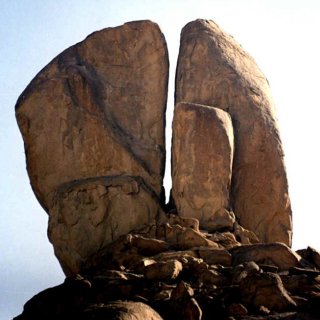
One of the greatest — and most doubted — miracles of the Exodus is the story about God instructing Moses to hit a large rock with his rod, which resulted in a flow of water for the Hebrews to drink from. Near Jabal al-Lawz is a large rock, standing about 60 feet high, split down the middle. The edges of the split and the rock underneath it have become smooth, as if a stream of water had poured forth from the rock, creating a river. Given the annual rainfall in Saudi Arabia and the fact that the erosion is only present on that rock and no other ones in the surrounding area, it’s hard to find a plausible explanation for this remarkable find.

Water from this rock?

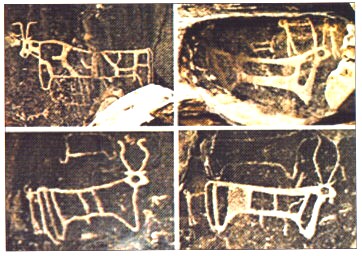
A site matching the description of the altar of the golden calf is also at this site. As the Biblical story goes, while Moses was away for 40 days on Mt. Sinai, the Hebrews created an altar with a golden calf on top of it, which they worshiped. Moses, incensed at the betrayal, crushed the calf into smithereens. A large altar with inscriptions of Egyptian bulls engraved onto it is also near Mt. Sinai, making it the only location in Saudi Arabia to have such inscriptions. Moller notes in his book that “one block of stone at the altar had a slight depression and after a brief shower something glistened at the bottom, which turned out to be small flakes of gold. This rock could well have been the place where Moses ground the golden calf into powder.”
Golden calf inscriptions?

This is just scratching the surface. The 12 wells of Elim, the altar constructed by Moses after the defeat of the Amalekites, evidence of large encampments, the boundary markers and stone pillars the Bible says were placed around Mt. Sinai, and several other sites identified in the Old Testament are located. Simply put, everything that the Bible indicates should be there is present. The researchers even describe how the locals refer to the site as “Moses’ Mountain” and it is common knowledge that Moses passed through the area.

Dr. Veith says:
I’ve got to say, though, I feel suspicious. The books came out in the early 2000s, do not seem to be from mainline publishers (except for one from Broadman & Holman), and are already out of print. Why is this work from a decade ago being brought up now? Why hasn’t this already made an impact if it is so compelling? Still, bogus or real, it’s intriguing. Does anyone know any more about this?

UPDATE: Here is a critical review, though it doesn’t deal with all of the questions.

The mountain is called Jabal al-Lawz. You can see it on Google Earth.

Thursday, November 13, 2008

(CNN) -- Archaeologists believe a desert site in Jordan may contain the ruins of the elusive King Solomon's Mines.

From CNN:

Researchers using carbon dating techniques at Khirbat en-Nahas in southern Jordan discovered that copper production took place there around the time King Solomon is said to have ruled the Israelites.

The research findings were reported in this week's issue of the journal, Proceedings of the National Academy of Sciences, which came out Monday.

(Photo: The bottom stratum of the ruins at Khirbat en-Nahas in Jordan revealed a period of extensive mining that lasted for about 40 years around 940 BC, the time King Solomon is said to have lived. A digital reconstruction of the site is on display in the StarCAVE, a 3-D virtual environment at UC San Diego. Photos by Thomas Levy UC San Diego)

King Solomon is known in the Old Testament for his wisdom and wealth and for building the First Temple in Jerusalem.

The fabled mines entered popular culture in 1885 with the publication in Great Britain of the bestselling "King Solomon's Mines" by Sir H. Rider Haggard. In the book, adventurers in search of the mines find gold, diamonds and ivory.

Since then, the mines have been the the subject of several films. Yet their possible location -- and whether they exist at all -- remains cloaked in mystery.

Thomas Levy of the University of California San Diego, who led the research, said carbon dating placed copper production at Khirbat en-Nahas (Arabic for 'Ruins of copper") in the 10th century -- in line with the biblical narrative of Solomon's rule.

"We can't believe everything ancient writings tell us," Levy said in a university statement. "But this research represents a confluence between the archaeological and scientific data and the Bible."

Khirbat en-Nahas is an arid region south of the Dead Sea, in Jordan's Faynan district. The Old Testament identifies the area with the Kingdom of Edom.

As early as the 1930s, archaeologists linked the site to the Edomite kingdom, but some of those claims were dismissed in subsequent years.

"Now ... we have evidence that complex societies were indeed active in 10th and 9th centuries BCE and that brings us back to the debate about the historicity of the Hebrew Bible narratives related to this period," Levy said
Chuck Colson notes:
The past few decades have witnessed a marked shift in scholars’ attitudes towards the biblical narratives. When the area was first explored in the 1970s, many archaeologists doubted whether biblical figures such as David or Solomon ever existed, and they certainly didn’t believe biblical accounts about their accomplishments.

To them, the Bible was a collection of stories that illustrated theological points, while containing little that is historically accurate.

Then as archaeologists found evidence for the existence of figures like David and Caiaphas and events like the Exodus, attitudes began to change.

Discoveries that corroborated biblical details, like the going price for slaves in ancient Egypt, obliged them to at least approach the biblical accounts with an open mind. As Levy put it, while “we can’t believe everything ancient writings tell us . . . this research represents a confluence between the archaeological and scientific data and the Bible.”

Openness to the possibility of “confluence” is all believers ever ask. Christians have nothing to fear from this kind of scientific inquiry. In fact, we welcome it. Unlike other faiths, biblical faith is rooted in history. It’s the account of how God has acted in human history to accomplish His purposes, and we are confident that the biblical account reflects this fact.

That the result is discoveries “straight out of an Indiana Jones’ movie” just goes to show how truth, in the end, really can top fiction.

Monday, November 03, 2008

Archaeologists report finding oldest Hebrew text

Ari Rabinovitch from Reuters reports that Archaeologists in Israel said on Thursday they had unearthed the oldest Hebrew text ever found, while excavating a fortress city overlooking a valley where the Bible says David slew Goliath.

The Report:

The dig's uncovering of the past near the ancient battlefield in the Valley of Elah, now home to wineries and a satellite station, could have implications for the emotional debate over the future of Jerusalem, some 20 km (12 miles) away.

Archaeologists from the Hebrew University said they found five lines of text written in black ink on a shard of pottery dug up at a five-acre (two-hectare) site called Elah Fortress, or Khirbet Qeiyafa.

Experts have not yet been able to decipher the text fully, but carbon dating of artifacts found at the site indicates the Hebrew inscription was written about 3,000 years ago, predating the Dead Sea Scrolls by 1,000 years, the archaeologists said.

Several words, including "judge," "slave" and "king," could be identified and the experts said they hoped the text would shed light on how alphabetic scripts developed.

In a finding that could have symbolic value for Israel, the archaeologists said other items discovered at the fortress dig indicated there was most likely a strong king and central government in Jerusalem during the period scholars believe that David ruled the holy city and ancient Israel.

Modern-day Israel often cites a biblical connection through David to Jerusalem in supporting its claim, which has not won recognition internationally, to all of the city as its "eternal and indivisible capital."

Palestinians, saying biblical claims have been superseded by the long-standing Arab population in Jerusalem, want the eastern part of the city, captured by Israel in a 1967 war, to be the capital of the state they hope to establish in the West Bank and Gaza Strip.

"The chronology and geography of Khirbet Qeiyafa create a unique meeting point between the mythology, history, historiography and archaeology of King David," said Yosef Garfinkel, the lead archaeologist at the fortress site.

Monday, March 10, 2008

New Testament Manuscripts Discovered in Albania

Dan Wallace @ http://www.reclaimingthemind.org reports that "for a long time, Albania has closed its doors to western scholars. Last summer, a four-person team from the Center for the Study of New Testament Manuscripts went to Tirana to photograph 13 manuscripts in the National Archive. They were unprepared for what would happen on their first day on the job. They saw an old typewritten, in-house catalog of manuscripts, and noticed that there were forty-seven (47) NT MSS! The Dallas Morning News reported on this to some degree, featuring a full-page article on the Center for the Study of New Testament Manuscripts. In addition to this article, Christianity Today is scheduled to post a more in-depth story about the manuscript discoveries on March 10 at their website. Be sure to check it out."

Friday, January 18, 2008

First Temple seal found in Jerusalem

A stone seal bearing the name of one of the families who acted as servants in the First Temple and then returned to Jerusalem after being exiled to Babylonia has been uncovered in an archeological excavation in Jerusalem's City of David, a prominent Israeli archeologist said Wednesday.

Photo: Edwin Trebels courtesy of Dr. Eilat Mazar

The 2,500-year-old black stone seal, which has the name "Temech" engraved on it, was found earlier this week amid stratified debris in the excavation under way just outside the Old City walls near the Dung Gate, said archeologist Dr. Eilat Mazar, who is leading the dig.

According to the Book of Nehemiah, the Temech family were servants of the First Temple and were sent into exile to Babylon following its destruction by the Babylonians in 586 BCE.

The family was among those who later returned to Jerusalem, the Bible recounts.

The seal, which was bought in Babylon and dates to 538-445 BCE, portrays a common and popular cultic scene, Mazar said.

The 2.1 x 1.8-cm. elliptical seal is engraved with two bearded priests standing on either side of an incense altar with their hands raised forward in a position of worship.

Dr. Eilat Mazar
Photo: Dr. Eilat Mazar Expedition

A crescent moon, the symbol of the chief Babylonian god Sin, appears on the top of the altar.

Under this scene are three Hebrew letters spelling Temech, Mazar said.

The Bible refers to the Temech family: "These are the children of the province, that went up out of the captivity, of those that had been carried away, whom Nebuchadnezzar the king of Babylon had carried away, and came again to Jerusalem and to Judah, every one unto his city." [Nehemiah 7:6]... "The Nethinim [7:46]"... The children of Temech." [7:55].

The fact that this cultic scene relates to the Babylonian chief god seemed not to have disturbed the Jews who used it on their own seal, she added.

The seal of one of the members of the Temech family was discovered just dozens of meters away from the Opel area, where the servants of the Temple, or "Nethinim," lived in the time of Nehemiah, Mazar said.

"The seal of the Temech family gives us a direct connection between archeology and the biblical sources and serves as actual evidence of a family mentioned in the Bible," she said. "One cannot help being astonished by the credibility of the biblical source as seen by the archaeological find."

The find will be announced by Mazar at the 8th annual Herzliya Conference on Sunday.

The archeologist, who rose to international prominence for her recent excavation that may have uncovered King David's palace, most recently uncovered the remnants of a wall from Nehemiah.

The dig is being sponsored by the Shalem Center, a Jerusalem research institute where Mazar serves as a senior fellow, and the City of David Foundation, which promotes Jewish settlement throughout east Jerusalem.

Saturday, December 01, 2007

Nehemiah's Wall Found

From http://str.typepad.com

Jerusalem:

A wall mentioned in the Bible's Book of Nehemiah and long sought by archaeologists apparently has been found, an Israeli archaeologist says.

A team of archaeologists discovered the wall in Jerusalem's ancient City of David during a rescue attempt on a tower that was in danger of collapse, said Eilat Mazar, head of the Institute of Archaeology at the Shalem Center, a Jerusalem-based research and educational institute, and leader of the dig.

Artifacts including pottery shards and arrowheads found under the tower suggested that both the tower and the nearby wall are from the 5th century B.C., the time of Nehemiah, Mazar said this week. Scholars previously thought the wall dated to the Hasmonean period from about 142 B.C. to 37 B.C.

The findings suggest that the structure was actually part of the same city wall the Bible says Nehemiah rebuilt, Mazar said. The Book of Nehemiah gives a detailed description of construction of the walls, destroyed earlier by the Babylonians.

"We were amazed," she said, noting that the discovery was made at a time when many scholars argued that the wall did not exist."

Thursday, July 12, 2007

Archeology in the British Museum

From http://www.twoorthree.net

Tablet Why go on a dig when you can find "the most important biblical archaeology find in 100 years" in the basement of the British Museum?

The London Telegraph reports that Vienna professor Michael Jursa found a cuneiform tablet in the British museum which dates back 2,500 years.

Jursa says the tablet bears the name of the chief eunuch of Nebuchadnezzar II, king of Babylon.

It's the same name found in the book of Jeremiah chapter 39.

A British museum expert says, "a throwaway detail in the old testament turns out to be accurate and true. I think that it means the whole narrative of Jeremiah takes on a new kind of power."

Thursday, June 28, 2007

Tyrant's Tomb Unearthed: Herod the Great's final resting place said to be found.


With first-century historian Flavius Josephus as his guide, Israeli archaeologist Ehud Netzer searched for more than three decades to find the tomb of Herod the Great. He believed it was located at a small, conspicuously symmetrical, flat-topped mountain called Herodium, home to the ruins of Herod's 2,000-year-old fortified palace. Herodium lies three miles east of Bethlehem, the scene where, according to the Gospel of Matthew, Herod ordered the infant massacre.

Finally, on May 8, Netzer's perseverance paid off: His team discovered remains of a mausoleum and pieces of an ornate, 8-foot-long stone coffin at the end of a ceremonial staircase. No inscription links the tomb to Herod, Netzer said, but "there is not really anyone else that it could be."

Paul Maier, a professor of ancient history at Western Michigan University, is disappointed at the lack of identification. "It could well be Herod's tomb," he said, "but we have to withhold judgment."

From 1978 to 2006, Netzer's team excavated at the base of the mountain, the area he calls the Tomb Estate. "I'm convinced [Herod] intended to be buried there, until five to six years before he died," Netzer said.

Sometime shortly after Herod's death in 4 B.C., the tomb was ransacked. Netzer and Maier agree it was most likely the work of Jewish zealots, who provoked a revolt against Rome 70 years later. Even though Herod rebuilt the temple, Jews resented his rule. He imposed burdensome taxes, and though he identified himself as a Jew, he did not observe most Jewish religious practices.

Herodium, one of the largest palace complexes in the Roman Empire, boasted gardens, pools, and stables. Herod the Great earned his title by ordering monumental building projects. But he also murdered one of his wives, three of his sons, and a Jewish high priest.

Because Josephus wrote extensively about Herod, Maier said, we know more about this king than even the Roman Caesars. But not more than the baby he unsuccessfully tried to kill.

Related Elsewhere:

David Neff commented on the discovery and linked to news about it in CT Liveblog.

National Geographic News has photos of the site.

Articles about the discovery of the tomb include:

King Herod's ancient tomb 'found' | An Israeli archaeologist says he has found the tomb of King Herod, the ruler of Judea while it was under Roman administration in the first century BC. (BBC News)
Herod's tomb found | Sarcophagus dug up in Herodium in the Judean Desert (Associated Press)
Archeologist: King Herod's tomb desecrated, but discovery 'high point' | The archeologist who located King Herod's tomb at Herodium said Tuesday that the grave had been desecrated, apparently shortly after his death, but called the discovery a "high point." (Haaretz)
Team says it's found Herod's tomb | Site south of Jerusalem had been the focus of the search for 35 years. (The Los Angeles Times)
Herod's tomb found after 35-year search | Clues lead to remains of stone coffin on hillside Intifada disrupted search at site near Jerusalem (The Guardian)

Tuesday, May 08, 2007

Archeologist: King Herod's tomb desecrated, but discovery 'high point'

By Amiram Barkat, Haaretz Correspondent, and Haaretz Staff @ http://www.haaretz.com

The archeologist who located King Herod's tomb at Herodium said Tuesday that the grave had been desecrated, apparently shortly after his death, but called the discovery a "high point."

The Hebrew University of Jerusalem announced Monday night that it has uncovered the grave and tomb of Herod, who ruled Judea for the Roman empire from circa 37 BCE.

Professor Ehud Netzer of the university's Institute of Archaeology told reporters Tuesday that the tomb was discovered when a team of researchers found pieces of a limestone sarcophagus believed to belong to the ancient king.

Although there were no bones in the container, he said the sarcophagus' location and ornate appearance indicated it was Herod's.

"It's a sarcophagus we don't just see anywhere," Netzer said. "It is something very special."

Netzer led the team, though he said he was not on the site when the sarcophagus was found.

He said the sarcophagus had been smashed into pieces, most likely by someone seeking revenge on Herod during the great Jewish rebellion of 66-72 CE.

"The discovery of the grave is the high point in the excavation at the site," said Netzer.

The professor, who is considered one of the leading experts on King Herod, has conducted archeological digs at Herodium since 1972 in an attempt to locate the grave and tomb.

The discovery solves one of Israel's greatest archeological mysteries.

The majority of researchers had believed that Herod was in fact buried at Herodium, based on the writings of the ancient Jewish historian Flavius Josephus, but multiple excavations at the site failed to locate the grave.

Netzer's successful dig focused on a different part of the site than previous excavations, between the upper part of Herodium and the site's two palaces.

Herodium, a fortified palace built by Herod some 12 kilometers south of Jerusalem, was destroyed by the Romans in 71 CE.

Herod, whose father and grandfather converted to Judaism, was appointed governor of Galilee at the age of 25 and was made "King of the Jews" by the Roman senate in approximately 40 BCE. He remained king for around 34 years.

Herod, also known as Herod the Great, is credited with expanding the Second Temple and building Caesarea, Masada, and many other monumental construction projects. He died in the year 4 BCE in Jericho after a long illness.

Herod decided to construct his tomb at Herodium because the site played a role in two dramatic events in his life. In the year 43 BCE, when Herod was still governor of the Galilee, he was forced to flee Jerusalem along with his family after his enemies the Parthians laid siege to the city.

His mother's chariot flipped over near Herodium, and Herod became hysterical until he realized she was only lightly wounded. A short while later, the Parthians caught up to Herod and his entourage, although Herod and his men emerged victorious in the ensuing battle.

At Herodium, Herod built one of the largest monarchical complexes in the Roman Empire, which served as a residential palace, a sanctuary, an administrative center and a mausoleum. Herod first built an artificial cone-shaped hill that could be seen from Jerusalem, on which he constructed a fortified palace surrounded by watchtowers that he used solely in wartime.

At the base of the hill, he built an additional palace, which was the size of a small town and known as "Lower Herodium." The palace included many buildings, fancy gardens, pools, stables, and storage areas.

Herod spared no expense in an attempt to turn the site into a regional gem, bringing water from Solomon's Pools and special soil to allow his gardens to blossom in the heart of the desert.

Following Herod's death, his son and heir Archilaus continued to reside and Herodium. After Judea became a Roman province, the site served as a center for Roman prefects.

With the outbreak of the Great Revolt, Herodium was seized by the rebels, but then handed over without resistance to the Romans following the fall of Jerusalem in 70 CE.

Fifty years later, Herodium was also used by the rebels during the Bar Kokhva revolt, but was abandoned thereafter.

In the 5th century CE, the site was settled by Byzantine monks, and then served as a leper colony before being finally abandoned in the 7th century CE.

The first archeological dig at the site, between the years 1956 and 1962, was conducted by a Franciscan monk and revealed most of the currently-known remains. Israel began excavations at the site in 1972, several years after its capture during the Six-Day War.

Saturday, January 06, 2007

Journey through Turkey

Ryan @ http://reasontobelieve.blogspot.com/ is on a firsthand study on the journeys of the Apostle Paul in Turkey. It is a fascinating journey, check it out. One of my Favourite:

After Emperor Domitian died, the Senate hated him so much they demanded his name be chiseled out of every stone in the Roman Empire. (They did this with many people they didn’t like) This picture shows an example of where that happened. This helps us understand the church in Sardis would have understood and really related to Jesus’ words in Revelation 3:5 where He promises to never blot out their name from the book of life.

Thursday, October 05, 2006

Top 15 Finds of Biblical Archaeology

In this article Walter Kaiser explains the Top 15 Finds from Biblical Archaeology. Here's the list:
  1. Ketef Hinnom Amulets
  2. John Rylands Papyrus
  3. Dead Sea Scrolls
  4. Beni Hasan Painting
  5. Basalt Stelae from Dan
  6. Gilgamesh Epic
  7. Pool of Gibeon
  8. The Seal of Baruch
  9. King Sargon II of Assyria
  10. Black Obelisk of Shalmaneser III
  11. Caiaphas Ossuary
  12. Pontius Pilate Inscription
  13. Pool of Siloam
  14. Beersheba Horned Altar
  15. Cyrus Cylinder

Click here to see a number of articles on archaeology by the Gordon-Conwell faculty, the folks behind the Archaeological Study Bible.