Showing posts with label Seasons-Advent. Show all posts

Monday, December 29, 2014

The Time Is Now: Daily Reflections for Advent, December 29

Advent is a time of preparation – a time when we reflect on the coming of the Lord in the Person of Christ. These daily studies take us right through December and dwell on God’s preparation of people and events in history, which made the incarnation possible.

Monday, December 15, 2014

The Time Is Now: Daily Reflections for Advent, December 15

Advent is a time of preparation – a time when we reflect on the coming of the Lord in the Person of Christ. These daily studies take us right through December and dwell on God’s preparation of people and events in history, which made the incarnation possible.

Thursday, December 04, 2014

The Time Is Now: Daily Reflections for Advent

The Time Is Now: Daily Reflections for Advent
Written and presented by Amy Orr-Ewing

Friday, December 04, 2009

The Obstacles of Advent

Skye Jethani discusses how Skye's church combats the busyness and materialism of the season.

The first obstacle we identified was busyness.

We decided the church should combat this tendency rather than contribute to it. So, instead of adding programs and activities during December, we've actually reduced them. For example, we've stayed away from large Christmas productions for children or adults. These events, while beautiful and worshipful, often take weeks of preparation that fill up the calendar with practices which separate families. We also suspend most adult and children's classes on Sunday so families can worship together, and we provide at-home Advent family devotionals and encourage heads of households to gather their clan weekly.

In addition, beginning in late October we start encouraging everyone to complete their Christmas shopping before December 1. This frees up time during Advent to connect with others, and hours that would otherwise be spent at the mall can now be used to serve someone in the name of Christ. It seems so simple, but I can't tell you how many people have been blessed by this suggestion.

The second obstacle we identified was materialism.

To address this obstacle, we encourage our community to reduce their shopping expenses and match whatever they spend by giving to a compassion or missions project. This year we're highlighting two projects in particular. The first is in partnership with our missionaries in Cambodia working with AIDS patients. The other is an urban ministry in Chicago we've been connected with for years. There are other projects available, and a number involve more than giving money. Many small groups, for example, take time to engage a local service project together and children are encouraged to participate as well.

To be honest, not everyone has appreciated this approach. Some come to our church with expectations of an elaborate Christmas pageant, and others don't want to be challenged every week to shop earlier and spend less. But our desire is simple: to release time for communion with God and service to others, and to refocus our attention away from the kitsch and onto Christ.

Thursday, December 03, 2009

Why Recognize Advent?

Elliot Grudem and Bruce Benedict continue with their Learning to Advent series: Click | View Series

The Scriptures don’t require us to do anything different during the Advent season. Recognizing Advent as individuals, families, or as a church doesn’t make you better or more spiritual than a church that doesn’t recognize Advent.

That said, there are some real advantages for a church to recognize and celebrate the Advent season.

1. It’s Expected

2. It Tells the Story about Jesus

3. It Tells the Whole Story

Wednesday, December 02, 2009

What Is Advent?

Noel Piper has a helpful summary on what Advent is adapted from Treasuring God in Our Traditions

Advent is what we call the season leading up to Christmas. It begins four Sundays before December 25, sometimes in the last weekend of November, sometimes on the first Sunday in December. This year it was Novemeber 29.

  • 1 Peter 1:10-12 is a clear description of what we look back to during Advent.


Sunday, December 21, 2008

The Lighting of the Fourth Candle: Waiting for the Son

Mark Roberts@ http://www.markdroberts.com covers the Fourth Sunday of Advent

[Re-light two purple candles and the pink candle.]

This Sunday: We Remember the Meaning of Advent

Advent is a word that means "coming" or "visit". In the Christian season of Advent we prepare for the "advent" of Christ at Christmas. Our preparation includes many things:

• We remember Israel's hope for the coming of God's Messiah to save, to forgive, and to restore them.

• We remember our hope for the second coming of Jesus.

• We remember our need for a Savior to save us from our sins.

• We prepare to welcome Christ at Christmas into our world . . . and into our hearts.

By lighting one candle each week of Advent, we help ourselves to get ready for the birth of Jesus. So far we have lit three candles. The first reminded us to wait for God our Shepherd. With the second we asked the Lord to come and forgive our sins. The third, pink, candle signified our joy as we wait.

Today we focus on the coming of the Son -- the son of Mary, the Son of God!

A prayer for God's Help

Dear God, thank you for this season of Advent that helps us to prepare for the coming of Christ at Christmas. As we read the Bible and light a candle, may excitement for Christ's coming burn in our hearts. Amen.

Scripture Readings

Psalm 89:1-4, 19-37, 46-52

This psalm celebrates God's covenant with David and with the descendants of David. He even calls God "my Father" (vs. 26). But the psalmist composed this psalm at a time when God's blessing upon Israel seemed very far away. He calls upon the Lord to remember his covenant to David.

Isaiah 9:1-7

Deliverance will come for God's people through the "son" who is given to them. He will sit on the throne of David and his kingdom will last forever.

Luke 1:26-38

The angel Gabriel announces to Mary that she is pregnant and will give birth to a son. Her son will also be "the Son of the Most High" and will sit on the throne of David. He will be the reigning Son of David and the divine Son of God!

Lighting of the Candle

[As someone lights the final purple candle, the following should be read or paraphrased. If you're doing this online, click on the wick of the final purple candle.]
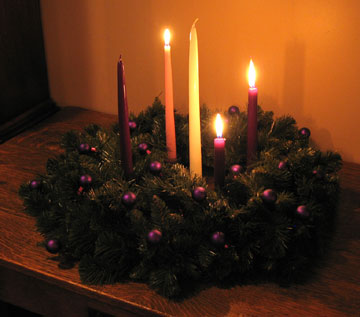
We light this candle because we look forward with eagerness to the birth of a child, the son of Mary and the Son of God! The purple color reminds us of how serious we are in looking forward to the Son's birth.

Prayer of Hope

Dear God, as we light this candle, we look ahead with hope to the birth of your Son -- the Son of David, the son of Mary. May we be prepared to welcome him with open arms and open hearts. O come now, Son of David! Amen!

Closing Song

[To be sung to the tune of "O come let us adore him" from "O Come All Ye Faithful."]

O come now, Son of David,
Christ the Lord!

Sunday, December 14, 2008

Advent Devotion: The Lighting of the Third Candle
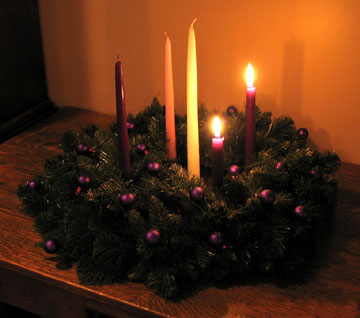
Mark D. Roberts @http://markdroberts.comhas an Advent devotional for the Third Sunday in Advent

We Remember the Meaning of Advent

Advent is a word that means “coming” or “visit”. In the Christian season of Advent we prepare for the “advent” of Christ at Christmas. Our preparation includes many things:

• We remember Israel’s hope for the coming of God’s Messiah to save, to forgive, and to restore them.

• We remember our hope for the second coming of Jesus.

• We remember our need for a Savior to save us from our sins.

• We prepare to welcome Christ at Christmas into our world . . . and into our hearts.

By lighting one candle each week of Advent, we help ourselves to get ready for the birth of Jesus. So far we have lit two candles. The first helped us to hope for God our Shepherd; with the second we asked God to come and forgive our sins.

Today we remember the joy of waiting — because we know how the story ends!

He concludes with a prayer for God’s Help

Dear God, thank you for this season of Advent that helps us to prepare for the coming of Christ at Christmas. As we read the Bible and light a candle, may excitement for Christ’s coming burn in our hearts. Amen.

Sunday, December 07, 2008

The Lighting of the Second Candle: Waiting for Forgiveness

Mark Roberts @ http://www.markdroberts.com continues his series for the Second Sunday of Advent

[Re-light the first purple candle]

We Remember the Meaning of Advent

Advent is a word that means "coming" or "visit". In the Christian season of Advent we prepare for the "advent" of Christ at Christmas. Our preparation includes many things:

• We remember Israel's hope for the coming of God's Messiah to save, to forgive, and to restore them.

• We remember our hope for the second coming of Jesus.

• We remember our need for a Savior to save us from our sins.

• We prepare to welcome Christ at Christmas into our world . . . and into our hearts.

By lighting one candle each week of Advent, we help ourselves to get ready for the birth of Jesus. Last week we lit a candle that signified our waiting for God our Shepherd.

Today we focus on the coming of Christ who brings forgiveness from our sins.

Prayer for God's Help

Dear God, thank you for this season of Advent that helps us to prepare for the coming of Christ at Christmas. As we read the Bible and light a candle, may excitement for Christ's coming burn in our hearts. Amen.

Scripture Readings

Psalm 130:1-8

In this psalm we join the psalmist in crying out for God's forgiveness.

Jeremiah 31:31-34

God promises to make a new covenant with us, in which our sins will be forgiven and forgotten.

Luke 1:68-79

When an angel appears to Zechariah in the temple and tells him that his wife will give birth to a son, the old man doesn't believe the angel. As a result, Zechariah is unable to speak for many months, until immediately after the birth of his son John (the Baptist). Right after the birth, Zechariah is filled with the Holy Spirit and speaks the prophecy that we will read.

Lighting of the Candle

[As someone lights the second purple candle, the following should be read or paraphrased. If you're doing this online, in order to "light" the next Advent candle, click on the wick of the purple candles until you "light" the right one.]
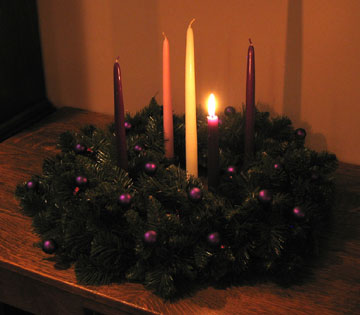
We light this candle because, like God's people centuries ago, we also need a Savior who will forgive our sins. The purple color reminds us of the seriousness of our sin and our great need for God's forgiveness.

Prayer of Hope

Dear God, as we light this candle, we recognize our sin and our need for a savior. We wait for your forgiveness in Christ. We long to be purified so that we might present ourselves to you in righteousness. Come, Our Savior! Amen!

Closing Song

[To be sung to the tune of "O come let us adore him" from "O Come All Ye Faithful."]

O come to us, forgive us,
Christ the Lord!


Monday, December 01, 2008

Advent Begins

advent-wreath-not-litMark D. Roberts @http://markdroberts.com has useful resources on on Advent:

Advent and the Christian Year

Advent F.A.Q.

Preparing for the Coming of Christ:
A Guide for Using the Advent Wreath
. Advent devotional

(Photo: An Advent wreath with the candles unlit. Visit the Advent Guide to “light” the appropriate candle for today.)

I pray that in this season of Advent you might be prepared for a richer and truer celebration of the miracle of Christmas!

Sunday, November 30, 2008

Advent

Advent

Many churches make use of Advent wreaths during this season, with one candle representing each of the four Sundays of Advent. The rose candle is lit on the 3rd Sunday of Advent. During Christmas Day, four lit white candles are used.
(larger image)
Advent (from the Latin word adventus, meaning "coming") is a season of the Christian church, the period of expectant waiting and preparation for the celebration of the Nativity of Jesus, in other words, the period immediately before Christmas. It is the beginning of the Western Christian year and commences on Advent Sunday. The Eastern churches begin the liturgical year on 1 September. The Eastern Christian equivalent of Advent is called the Nativity Fast but it differs both in length and observances.

The progression of the season may be marked with an Advent calendar, a practice introduced by German Lutherans. At least in the Roman Catholic calendar, Advent starts on the fourth Sunday before December 25; in other words, the Sunday between November 27 and December 3 inclusive.

Latin adventus is the translation of the Greek word parousia, commonly used in reference to the Second Coming of Christ. Christians believe that the season of Advent serves a dual reminder of the original waiting that was done by the Hebrews for the birth of their Messiah as well as the waiting that Christians today endure as they await the second coming of Christ.

Tradition

The theme of readings and teachings during Advent is often to prepare for the Second Coming while commemorating the First Coming of Christ at Christmas. With the view of directing the thoughts of Christians to the first coming of Jesus Christ as Saviour, and to his second coming as Judge, special lessons are prescribed for each of the four Sundays in Advent.

The usual liturgical color for Advent is purple or violet. The color is often used for hangings around the church, on the vestments of the clergy, and often also the tabernacle. On the 3rd Sunday of Advent, Gaudete Sunday, rose may be used instead, referencing the rose used on Laetare Sunday, the 4th Sunday of Lent. In some Anglican and Lutheran churches, blue is the liturgical colour for Advent, a custom traced to the usage of the Church of Sweden (Lutheran) and the medieval Sarum Rite. This color is often referred to as "Sarum blue". Red is used in the Eastern churches.

Many churches make use of Advent wreaths during this season, with one candle representing each of the four Sundays of Advent. The rose candle is lit on the 3rd Sunday of Advent. During Christmas Day, four lit white candles are used.

Advent is the beginning of the Church Year for most churches in the Western tradition. It begins on the fourth Sunday before Christmas Day, which is the Sunday nearest November 30, and ends on Christmas Eve (Dec 24). If Christmas Eve is a Sunday, it is counted as the fourth Sunday of Advent, with Christmas Eve proper beginning at sundown.

The Colors of Advent Historically, the primary sanctuary color of Advent is Purple. This is the color of penitence and fasting as well as the color of royalty to welcome the Advent of the King. Purple is still used in Catholic churches. The purple of Advent is also the color of suffering used during Lent and Holy Week. This points to an important connection between Jesus’ birth and death. The nativity, the Incarnation, cannot be separated from the crucifixion. The purpose of Jesus’ coming into the world, of the "Word made flesh" and dwelling among us, is to reveal God and His grace to the world through Jesus’ life and teaching, but also through his suffering, death, and resurrection. To reflect this emphasis, originally Advent was a time of penitence and fasting, much as the Season of Lent and so shared the color of Lent.

In the four weeks of Advent the third Sunday came to be a time of rejoicing that the fasting was almost over (in some traditions it is called Gaudete Sunday, from the Latin word for "rejoice"). The shift from the purple of the Season to pink or rose for the third Sunday Advent candles reflected this lessening emphasis on penitence as attention turned more to celebration of the season.

In recent times, however, Advent has undergone a shift in emphasis, reflected in a change of colors used in many churches. Except in the Eastern churches, the penitential aspect of the Season has been almost totally replaced by an emphasis on hope and anticipation.

In many churches the third Sunday remains the Sunday of Joy marked by pink or rose. However, most Protestant churches now use blue to distinguish the Season of Advent from Lent. Royal Blue is sometimes used as a symbol of royalty. Some churches use Bright Blue to symbolize the night sky, the anticipation of the impending announcement of the King’s coming, or to symbolize the waters of Genesis 1, the beginning of a new creation. Some churches, including some Catholic churches, use blue violet to preserve the traditional use of purple while providing a visual distinction between the purple or red violet of Lent.

This does not eliminate any sense of penitence from the Season. With the focus on the Advent or Coming of Jesus, especially in anticipating His Second Advent, there remains a need for preparation for that coming. Most liturgical churches incorporate confessional prayers into the service that relate to a sense of unworthiness as we anticipate His Coming. It is appropriate even in more traditional services of worship to incorporate confessional prayers as part of the anticipation and preparation of the Season.

With the shift to blue for Advent in most non-Catholic churches, there is also a tendency to move pink to the Fourth Sunday of Advent. It still remains associated with Joy, but is sometimes used as the climax of the Advent Season on the last Sunday before Christmas.

Red and Green are more secular colors of Christmas. Although they derive from older European practices of using evergreens and holly to symbolize ongoing life and hope that Christ’s birth brings into a cold world, they are never used as liturgical colors during Advent since they have other uses in other parts of the church year (see Colors of the Church Year).

The word Advent means "coming" or "arrival." The focus of the entire season is the celebration of the birth of Jesus the Christ in his First Advent, and the anticipation of the return of Christ the King in his Second Advent. Thus, Advent is far more than simply marking a 2,000 year old event in history. It is celebrating a truth about God, the revelation of God in Christ whereby all of creation might be reconciled to God. That is a process in which we now participate, and the consummation of which we anticipate. Scripture reading for Advent will reflect this emphasis on the Second Advent, including themes of accountability for faithfulness at His coming, judgment on sin, and the hope of eternal life.

In this double focus on past and future, Advent also symbolizes the spiritual journey of individuals and a congregation, as they affirm that Christ has come, that He is present in the world today, and that He will come again in power. That acknowledgment provides a basis for Kingdom ethics, for holy living arising from a profound sense that we live "between the times" and are called to be faithful stewards of what is entrusted to us as God’s people. So, as the church celebrates God’s inbreaking into history in the Incarnation, and anticipates a future consummation to that history for which "all creation is groaning awaiting its redemption," it also confesses its own responsibility as a people commissioned to "love the Lord your God with all your heart" and to "love your neighbor as yourself."

The Spirit of Advent Advent is marked by a spirit of expectation, of anticipation, of preparation, of longing. There is a yearning for deliverance from the evils of the world, first expressed by Israelite slaves in Egypt as they cried out from their bitter oppression. It is the cry of those who have experienced the tyranny of injustice in a world under the curse of sin, and yet who have hope of deliverance by a God who has heard the cries of oppressed slaves and brought deliverance!

It is that hope, however faint at times, and that God, however distant He sometimes seems, which brings to the world the anticipation of a King who will rule with truth and justice and righteousness over His people and in His creation. It is that hope that once anticipated, and now anticipates anew, the reign of an Anointed One, a Messiah, who will bring peace and justice and righteousness to the world.

Part of the expectation also anticipates a judgment on sin and a calling of the world to accountability before God. We long for God to come and set the world right! Yet, as the prophet Amos warned, the expectation of a coming judgment at the "Day of the Lord" may not be the day of light that we might want, because the penetrating light of God’s judgment on sin will shine just as brightly on God’s people.

Because of this important truth, especially in the Eastern Orthodox Churches, the Season of Advent has been a time of fasting and penitence for sins similar to the Season of Lent. However, a different emphasis for the season of Advent has gradually unfolded in much of the rest of the church. The season of Advent has come to be celebrated more in terms of expectation or anticipation. Yet, the anticipation of the Coming of the Messiah throughout the Old Testament and Judaism was not in connection with remembrance of sins. Rather, it was in the context of oppression and injustice, the longing for redemption, not from personal guilt and sin but from the systemic evil of the world expressed in evil empires and tyrants. It is in that sense that all creation groans for its redemption as we witness the evil that so dominates our world (Rom 8:18-25).

Of course, there is the problem of longing for vindication from an evil world when we are contributors to that evil. This is the power of the images of Amos when he warns about longing for the "Day of the Lord" that will really be a day of darkness (Amos 5:18-20). Still, even with Amos’ warning the time of Advent is one of expectation and anticipation, a longing for God's actions to restore all things and vindicate the righteous. This is why during Advent we as Christians also anticipate the Second Coming as a twin theme of the season. So, while some church traditions focus on penitence during Advent, and there remains a place for that, the spirit of that expectation from the Old Testament is better captured with a joyous sense of expectancy. Rather than a time of mourning and fasting, Advent is celebrated as a time of joy and happiness as we await the coming of the King. (see Can We Sing Christmas Carols During Advent?)

There will be time enough during the rest of the journey through the Church Year to remember our sins. It begins in Epiphany when we hear about the brotherhood of the Kingdom, and realize our failure to effect it. Then as we move toward and through Lent we realize that the coming of Jesus served more to lay bare our own sin than it did to vindicate our righteousness. There will be time to shed Peter's bitter tears as we realize that what started with such possibility and expectation has apparently ended in such failure.

It is only as we experience that full cycle, beginning with unbridled joy in Advent that slowly fades into the realization of what we have done with and to the Christ, that the awful reality of Good Friday can have its full impact. And in that realization we can finally be ready to hear the Good News on Resurrection Sunday! That is the journey that the disciples took. And so there is value in taking the same journey beginning with the anticipation and joy of Advent!

So, we celebrate with gladness the great promise in the Advent, yet knowing that there is also a somber tone as the theme of threat is added to the theme of promise. This is reflected in some of the Scripture readings for Advent, in which there is a strong prophetic tone of accountability and judgment on sin. But this is also faithful to the role of the Coming King who comes to rule, save, and judge the world.

Because of the dual themes of threat and promise, Advent is a time of preparation that is marked by prayer. While Lent is characterized by fasting and a spirit of penitence, Advent’s prayers are prayers of humble devotion and commitment, prayers of submission, prayers for deliverance, prayers from those walking in darkness who are awaiting and anticipating a great light (Isa 9)!

The spirit of Advent is expressed well in the parable of the bridesmaids who are anxiously awaiting the coming of the Bridegroom (Matt 25:1-13). There is profound joy at the Bridegroom’s expected coming. And yet a warning of the need for preparation echoes through the parable. But even then, the prayer of Advent is still:

Come, O Come, Emmanuel, And ransom captive Israel!

Evergreens and The Advent Wreath

The beginning of Advent is a time for the hanging of the green, decoration of the church with evergreen wreaths, boughs, or trees that help to symbolize the new and everlasting life brought through Jesus the Christ. Some churches have a special weekday service, or the first Sunday evening of Advent, or even the first Sunday morning of Advent, in which the church is decorated and the Advent wreath put in place. This service is most often primarily of music, especially choir and hand bells, and Scripture reading, along with an explanation of the various symbols as they are placed in the sanctuary.

The Advent wreath is an increasingly popular symbol of the beginning of the Church year in many churches as well as homes. It is a circular evergreen wreath (real or artificial) with five candles, four around the wreath and one in the center. Since the wreath is symbolic and a vehicle to tell the Christmas story, there are various ways to understand the symbolism. The exact meaning given to the various aspects of the wreath is not as important as the story to which it invites us to listen, and participate.

The circle of the wreath reminds us of God Himself, His eternity and endless mercy, which has no beginning or end. The green of the wreath speaks of the hope that we have in God, the hope of newness, of renewal, of eternal life. Candles symbolize the light of God coming into the world through the birth of His son. The four outer candles represent the period of waiting during the four Sundays of Advent, which themselves symbolize the four centuries of waiting between the prophet Malachi and the birth of Christ.

The colors of the candles vary with different traditions, but there are usually three purple or blue candles, corresponding to the sanctuary colors of Advent, and one pink or rose candle. One of the purple candles is lighted the first Sunday of Advent, a Scripture is read, a short devotional or reading is given, and a prayer offered. On subsequent Sundays, previous candles are relighted with an additional one lighted. The pink candle is usually lighted on the third Sunday of Advent. However, different churches or traditions light the pink candle on different Sundays depending on the symbolism used (see above on Colors of Advent). In Churches that use a Service of the Nativity, it is often lighted on the fourth Sunday of Advent, the final Sunday before Christmas.

The light of the candles itself becomes an important symbol of the season. The light reminds us that Jesus is the light of the world that comes into the darkness of our lives to bring newness, life, and hope. It also reminds us that we are called to be a light to the world as we reflect the light of God's grace to others (Isa 42:6). The progression in the lighting of the candles symbolizes the various aspects of our waiting experience. As the candles are lighted over the four week period, it also symbolizes the darkness of fear and hopelessness receding and the shadows of sin falling away as more and more light is shed into the world. The flame of each new candle reminds the worshippers that something is happening, and that more is yet to come. Finally, the light that has come into the world is plainly visible as the Christ candle is lighted at Christmas, and worshippers rejoice over the fact that the promise of long ago has been realized.

The first candle is traditionally the candle of Expectation or Hope (or in some traditions, Prophecy). This draws attention to the anticipation of the coming of a Messiah that weaves its way like a golden thread through Old Testament history. As God’s people were abused by power hungry kings, led astray by self-centered prophets, and lulled into apathy by half-hearted religious leaders, there arose a longing among some for God to raise up a new king who could show them how to be God’s people. They yearned for a return of God’s dynamic presence in their midst.

And so, God revealed to some of the prophets that indeed He would not leave His people without a true Shepherd. While they expected a new earthly king, their expectations fell far short of God’s revelation of Himself in Christ. And yet, the world is not yet fully redeemed. So, we again with expectation, with hope, await God’s new work in history, the second Advent, in which He will again reveal Himself to the world. And we understand in a profound sense that the best, the highest of our expectations will fall far short of what our Lord’s Second Advent will reveal!

The remaining three candles of Advent may be associated with different aspects of the Advent story in different churches, or even in different years. Usually they are organized around characters or themes as a way to unfold the story and direct attention to the celebrations and worship in the season. So, the sequence for the remaining three Sundays might be Bethlehem, Shepherds, Angels. Or Love, Joy, Peace. Or John the Baptist, Mary, the Magi. Or the Annunciation, Proclamation, Fulfillment. Whatever sequence is used, the Scripture readings, prayers, lighting of the candles, the participation of worshipers in the service, all are geared to telling the story of redemption through God’s grace in the Incarnation.

The third candle, usually for the Third Sunday of Advent, is traditionally Pink or Rose, and symbolizes Joy at the soon Advent of the Christ. It marks a shift from the more solemn tone of the first two Sundays of Advent that focus on Preparation and Hope, to a more joyous atmosphere of anticipation and expectancy. Sometimes the colors of the sanctuary and vestments are also changed to Rose for this Sunday. As noted above, in some churches the pink Advent candle is used on the fourth Sunday to mark the joy at the impending Nativity of Jesus.

Whatever sequence is adopted for these Sundays, the theme of Joy can still be the focus for the pink candle. For example, when using the third Sunday to commemorate the visit of the Magi the focus can be on the Joy of worshipping the new found King. Or the Shepherds as the symbol for the third Sunday brings to mind the joy of the proclamation made to them in the fields, and the adoration expressed as they knelt before the Child at the manager. If used on the fourth Sunday of Advent, it can symbolize the Joy in fulfilled hope.

The center candle is white and is called the Christ Candle. It is traditionally lighted on Christmas Eve or Day. However, since many Protestant churches do not have services on those days, many light it on the Sunday preceding Christmas, with all five candles continuing to be lighted in services through Epiphany (Jan 6). The central location of the Christ Candle reminds us that the incarnation is the heart of the season, giving light to the world.

Celebrating Advent Advent is one of the few Christian festivals that can be observed in the home as well as at church. In its association with Christmas, Advent is a natural time to involve children in activities at home that directly connect with worship at church. In the home an Advent wreath is often placed on the dining table and the candles lighted at meals, with Scripture readings preceding the lighting of the candles, especially on Sunday. A new candle is lighted each Sunday during the four weeks, and then the same candles are lighted each meal during the week. In this context, it provides the opportunity for family devotion and prayer together, and helps teach the Faith to children, especially if they are involved in reading the daily Scriptures.

It is common in many homes to try to mark the beginning of Advent in other ways as well, for the same purpose of instruction in the faith. Some families decorate the house for the beginning of Advent, or bake special cookies or treats, or simply begin to use table coverings for meals. An Advent Calendar is a way to keep children involved in the entire season. There are a wide variety of Advent calendars, but usually they are simply a card or poster with windows that can be opened, one each day of Advent, to reveal some symbol or picture associated with the Old Testament story leading up to the birth of Jesus. One unique and specialized Advent calendar that can be used either in the home or the sanctuary is a Jesse Tree. (We have available an online Advent calendar with devotionals for each day of Advent as well as Christmas through Epiphany Day: NazNet's Advent and Christmas Celebration). All of these provide opportunities to teach children the significance of this sacred time, and to remind ourselves of it as well.

In congregational worship, the Advent wreath is the central teaching symbol of the season, the focal point for drawing the congregation into the beginning of the story of redemption that will unfold throughout the church year. For this reason, members of the congregation are often involved in lighting the Advent candles and reading the appropriate Scriptures each Sunday. While in some churches it is customary for this to be done by families, it can also be an especially good opportunity to demonstrate the unity of the entire community of Faith by including those without families, such as those never married, divorced, widowed, elderly who live by themselves, or college students away from home.

References

  • Kallistos (Ware), Bishop (1969), "The Five Cycles", The Festal Menaion, London: Faber and Faber, p. 40

Wednesday, December 19, 2007

This Week's Advent Poem

By: John Piper @www.desiringgod.org

In my final Advent Poem on Nicodemus, I concluded with lines about Christian courage in the face of the Colorado shootings:

So, Bethlehem, with candle three,
Are you afraid? Or are you free?
Do Christian-killers in the news
Make you a slave? Or do you choose
With Christ that they will make you brave?
What do you fear the most? The grave?
Did Jesus die and rise for this?
Or that the certain hope of bliss
Beyond the bullets and the blood
Would bless this planet with a flood
Of fearless sacrifice? What gun
Can cut us off from Jesus? None!
Nor tribulation or distress,
Nor danger, sword, or nakedness.
Though we were killed like sheep all day,
The Shepherd of our souls holds sway.
And when he comes, it will be plain
That none of us has died in vain.
The body that was pierced and torn,
Never forget, will be reborn.

Read the whole thing.

Friday, December 07, 2007

Turning a Corner to Paradise: An Advent Lesson

By John Mark Reynolds@http://www.scriptoriumdaily.com

Advent remembers and anticipates two appearances of Christ. First, we recall his Incarnation when the Word became Flesh. Second, we look forward to his Second Coming when He will come as King to rule on the Earth.

Mary and Joseph went on a weary journey and suddenly Bethlehem was not just a little town anymore.

They turned a corner and Paradise came down.

Someday, perhaps soon, we will turn a corner and the trumpet will sound, the dead will rise, and Christ will return.

We will turn a corner and Paradise will come down.

Mongolia is not Los Angeles, but it was a classroom for me about this reality.

A group of about twenty Torrey Honors students and my family went at the invitation of Campus Crusade and the Mongolian government to do a series of meetings in the schools. Watching my students respond, mostly without complaint, to difficult circumstances showed their quality. Having a chance to share the gospel with them, seeing what we had learned in the classroom matter in eternity, revealed what we had done well in Torrey and what we could do better.

Most of all I remember seeing an upperclassman, Angela Good, come into her own. She loved missions, education, and great conversations and we were involved in all three. We were all moved by teachers forced to do great work with poor resources.

Angie came home and began a Torrey project to send school supplies to those teachers. It was one of her last acts. She would graduate to a greater school that fall following a car accident.

From the moment I got what my family now simply calls “the call,” I have seldom forgotten that what we do is not the only thing that impacts eternity. We are, all of us, just one step from the eternal Kingdom. I have never forgotten Angie and I have never forgotten the truth that any one of us might turn a corner and find ourselves with Christ in Paradise.

What have you done about it?

Come, Thou Long Expected Servant

isaiah
By Matt Jenson@ http://www.scriptoriumdaily.com

Advent is upon us, and as God’s good timing would have it, I spent all Tuesday last week reading and many hours throughout the week discussing Isaiah with students.

Often spoken of as a ‘fifth gospel’, the book of Isaiah is a feast for Old Testament Jesus-watchers. That’s helped by Handel, whose Messiah teaches us to hear the prophet as evangelist. And we are right so to do.

As long as we’re patient.

In Advent, we sing of the ‘long expected Jesus’. To hear Israel’s Scriptures faithfully is to hear in them the slow, painful, hopeful building of expectation. It is to hear a people fumbling toward a future usually only hinted at, but occasionally emerging from the fog in visions as brilliant as they are evanescent.

To jump to Jesus to quickly in reading the Old Testament is to miss the Old Testament and, ironically, to miss Jesus himself. To appreciate a promise fulfillment we must enter into the long years during which it remained unfulfilled.

How, then, do we read Isaiah? Well, we can start by listening to Isaiah on its own terms, with its own local concerns, questions and answers – and by resisting the temptation to say ‘Jesus’ at every turn.

It pays off, by the way. Take Isaiah 46. The chapter begins with a lampoon of Babylon’s gods.

‘Bel bows down; Nebo stoops;
their idols are on beasts and livestock;
these things you carry are borne
as burdens on weary beasts.
They stoop; they bow down together;
they cannot save the burden,
but themselves go into captivity.’ (46.1-2)

The gods of Babylon can do nothing but be carried by dusty donkeys. Contrast them with the God of Israel, who address his people in the following verses:

‘Listen to me, O house of Jacob,
all the remnant of the house of Israel,
who have been borne by me from before your birth,
carried from the womb;
even to your old age I am he,
and to gray hairs I will carry you.
I have made, and I will bear;
I will carry and will save.’ (46.3-4)

Bel and Nebo are carried. The LORD carries. He carried like a mother in the womb, bore his son Israel and will continue to bear him into old age.

Now flip over a few pages to Isaiah 53. Isaiah is speaking of the servant, an enigmatic figure we meet in chapter 41 who is the subject of the second half of Isaiah. (Try a slow read-through of Isaiah 40-66, answering the question, ‘Who is the servant?’) Here’s what Isaiah says of the servant:

‘Surely he has borne our griefs
and carried our sorrows;
yet we esteemed him stricken,
smitten by God, and afflicted.
But he was wounded for our transgressions;
he was crushed for our iniquities;
upon him was the chastisement that brought us peace,
and with his stripes we are healed.
All we like sheep have gone astray;
we have turned every one to his own way;
and the LORD has laid on him the iniquity of us all.’ (53.4-6)

Now, only God carries. Only he bears. Isaiah is a grand vindication of God’s glory, constantly bearing witness to the God who is unlike any other, who will share his glory with no one (e.g., 42.8). And yet, he will share his glory with his servant (see 52.13). What’s more, the servant does what we thought only God could do – he carries the people of God.

Okay, now it’s okay to say it – Jesus.

Monday, December 03, 2007

The Obstacles of Advent

By Bryan Wilkerson @ http://blog.christianitytoday.com

How is your church combating the busyness and materialism of the season?

Last week my wife and I got all of our Christmas shopping done—in one day. This blitzkrieg approach has become a tradition for us. It’s like pulling a tooth; better to have the whole thing out at once. In the evening we treated ourselves to a victory dinner at a restaurant. While savoring my accomplishment and my meal, I watched A Charlie Brown Christmas on the television above the bar. Ah, Christmas in America—spend all day battling the crowds at the mall and have Luke chapter 2 recited to you by a cartoon character at night.

Many have lamented the way our culture has “taken Christ out of Christmas,” and in recent years we’ve heard conservative pundits freak out when retailers wish customers a “Happy Holiday” rather than “Merry Christmas.” But even for those of us in the church, aware of the season’s spiritual significance, and determined to celebrate the advent of the Messiah, this month still poses many challenges. Let’s face it, focusing on God in our society is always difficult and the added stress of the holidays only makes things harder.

Four years ago we decided to shift the way our church engaged Advent. We came to see that December posed unique challenges for our people, and if these obstacles were left unchecked they would significantly interrupt our mission to be formed into the image of Christ. For this reason our church is taking some intentional steps to help people commune with God this Christmas in a counter-cultural way.

The first obstacle we identified was busyness. Ask anyone in my church, on any day, what keeps them from communing with God and chances are they’ll say busyness. But during December it really gets out of control. Beyond ordinary obligations schedules also fill up with numerous parties, school holiday programs, shopping excursions, vacations, and family gatherings with Cousin Eddie. During a season when we are supposed to slow down and commune deeply with Christ and family we can hardly find time to breathe.

We decided the church should combat this tendency rather than contribute to it. So, instead of adding programs and activities during December we’ve actually reduced them. For example, we’ve stayed away from large Christmas productions for children or adults. These events, while beautiful and worshipful, often take weeks of preparation that fill up the calendar with practices which separate families. We also suspend most adult and children’s classes on Sunday so families can worship together, and we provide at-home Advent family devotionals and encourage heads of households to gather their clan weekly.

In addition, beginning in late October we start encouraging everyone to complete their Christmas shopping before December 1. This frees up time during Advent to connect with others, and hours that would otherwise be spent at the mall can now be used to serve someone in the name of Christ. It seems so simple, but I can’t tell you how many people have been blessed by this suggestion.

The second obstacle we identified was materialism. You know consumption is a problem in society when the first day of the Christmas shopping season is known as “Black Friday.” It is so called because it’s the day most retailers discover if they will make a profit for the year (be in the black). Our entire economy hinges on whether or not people celebrate Christmas by purchasing ChiaPets and little dancing Santas. But all of the focus on “stuff” distracts us from focusing on Christ. (If you haven’t heard about it already, check out the site for What Would Jesus Buy?—a new film debuting this month.)

To address this obstacle we encourage our community to reduce their shopping expenses and match whatever they spend by giving to a compassion or missions project. This year we’re highlighting two projects in particular. The first is in partnership with our missionaries in Cambodia working with AIDS patients. The other is an urban ministry in Chicago we’ve been connected with for years. There are other projects available, and a number involve more than giving money. Many small groups, for example, take time to engage a local service project together and children are encouraged to participate as well.

To be honest, not everyone has appreciated this approach. Some come to our church with expectations of an elaborate Christmas pageant, and others don’t want to be challenged every week to shop earlier and spend less. But our desire is simple—to release time for communion with God and service to others, and to refocus our attention away from the kitsch and onto Christ.