Showing posts with label Reference-Book Review. Show all posts

Friday, July 25, 2008

Myths Christians Believe About Wealth and Poverty

Justin Taylor @ http://theologica.blogspot.com profiles Jay W. Richards (Ph.D. in philosophy and theology from Princeton) on his forthcoming HarperOne book in 2009: Money, Guilt and God: A Christian Case for Capitalism.

At the recent Acton University 2008 Dr. Richards gave a lectured entitled, Don’t Just Care – Think: Myths Christians Believe About Wealth and Poverty, based on his forthcoming book. Dr. Richards granted permission for me to reprint here his outline/handout:
For Christians, compassion for the poor is a non-negotiable. Compassion alone, however, doesn’t help the poor. In fact, many ideas that Christian leaders advocate really exacerbate the very problems they were intended to solve. So how do we insure that we not only mean well, but also do good? We have to learn to think economically about wealth and poverty.

Don’t worry. At its base, economics isn’t supply/demand charts and complicated math. Rather, the “art of economics,” as Henry Hazlitt puts it, “consists in looking not merely at the immediate but at the longer effects of any act or policy; it consists in tracing the consequences of that policy not merely for one group but for all groups.”

One way to do this is to learn to recognize eight simple myths that many well meaning Christians believe when they think about wealth and poverty.
  1. The nirvana myth (contrasting capitalism with an unrealizable ideal rather than with its live alternatives)
  2. The zero-sum game myth (believing that wealth gained in one place always means that wealth was lost someplace else)
  3. The materialist myth (believing that intellect cannot create new wealth)
  4. The greed myth (believing that the essence of capitalism is greed)
  5. The usury myth (believing that charging interest on money is always exploitive)
  6. The piety myth (focusing on our good intentions rather than the unintended consequences of our actions)
  7. The artsy myth (confusing aesthetic judgments with economic arguments)
  8. The freeze frame myth (believing that things always stay the same—for example, assuming population trends will continue indefinitely or treating “rich” and “poor” as static
  9. categories)
Each of these mistakes is easy to expose in the abstract, but easy to forget in practice. Remember them, however, and you’ll be immunized against a lot of economic falderal, even if you never take a course on economics, and you’ll begin to appreciate the value of a free market economy for creating wealth. Finally, and most importantly, you’ll be much more likely to advocate policies that not only have good purposes, but also good results.

Friday, August 17, 2007

Hanegraaff's "The Apocalypse Code"

by Kim Riddlebarger @ http://kimriddlebarger.squarespace.com

apocalypse%20code.jpgSeveral of you have asked me about my take on Hank Hanegraaff's recent book, The Apocalypse Code (Click here: Amazon.com: The Apocalypse Code: Find Out What the Bible REALLY Says About the End Times . . . and Why It Matters). So, here goes.

On the one hand, Hanegraaff does a very good job debunking the popular dispensational end-times scenarios set out by the likes of John Hagee and Tim LaHaye. Hanegraaff exposes the embarrassing problem faced by dispensationalists who claim to interpret the Bible literally, and who cannot make good on that promise. While John (Revelation 1:3; 22:10) tells us that the things recorded in his apocalyptic vision are soon to come to pass, dispensationalists are forced to tell us that "near" and "soon" don't really mean "near" and "soon." Instead, dispensationalists tell us, these things don't come to pass until the end of the age--a rather embarrassing problem given their insistence that they take the Bible (especially prophecy) "literally."

Hanegraaff also does a very good job debunking the Israel-centered hermeneutic of popular dispensational writers. Hanegraaff capably demonstrates that Jesus Christ is the true hermeneutical center of all of Scripture and that many of the things dispensationalists assign to the future and the end of the age (i.e., in the millennium), are already fulfilled in Christ! This includes the land promise of the Abrahamic covenant, the fact that Christ is the true temple, and so on. Hanegraaff also effectively replies to the common dispensational rant that non-dispensationalists are intrinsically anti-Semitic.

In all of these regards, Hanegraaff's book offers an effective rebuttal to dispensational claims. Would that all those who read Lindsey, LaHaye, and Hagee, and think their stuff is gospel, would also read Hanegraaff and consider well the biblical evidence he adduces which undoes the dispensational system.

On the other hand, Hanegraaff's The Apocalypse Code, has several serious weaknesses. I hate to criticize Hank personally, since he was so gracious to me when I was a guest on the Bible Answer Man several years ago. Hank was still working through his position on these matters and gave me two full hours on national radio to make my case. He had read my first book (A Case for Amillennialism) from cover to cover, was thoroughly conversant with all of the key issues and was very nice to my teenage son who went to the studio with me. Dads remember such things and I am grateful.

That being said, here are what I see as the main problems with The Apocalypse Code, and which detract from its overall impact and import.

First, the use of neo-logisms ("I coined the phrase Exegetical Eschatology -- e2", implying that dispensationalists don't do exegesis), the use of mnemonic devices (LIGHTS), and guilt by association arguments (LaHaye is juxtaposed with Bill Maher and Bill Clinton, among others) seriously undercuts the very point that Hanegraaff is trying to make--which is that LaHaye, Hagee, et al., can't be taken seriously. Inventing your own self-designation ("Exegetical Eschatology") requires that you do serious exegesis, not stoop to the sensationalist genre of those whom you are endeavoring to refute.

Refuting sensationalist eschatology with sensationalism might sell books, but this approach seriously detracts from Hanegraaff's overall case. The result is, in my opinion, Hanegraaff's book has a "snotty," condescending and sensationalist tone to it. This would make me reluctant to give The Apocalypse Code to a dispensational friend who was not yet at the point of re-thinking their entire eschatology.

Second, Hanegraaff adopts the partial preterist interpretation of the eschatological language of the New Testament. That's fine by me, since I too believe that the Olivet Discourse is primarily aimed to the disciples and that the events predicted there (with the exception of the Second Advent), are largely fulfilled by the events of A.D. 70. But Hanegraaff's "partial" preterism leads to the usual (and in my estimation, flawed) interpretation of a number of key points.

Preterists of all stripes are forced to argue for a pre-70 A.D. date for the Book of Revelation. I think the internal evidence points strongly for a date much closer to 95 A.D--although the dating of Revelation ultimately does not effect my overall eschatological position, which is Reformed amillennialism. I get the sense from writers like Hanegraaff (and Ken Gentry), that once you make the leap to some form of preterism, you've got to make the case for an early date for Revelation. You now have to "prove" this early date, not objectively examine evidence as to when John might have been given his vision.

Because of this preterist presupposition demanding an early date for the apocalypse, you get all kinds of far-fetched interpretations from Hanegraaff: Babylon (Revelation 17-18) is apostate Israel, not Rome; Nero and the current Roman Caesars fulfill in its entirety the beast motif (Revelation 13); and that the Jerusalem Temple was still standing when John was given his vision (based upon a misinterpretation of Revelation 11:1-3).

It is also highly problematic to argue that Christ returned (in a some form of parousia) with the events of 70 A. D. No doubt, the destruction of the temple marks the end of the Jewish era (not the end of "this age,") and it clearly led to the diaspora and the curse upon apostate Israel being tragically realized as foretold by Jesus in Matthew 23:37-39. But such does not constitute a "coming of Jesus." How many second comings are there? One or two? And isn't one of the criticisms of dispensationalists that they teach a "real coming" at the Rapture which no one sees?

Hanegraaff's The Apocalypse Code has enough weaknesses that I would be hesitant to give it to a dispensationalist who was not at the point of jettisoning their dispensationalism. I would give it (and therefore recommend it) to someone who was widely-read in this field, had thought about these issues for some time, and who understood most of the nuances and differences associated with these issues. The Apocalypse Code might just give that person the final shove they need.

Man%20of%20sin%20small.jpgSince this is my blog and I'm therefore entitled to make shameless appeals to those who read it, let me just say that I too have written a book which covers much of the same ground, and which I think is more exegetically based. Reformed amillennialism (i.e., Horton, Vos, Kline, Hoekema, Venema, Johnson, Beale) is not only able to deal with the "time is near" language of the Book of Revelation, it also does not strip the New Testament of those eschatological events which are yet to be fulfilled in the future.

You can find more information about my book, The Man of Sin, here: Click here: Riddleblog - Man of Sin - Uncovering the Truth About Antichrist

Friday, July 27, 2007

(A Bit Less) Positive About Potter


How Focus on the Family, Prison Fellowship, and others have—and haven't—changed their views about the books over the years.

"Harry Potter books and films have been attacked in the past by evangelicals for allegedly glamorizing the occult," say the papers. But Christians "are now eschewing condemnation for praise, embracing Ms. Rowling's tales as powerful religious fables for our time."

It's a narrative as fictional as the Potter books themselves. In late 1999, I noted that, contrary to media reports, no major Christian leader had spoken against the Harry Potter series, and several had actually supported the books. Some readers were upset with my summary, but the most prominent critic they could come up with at that time was Texas pastor John Hagee. Four books and five films later, it's time for an update to that piece.

One of the most prominent evangelical supporters of the series in 1999 was Charles Colson. "The magic in these books is purely mechanical, as opposed to occultic," he said in his BreakPoint broadcast. "That is, Harry and his friends cast spells, read crystal balls, and turn themselves into animals—but they don't make contact with a supernatural world. … The plots reinforce the theme that evil is real, and must be courageously opposed. … [Harry and his friends] develop courage, loyalty, and a willingness to sacrifice for one another—even at the risk of their lives. Not bad lessons in a self-centered world."

Now, eight years later, Colson tells his listeners, "Personally, I don't recommend the Potter books. I'd rather Christian kids not read them. … Dare [Christian kids] to have Daniel as their role model, not Harry Potter."

But four days after Colson's BreakPoint commentary, Prison Fellowship president Mark Earley had his own BreakPoint commentary recommending the books. "They are a good read," he said. "People have found something in the Harry Potter stories that is far more profound and inspiring than just a desire to be a part of the literary in-crowd. … A good fantasy author can remind us of the necessity of sacrifice and the redemption that can come from even the most brutal and senseless acts. They can help restore our faith in goodness—and, yes, sometimes even in God. … Great stories are even more closely related to the gospel than we realize. No wonder that great stories are so enticing."

Posts on Prison Fellowship's The Point blog, written largely by Prison Fellowship staffers, effusively praise the series, including the final book.

Meanwhile, Focus on the Family wants to make it clear that The Washington Post was wrong when it reported, "Christian parenting guru James Dobson has praised the Potter books." The Focus on the Family website issued a response, which it promoted on its daily radio program, that explains:

This is the exact opposite of Dr. Dobson's opinion — in fact, he said a few years ago on his daily radio broadcast that "we have spoken out strongly against all of the Harry Potter products." His rationale for that statement: Magical characters — witches, wizards, ghosts, goblins, werewolves, poltergeists, and so on — fill the Harry Potter stories, and given the trend toward witchcraft and New Age ideology in the larger culture, it's difficult to ignore the effects such stories (albeit imaginary) might have on young, impressionable minds.

That may be true of Dobson himself, but earlier Focus on the Family treatments of the Hogwarts series specifically denied his charge. "The spiritual fault of Harry Potter is not so much that Rowling is playing to dark supernatural powers, but that she doesn't acknowledge any supernatural powers at all," Lindy Beam (now Lindy Keffer) wrote for Focus on the Family's entertainment guide, Plugged In. "These stories are not fueled by witchcraft, but by secularism."

Keffer's comments no longer appear on the Focus on the Family site, but Keffer repeated a version of her argument this month in her review of the film version of Harry Potter and the Order of the Phoenix:

Even with all the magic in the air, the worldview of Phoenix can't be called consistently occult. Like the world we live in today, it's a hodgepodge of ideas that are accepted simultaneously, even if they don't really fit together. Students repeatedly wish each other "Merry Christmas" before their school holiday begins. At one point, Snape tells Harry to pray, with no reference to whom he should pray to. And much of the magic in the film is arguably "mechanical," lending support to a naturalistic philosophy.

World magazine, meanwhile, continues the ambivalent position it has taken toward the books ever since its parent company stopped selling them through its book club in 1999.

"Although the witchcraft taught here is arguably not the same as that of devil worshippers or even Wiccans, parents were right to worry that the Potter novels and movies might make real witchcraft seem attractive to their children," Gene Edward Veith wrote about the Harry Potter and The Goblet of Fire film in 2005. He continues:

True, in the Potter universe, there is a conflict between good witches and bad witches, so that a moral structure prevails. But in the first three books and movies, the conflict between good and evil is mostly symbolic. … Goblet of Fire is more mature. It does not dramatize the Muggle/Witch dichotomy, and the realm of magic is depicted not as fun but as a grim and dangerous place. … In this movie, the conflict between good and evil is genuine.

Veith still recommends that parents keep their kids from the books and films, but he does not condemn them. A 2005 review of Harry Potter and the Half-Blood Prince similarly avoids direct criticism while telling readers that concerns that the book implicitly approves of sorcery "should be taken seriously." Likewise, the magazine's review of the Order of the Phoenix film this month refers to "objections of many thoughtful Christian parents" without actually endorsing those concerns. Meanwhile, on World's blog, features editor Lynn Vincent noted that her children stood in line at Barnes & Noble Friday night to get a copy of the final volume.

As an editor at a magazine that has repeatedly praised the Harry Potter books and films (our reviewer didn't care for the latest movie, but it had nothing to do with concerns about occult imagery or violence), I can attest that there are a number of Christians out there who adamantly feel that the books endorse evil—or are evil themselves. They have tried hard to get Christianity Today to change its view on J. K. Rowling's works, but without success (we haven't actually taken an official stance on the books since our January 2000 issue). Whether similar efforts have convinced Colson, Dobson, and some others to take a slightly stronger stance against Harry Potter is unknown. There may have been other reasons. (The books have indeed become increasingly dark and violent, for example.) Regardless, their heart doesn't seem in it. I still don't think there's a groundswell of opposition to the Potter books. But what opposition does exist, it seems clear, is originating in the pews rather than the pulpits.

Related Elsewhere:

Harry Potter and the Deathly Hallows is available from Amazon.com and other retailers.

Our coverage of Deathly Hallows includes:

The Gospel According to J.K. Rowling | The magic world of Harry Potter begins yielding to a 'deeper magic.' (July 23, 2007)
What Would Jonathan Edwards Say About Harry Potter? | How the preacher responded to pop culture's version of transcendence. (July 24, 2007)

Wednesday, July 25, 2007

What Would Jonathan Edwards Say About Harry Potter?


How the preacher responded to pop culture's version of transcendence.

[WARNING: SOME PLOT SPOILERS.]

So there we have it. The most engrossing imaginative world created at the start of the 21st century is essentially pagan. Don't get me wrong—I like the Harry Potter series. I've read all of the books. And I'm sure Jonathan Edwards would have done so, too.

Edwards was acutely aware of the cultural movements of his time. He said in "Some Thoughts Concerning the Revival" that he made it his practice to take light from wherever it came. Of course, reading John Locke and the like is not quite like reading books designed (originally) for children.

It's hard to imagine that Edwards would have remained ignorant about what has become such a powerful phenomenon of our time. He immersed himself in the cutting-edge Enlightenment thinking of his age, and his book list and letters reveal a breadth of reading anything but narrow. No doubt Edwards would have mined the Harry Potter series for insights into the predominant spiritual atmosphere in which we live.

Edwards neither ignored nor capitulated to the Enlightenment's materialistic/mechanistic view of life and the universe. Instead he "re-formed" the Enlightenment on specifically biblical terms and constructed intellectual bridges to cultural attitudes, along which the orthodox gospel could more readily transverse.

Or you could imagine his engagement with Enlightenment thinking as sending Trojan horses full of gospel truths into contemporary minds. He carefully used "sense," "idea" and "light"—Enlightenment buzzwords—in sermons and his more erudite works, and he invested those terms with biblical material and content.

The latest and last of Rowling's Potter series (though she leaves it tantalizingly open to sequels, despite her reported refusal to contemplate future work—perhaps not Potter, but maybe a return to Hogwarts?) is all about death. In case the title didn't make that clear ("the Deathly Hallows"), the frontispiece has two quotations referring to death. There is a sense in which the whole seven-volume series has been about death.

Even Dumbledore (beware: spoiler) seems to have tinkered with the less-than-salutary sides of this fascination. Also, there's Voldemort, with his evil determination to avoid death at the cost of others' lives, and Harry, dear Harry, who with his purity and bravery manages to cheat death again and again, even finding himself at one point in a sort of cosmic waiting room with the dead Dumbledore.

What does this tell us, Edwards would have wondered. He would have discovered that we live in an age that is fascinated by the transcendent—and the paranormal—but that, while intrigued, is totally confused about that realm.

Edwards would have seen that the essential question of spirituality—What happens when I die?—is a great vacuum that culture is looking to fill. The series also tells us—and this no less important—that if Rowling's world is expertly reflecting the light our world can shed on these matters, true understanding is at a pretty low level.

That doesn't mean I shouldn't read it. Nor does it mean that Edwards would disapprove of us learning from it (light from wherever it comes), but (borrowing from more recent intellectual heroes like Lewis or Tolkien) it does mean that if the world's imagination is captured by Potter-esque versions of the afterlife and the transcendent—a less-than-Christian way of looking at the world—we have work to do. The imagination is a hairbreadth away from the soul.

I believe Edwards would also look from Potter to us and say, "Who's going to tell a more compelling story that sheds true gospel light on the transcendent?"

Josh Moody (PhD, Cambridge University) is senior pastor of Trinity Baptist Church in Newhaven, CT, associate fellow of Jonathan Edwards College, Yale University, and the author of The God-Centered Life: Insights from Jonathan Edwards for Today.


Related Elsewhere:

Harry Potter and the Deathly Hallows is available from Amazon.com and other retailers.

For more articles on previous Harry Potter books and movies, see our full coverage area.

Christian History and Biography has an issue on Jonathan Edwards.

Monday, May 28, 2007

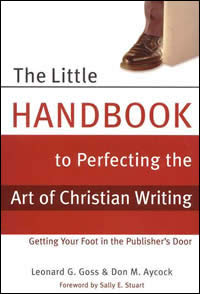
Book Review—The Little Handbook to Perfecting the Art of Christian Writing

by RoseyDow @

Goss, Leonard, and Don Aycock. The Little Handbook to Perfecting the Art of Christian Writing. Nashville, TN: B&H Publishing Group, 2006. 267 pp., $14.99/paperback

(Review copy courtesy of B&H Publishing)

perfecting2.jpgPurchase: B&H Publishing, CBD

Special Features: The back of the book features a sample style guide, which is an excerpt from The Little Style Guide to Great Christian Writing and Publishing, Leonard G. Goss and Carolyn Stanford Goss (Nashville, Tenn.: Broadman & Holman Publishers, 2004).

ISBNs: 0805432647 / 9780805432640

LCCN: BR44 .G66 2006

DCN: 808.0662 GOSS

Subject(s): Christian Literature, Authorship, Publishing

Leonard G. Goss is senior acquisitions editor at Broadman & Holman Publishers. He has led the editorial efforts at Crossway Books, Zondervan, and the Evangelical Book Club. Goss and his wife live in Franklin, Tennessee.

Don M. Aycock is a prolific author and seminar leader who speaks nationally on the topics of writing, prayer, men’s issues, and ministry. He also pastors Liberty Baptist Church in Palatka, Florida.

The Little Handbook reveals an insider’s view of the Christian publishing industry: how the market functions and how authors function within it. By revealing the step-by-step processes involved in publishing, Goss and Aycock seek to create a positive synergy between the publishing industry and the freelance author by increasing the author’s understanding of the publisher’s challenges, risks, and expectations.

Tuesday, February 27, 2007

The Dawkins Confusion: Naturalism ad absurdum.

by Alvin Plantinga @ http://www.christianitytoday.com

The God Delusion

The God Delusion
by Richard Dawkins
Houghton Mifflin
416 pp., $27
Richard Dawkins is not pleased with God:
The God of the Old Testament is arguably the most unpleasant character in all of fiction. Jealous and proud of it; a petty, unjust unforgiving control-freak; a vindictive, bloodthirsty ethnic-cleanser; a misogynistic homophobic racist, infanticidal, genocidal, filicidal, pestilential, megalomaniacal….

Well, no need to finish the quotation; you get the idea. Dawkins seems to have chosen God as his sworn enemy. (Let's hope for Dawkins' sake God doesn't return the compliment.)

The God Delusion is an extended diatribe against religion in general and belief in God in particular; Dawkins and Daniel Dennett (whose recent Breaking the Spell is his contribution to this genre) are the touchdown twins of current academic atheism.1 Dawkins has written his book, he says, partly to encourage timorous atheists to come out of the closet. He and Dennett both appear to think it requires considerable courage to attack religion these days; says Dennett, "I risk a fist to the face or worse. Yet I persist." Apparently atheism has its own heroes of the faith—at any rate its own self-styled heroes. Here it's not easy to take them seriously; religion-bashing in the current Western academy is about as dangerous as endorsing the party's candidate at a Republican rally.

Dawkins is perhaps the world's most popular science writer; he is also an extremely gifted science writer. (For example, his account of bats and their ways in his earlier book The Blind Watchmaker is a brilliant and fascinating tour de force.) The God Delusion, however, contains little science; it is mainly philosophy and theology (perhaps "atheology" would be a better term) and evolutionary psychology, along with a substantial dash of social commentary decrying religion and its allegedly baneful effects. As the above quotation suggests, one shouldn't look to this book for evenhanded and thoughtful commentary. In fact the proportion of insult, ridicule, mockery, spleen, and vitriol is astounding. (Could it be that his mother, while carrying him, was frightened by an Anglican clergyman on the rampage?) If Dawkins ever gets tired of his day job, a promising future awaits him as a writer of political attack ads.

Now despite the fact that this book is mainly philosophy, Dawkins is not a philosopher (he's a biologist). Even taking this into account, however, much of the philosophy he purveys is at best jejune. You might say that some of his forays into philosophy are at best sophomoric, but that would be unfair to sophomores; the fact is (grade inflation aside), many of his arguments would receive a failing grade in a sophomore philosophy class. This, combined with the arrogant, smarter-than-thou tone of the book, can be annoying. I shall put irritation aside, however and do my best to take Dawkins' main argument seriously.

Chapter 3, "Why There Almost Certainly is No God," is the heart of the book. Well, why does Dawkins think there almost certainly isn't any such person as God? It's because, he says, the existence of God is monumentally improbable. How improbable? The astronomer Fred Hoyle famously claimed that the probability of life arising on earth (by purely natural means, without special divine aid) is less than the probability that a flight-worthy Boeing 747 should be assembled by a hurricane roaring through a junkyard. Dawkins appears to think the probability of the existence of God is in that same neighborhood—so small as to be negligible for all practical (and most impractical) purposes. Why does he think so?

Here Dawkins doesn't appeal to the usual anti-theistic arguments—the argument from evil, for example, or the claim that it's impossible that there be a being with the attributes believers ascribe to God.2 So why does he think theism is enormously improbable? The answer: if there were such a person as God, he would have to be enormously complex, and the more complex something is, the less probable it is: "However statistically improbable the entity you seek to explain by invoking a designer, the designer himself has got to be at least as improbable. God is the Ultimate Boeing 747." The basic idea is that anything that knows and can do what God knows and can do would have to be incredibly complex. In particular, anything that can create or design something must be at least as complex as the thing it can design or create. Putting it another way, Dawkins says a designer must contain at least as much information as what it creates or designs, and information is inversely related to probability. Therefore, he thinks, God would have to be monumentally complex, hence astronomically improbable; thus it is almost certain that God does not exist.

But why does Dawkins think God is complex? And why does he think that the more complex something is, the less probable it is? Before looking more closely into his reasoning, I'd like to digress for a moment; this claim of improbability can help us understand something otherwise very perplexing about Dawkins' argument in his earlier and influential book, The Blind Watchmaker. There he argues that the scientific theory of evolution shows that our world has not been designed—by God or anyone else. This thought is trumpeted by the subtitle of the book: Why the Evidence of Evolution Reveals a Universe without Design.

How so? Suppose the evidence of evolution suggests that all living creatures have evolved from some elementary form of life: how does that show that the universe is without design? Well, if the universe has not been designed, then the process of evolution is unguided, unorchestrated, by any intelligent being; it is, as Dawkins suggests, blind. So his claim is that the evidence of evolution reveals that evolution is unplanned, unguided, unorchestrated by any intelligent being.

But how could the evidence of evolution reveal a thing like that? After all, couldn't it be that God has directed and overseen the process of evolution? What makes Dawkins think evolution is unguided? What he does in The Blind Watchmaker, fundamentally, is three things. First, he recounts in vivid and arresting detail some of the fascinating anatomical details of certain living creatures and their incredibly complex and ingenious ways of making a living; this is the sort of thing Dawkins does best. Second, he tries to refute arguments for the conclusion that blind, unguided evolution could not have produced certain of these wonders of the living world—the mammalian eye, for example, or the wing. Third, he makes suggestions as to how these and other organic systems could have developed by unguided evolution.

Suppose he's successful with these three things: how would that show that the universe is without design? How does the main argument go from there? His detailed arguments are all for the conclusion that it is biologically possible that these various organs and systems should have come to be by unguided Darwinian mechanisms (and some of what he says here is of considerable interest). What is truly remarkable, however, is the form of what seems to be the main argument. The premise he argues for is something like this:

1. We know of no irrefutable objections to its being biologically possible that all of life has come to be by way of unguided Darwinian processes;
and Dawkins supports that premise by trying to refute objections to its being biologically possible that life has come to be that way. His conclusion, however, is
2. All of life has come to be by way of unguided Darwinian processes.

It's worth meditating, if only for a moment, on the striking distance, here, between premise and conclusion. The premise tells us, substantially, that there are no irrefutable objections to its being possible that unguided evolution has produced all of the wonders of the living world; the conclusion is that it is true that unguided evolution has indeed produced all of those wonders. The argument form seems to be something like

We know of no irrefutable objections to its being possible that p;
Therefore
p is true.

Philosophers sometimes propound invalid arguments (I've propounded a few myself); few of those arguments display the truly colossal distance between premise and conclusion sported by this one. I come into the departmental office and announce to the chairman that the dean has just authorized a $50,000 raise for me; naturally he wants to know why I think so. I tell him that we know of no irrefutable objections to its being possible that the dean has done that. My guess is he'd gently suggest that it is high time for me to retire.

Here is where that alleged massive improbability of theism is relevant. If theism is false, then (apart from certain weird suggestions we can safely ignore) evolution is unguided. But it is extremely likely, Dawkins thinks, that theism is false. Hence it is extremely likely that evolution is unguided—in which case to establish it as true, he seems to think, all that is needed is to refute those claims that it is impossible. So perhaps we can think about his Blind Watchmaker argument as follows: he is really employing as an additional if unexpressed premise his idea that the existence of God is enormously unlikely. If so, then the argument doesn't seem quite so magnificently invalid. (It is still invalid, however, even if not quite so magnificently—you can't establish something as a fact by showing that objections to its possibility fail, and adding that it is very probable.)

Now suppose we return to Dawkins' argument for the claim that theism is monumentally improbable. As you recall, the reason Dawkins gives is that God would have to be enormously complex, and hence enormously improbable ("God, or any intelligent, decision-making calculating agent, is complex, which is another way of saying improbable"). What can be said for this argument?

Not much. First, is God complex? According to much classical theology (Thomas Aquinas, for example) God is simple, and simple in a very strong sense, so that in him there is no distinction of thing and property, actuality and potentiality, essence and existence, and the like. Some of the discussions of divine simplicity get pretty complicated, not to say arcane.3 (It isn't only Catholic theology that declares God simple; according to the Belgic Confession, a splendid expression of Reformed Christianity, God is "a single and simple spiritual being.") So first, according to classical theology, God is simple, not complex.4 More remarkable, perhaps, is that according to Dawkins' own definition of complexity, God is not complex. According to his definition (set out in The Blind Watchmaker), something is complex if it has parts that are "arranged in a way that is unlikely to have arisen by chance alone." But of course God is a spirit, not a material object at all, and hence has no parts.5 A fortiori (as philosophers like to say) God doesn't have parts arranged in ways unlikely to have arisen by chance. Therefore, given the definition of complexity Dawkins himself proposes, God is not complex.

So first, it is far from obvious that God is complex. But second, suppose we concede, at least for purposes of argument, that God is complex. Perhaps we think the more a being knows, the more complex it is; God, being omniscient, would then be highly complex. Perhaps so; still, why does Dawkins think it follows that God would be improbable? Given materialism and the idea that the ultimate objects in our universe are the elementary particles of physics, perhaps a being that knew a great deal would be improbable—how could those particles get arranged in such a way as to constitute a being with all that knowledge? Of course we aren't given materialism. Dawkins is arguing that theism is improbable; it would be dialectically deficient in excelsis to argue this by appealing to materialism as a premise. Of course it is unlikely that there is such a person as God if materialism is true; in fact materialism logically entails that there is no such person as God; but it would be obviously question-begging to argue that theism is improbable because materialism is true.

So why think God must be improbable? According to classical theism, God is a necessary being; it is not so much as possible that there should be no such person as God; he exists in all possible worlds. But if God is a necessary being, if he exists in all possible worlds, then the probability that he exists, of course, is 1, and the probability that he does not exist is 0. Far from its being improbable that he exists, his existence is maximally probable. So if Dawkins proposes that God's existence is improbable, he owes us an argument for the conclusion that there is no necessary being with the attributes of God—an argument that doesn't just start from the premise that materialism is true. Neither he nor anyone else has provided even a decent argument along these lines; Dawkins doesn't even seem to be aware that he needs an argument of that sort.

A second example of Dawkinsian-style argument. Recently a number of thinkers have proposed a new version of the argument from design, the so-called "Fine-Tuning Argument." Starting in the late Sixties and early Seventies, astrophysicists and others noted that several of the basic physical constants must fall within very narrow limits if there is to be the development of intelligent life—at any rate in a way anything like the way in which we think it actually happened. For example, if the force of gravity were even slightly stronger, all stars would be blue giants; if even slightly weaker, all would be red dwarfs; in neither case could life have developed. The same goes for the weak and strong nuclear forces; if either had been even slightly different, life, at any rate life of the sort we have, could probably not have developed. Equally interesting in this connection is the so-called flatness problem: the existence of life also seems to depend very delicately upon the rate at which the universe is expanding. Thus Stephen Hawking:

reduction of the rate of expansion by one part in 1012 at the time when the temperature of the Universe was 1010 K would have resulted in the Universe's starting to recollapse when its radius was only 1/3000 of the present value and the temperature was still 10,000 K.6

That would be much too warm for comfort. Hawking concludes that life is possible only because the universe is expanding at just the rate required to avoid recollapse. At an earlier time, he observes, the fine-tuning had to be even more remarkable:

we know that there has to have been a very close balance between the competing effect of explosive expansion and gravitational contraction which, at the very earliest epoch about which we can even pretend to speak (called the Planck time, 10-43 sec. after the big bang), would have corresponded to the incredible degree of accuracy represented by a deviation in their ratio from unity by only one part in 10 to the sixtieth.7

One reaction to these apparent enormous coincidences is to see them as substantiating the theistic claim that the universe has been created by a personal God and as offering the material for a properly restrained theistic argument—hence the fine-tuning argument.8 It's as if there are a large number of dials that have to be tuned to within extremely narrow limits for life to be possible in our universe. It is extremely unlikely that this should happen by chance, but much more likely that this should happen if there is such a person as God.

Now in response to this kind of theistic argument, Dawkins, along with others, proposes that possibly there are very many (perhaps even infinitely many) universes, with very many different distributions of values over the physical constants. Given that there are so many, it is likely that some of them would display values that are life-friendly. So if there are an enormous number of universes displaying different sets of values of the fundamental constants, it's not at all improbable that some of them should be "fine-tuned." We might wonder how likely it is that there are all these other universes, and whether there is any real reason (apart from wanting to blunt the fine-tuning arguments) for supposing there are any such things.9 But concede for the moment that indeed there are many universes and that it is likely that some are fine-tuned and life-friendly. That still leaves Dawkins with the following problem: even if it's likely that some universes should be fine-tuned, it is still improbable that this universe should be fine-tuned. Name our universe alpha: the odds that alpha should be fine-tuned are exceedingly, astronomically low, even if it's likely that some universe or other is fine-tuned.

What is Dawkins' reply? He appeals to "the anthropic principle," the thought that the only sort of universe in which we could be discussing this question is one which is fine-tuned for life:

the anthropic answer, in its most general form, is that we could only be discussing the question in the kind of universe that was capable of producing us. Our existence therefore determines that the fundamental constants of physics had to be in their respective Goldilocks [life-friendly] zones.

Well, of course our universe would have to be fine-tuned, given that we live in it. But how does that so much as begin to explain why it is that alpha is fine-tuned? One can't explain this by pointing out that we are indeed here—anymore than I can "explain" the fact that God decided to create me (instead of passing me over in favor of someone else) by pointing out that if God had not thus decided, I wouldn't be here to raise that question. It still seems striking that these constants should have just the values they do have; it is still monumentally improbable, given chance, that they should have just those values; and it is still much less improbable that they should have those values, if there is a God who wanted a life-friendly universe.

One more example of Dawkinsian thought. In The Blind Watchmaker, he considers the claim that since the self-replicating machinery of life is required for natural selection to work, God must have jumpstarted the whole evolutionary process by specially creating life in the first place—by specially creating the original replicating machinery of DNA and protein that makes natural selection possible. Dawkins retorts as follows:

This is a transparently feeble argument, indeed it is obviously self-defeating. Organized complexity is the thing that we are having difficulty in explaining. Once we are allowed simply to postulate organized complexity, if only the organized complexity of the DNA/protein replicating machine, it is relatively easy to invoke it as a generator of yet more organized complexity… . But of course any God capable of intelligently designing something as complex as the DNA/protein machine must have been at least as complex and organized as that machine itself… . To explain the origin of the DNA/protein machine by invoking a supernatural Designer is to explain precisely nothing, for it leaves unexplained the origin of the Designer.

In Darwin's Dangerous Idea, Daniel Dennett approvingly quotes this passage from Dawkins and declares it an "unrebuttable refutation, as devastating today as when Philo used it to trounce Cleanthes in Hume's Dialogues two centuries earlier." Now here in The God Delusion Dawkins approvingly quotes Dennett approvingly quoting Dawkins, and adds that Dennett (i.e., Dawkins) is entirely correct.

Here there is much to say, but I'll say only a bit of it. First, suppose we land on an alien planet orbiting a distant star and discover machine-like objects that look and work just like tractors; our leader says "there must be intelligent beings on this planet who built those tractors." A first-year philosophy student on our expedition objects: "Hey, hold on a minute! You have explained nothing at all! Any intelligent life that designed those tractors would have to be at least as complex as they are." No doubt we'd tell him that a little learning is a dangerous thing and advise him to take the next rocket ship home and enroll in another philosophy course or two. For of course it is perfectly sensible, in that context, to explain the existence of those tractors in terms of intelligent life, even though (as we can concede for the moment) that intelligent life would have to be at least as complex as the tractors. The point is we aren't trying to give an ultimate explanation of organized complexity, and we aren't trying to explain organized complexity in general; we are only trying to explain one particular manifestation of it (those tractors). And (unless you are trying to give an ultimate explanation of organized complexity) it is perfectly proper to explain one manifestation of organized complexity in terms of another. Similarly, in invoking God as the original creator of life, we aren't trying to explain organized complexity in general, but only a particular kind of it, i.e., terrestrial life. So even if (contrary to fact, as I see it) God himself displays organized complexity, we would be perfectly sensible in explaining the existence of terrestrial life in terms of divine activity.

A second point: Dawkins (and again Dennett echoes him) argues that "the main thing we want to explain" is "organized complexity." He goes on to say that "The one thing that makes evolution such a neat theory is that it explains how organized complexity can arise out of primeval simplicity," and he faults theism for being unable to explain organized complexity. Now mind would be an outstanding example of organized complexity, according to Dawkins, and of course (unlike with organized complexity) it is uncontroversial that God is a being who thinks and knows; so suppose we take Dawkins to be complaining that theism doesn't offer an explanation of mind. It is obvious that theists won't be able to give an ultimate explanation of mind, because, naturally enough, there isn't any explanation of the existence of God. Still, how is that a point against theism? Explanations come to an end; for theism they come to an end in God. Of course the same goes for any other view; on any view explanations come to an end. The materialist or physicalist, for example, doesn't have an explanation for the existence of elementary particles: they just are. So to claim that what we want or what we need is an ultimate explanation of mind is, once more, just to beg the question against theism; the theist neither wants nor needs an ultimate explanation of personhood, or thinking, or mind.

Toward the end of the book, Dawkins endorses a certain limited skepticism. Since we have been cobbled together by (unguided) evolution, it is unlikely, he thinks, that our view of the world is overall accurate; natural selection is interested in adaptive behavior, not in true belief. But Dawkins fails to plumb the real depths of the skeptical implications of the view that we have come to be by way of unguided evolution. We can see this as follows. Like most naturalists, Dawkins is a materialist about human beings: human persons are material objects; they are not immaterial selves or souls or substances joined to a body, and they don't contain any immaterial substance as a part. From this point of view, our beliefs would be dependent on neurophysiology, and (no doubt) a belief would just be a neurological structure of some complex kind. Now the neurophysiology on which our beliefs depend will doubtless be adaptive; but why think for a moment that the beliefs dependent on or caused by that neurophysiology will be mostly true? Why think our cognitive faculties are reliable?

From a theistic point of view, we'd expect that our cognitive faculties would be (for the most part, and given certain qualifications and caveats) reliable. God has created us in his image, and an important part of our image bearing is our resembling him in being able to form true beliefs and achieve knowledge. But from a naturalist point of view the thought that our cognitive faculties are reliable (produce a preponderance of true beliefs) would be at best a naïve hope. The naturalist can be reasonably sure that the neurophysiology underlying belief formation is adaptive, but nothing follows about the truth of the beliefs depending on that neurophysiology. In fact he'd have to hold that it is unlikely, given unguided evolution, that our cognitive faculties are reliable. It's as likely, given unguided evolution, that we live in a sort of dream world as that we actually know something about ourselves and our world.

If this is so, the naturalist has a defeater for the natural assumption that his cognitive faculties are reliable—a reason for rejecting that belief, for no longer holding it. (Example of a defeater: suppose someone once told me that you were born in Michigan and I believed her; but now I ask you, and you tell me you were born in Brazil. That gives me a defeater for my belief that you were born in Michigan.) And if he has a defeater for that belief, he also has a defeater for any belief that is a product of his cognitive faculties. But of course that would be all of his beliefs—including naturalism itself. So the naturalist has a defeater for naturalism; natural- ism, therefore, is self-defeating and cannot be rationally believed.

The real problem here, obviously, is Dawkins' naturalism, his belief that there is no such person as God or anyone like God. That is because naturalism implies that evolution is unguided. So a broader conclusion is that one can't rationally accept both naturalism and evolution; naturalism, therefore, is in conflict with a premier doctrine of contemporary science. People like Dawkins hold that there is a conflict between science and religion because they think there is a conflict between evolution and theism; the truth of the matter, however, is that the conflict is between science and naturalism, not between science and belief in God.

The God Delusion is full of bluster and bombast, but it really doesn't give even the slightest reason for thinking belief in God mistaken, let alone a "delusion."

The naturalism that Dawkins embraces, furthermore, in addition to its intrinsic unloveliness and its dispiriting conclusions about human beings and their place in the universe, is in deep self-referential trouble. There is no reason to believe it; and there is excellent reason to reject it.

Alvin Plantinga is John A. O'Brien Professor of Philosophy at the University of Notre Dame.

1. A third book along these lines, The End of Faith, has recently been written by Sam Harris, and more recently still a sequel, Letter to a Christian Nation, so perhaps we should speak of the touchdown triplets—or, given that Harris is very much the junior partner in this enterprise (he's a grad student) maybe the "Three Bears of Atheism"?

2. Although Dawkins does bring up (p. 54), apparently approvingly, the argument that God can't be both omniscient and omnipotent: if he is omniscient, then he can't change his mind, in which case there is something he can't do, so that he isn't omnipotent(!).

3. See my Does God Have a Nature? Aquinas Lecture 44 (Marquette Univ. Press, 1980).

4. The distinguished Oxford philosopher (Dawkins calls him a theologian) Richard Swinburne has proposed some sophisticated arguments for the claim that God is simple. Dawkins mentions Swinburne's argument, but doesn't deign to come to grips with it; instead he resorts to ridicule (pp. 110-111).

5. What about the Trinity? Just how we are to think of the Trinity is of course not wholly clear; it is clear, however, that it is false that in addition to each of the three persons of the Trinity, there is also another being of which each of those persons is a part.

6. "The Anisotropy of the Universe at Large Times," in M. S. Longair, ed., Confrontation of Cosmological Theories with Observational Data (Springer, 2002), p. 285.

7. John Polkinghorne, Science and Creation: The Search for Understanding (Random House, 1989), p. 22.

8. One of the best versions of the fine-tuning argument is proposed by Robin Collins in "A Scientific Argument for the Existence of God: The Fine-Tuning Design Argument," in Michael J. Murray, ed., Reason for the Hope Within (Eerdmans, 1999), pp. 47-75.

9. See my review of Daniel Dennett's Darwin's Dangerous Idea in Books & Culture, May/June 1996.

by the author or Christianity Today International/Books & Culture magazine.

Click here for reprint information on Books & Culture.

March/April 2007, Vol. 13, No. 2, Page 21

Saturday, February 24, 2007

Review of "The New Faces of Christianity"

As I mentioned last weekend, I have been reading Philip Jenkins' book, The New Faces of Christianity (Oxford University Press, 2006). It is a sequel of sorts to his earlier work, The Next Christendom as Jenkins expands on his earlier observations the growing, vibrant church of the South. He demonstrates further how the Church in the South (i.e. non-Western) is typically more conservative theologically, committed to the absolute authority of the Bible, open to supernatural manifestations, and persecuted. They also make up the majority of Christians in the world today!

None of this was particularly to me, as one who has traveled extensively on behalf of VOMC and with another mission prior to that. I also recognize from my discussions with church leaders around the world that they are troubled by developments in the Northern church, especially in regardless to sexuality (and homosexuality in particular), the role of women in the church, the authority of scripture, and a number of other issues. The fact is, the church in the South (Asia, Africa, and South America) are not creating a new Christendom (as Jenkins prior book labeled them); they are the defenders of the old one! It is we in the West who are abandoning the foundations of the faith. Frankly, I am greatly encouraged by the Church in the South, although we must not idolize it or think that it is without its problems. Those of us who minister there (and national church leader themselves) recognize this.

The most significant lesson I learned from The New Faces of Christianity, however, was the observation that Christians in the South (and in Africa particularly) identify powerfully with the world of the Bible; an agriculturally-based rural society marked by famine, poverty, plague and exile. As such, it is helpful to listen to their understanding of Biblical passages, as it often throughs light on what is probably the original intent of the passage (cf. my blog of February 17, Sowing With Tears for an example).

Overall, I found the book a worthwhile read, although I wish that he had made more references to the church in South America and Asia. The book draws heavily from African sources. This is fine but the rapid growth of the Church in South America would beg for further examination and comparison. Asia is dealt with better than South America but still not as thoroughly as Africa. As such, those wanting to serve the Lord in Africa would find this book especially helpful, whereas those ministering in South America would likely be disappointed.

Tuesday, February 06, 2007

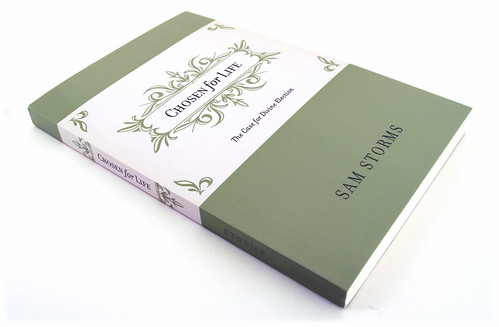
Book review > Chosen for Life by Sam Storms

Review from Tony S. Reinke @ http://spurgeon.wordpress.com

One of the best defenses of the sovereign election of God in salvation comes from the pen of Sam Storms in his classic book, Chosen for Life: The Case for Divine Election. Crossway just released the revised and expanded version, 20 years after it was first published by Baker.

Chosen for Life is a humble and deeply biblical look at the controversial subject of God’s sovereign election of sinners. Storms excels at incorporating illustrations that make the concepts easy to comprehend for those who are new to the discussion.

While there are many books on the doctrine of election (to my knowledge) none emphasize God’s unmerited delight in His chosen! That’s right, God delights in the elect. Building off Ephesians 1:11-18, Storms writes,

“God didn’t predestine us unwillingly, grudgingly, or reluctantly. He wanted to do it. He delighted to do it. God has an emotional life. There is immense and unfathomable complexity in his feelings: He delights in some things, and despises others. He loves and hates. He rejoices and judges. Choosing hell-deserving sinners to spend an eternity with him as his beloved children is uniquely joyful and pleasing and delightful and exciting and satisfying to the heart of God! … God not only delights in the act of election, he also delights in the objects of election: us! … God wants us to fully understand and grasp and experience what we are to him! But note well: the glory and honor of being elect is not why we are elect. Rather, there is glory and honor because we are elect. Election bestows glory and honor, but is not based upon it” (p. 188, 191-192).

What Humble Calvinists we would become if we truly grasped this concept. God rejoices over us and exults over us with loud singing (Zeph. 3:17)! He delights in His elect. If you were elected by God, His heart rejoices, delights, excites and is satisfied over you. But we are totally depraved sinners deserving only of God’s wrath?!? Yes, but God delights. Never does God delight in us because we are delightful. He delights in us because He has freely chosen us. We are the depraved prodigal son, God is our father who lavishes unmerited righteousness, joy and delight over us (Luke 15:11-32).

Few truths will better encourage us, help us to battle the sin of condemnation in our hearts, focus our corporate worship upon God’s grace or truly bring humility to our hearts. God sings over me. Amazing truth!

If you are opposed to Calvinism or if you’ve been a Calvinist for 50 years, this book will be a great challenge and encouragement. Your mind will be challenged and your heart will be stirred. Chosen for Life is a wonderful book about our glorious and sovereign God!

Title: Chosen for Life: The Case for Divine Election
Author: Sam Storms
Boards: paperback
Pages: 237
Volumes: 1
Dust jacket: no
Binding: glue
Paper: normal
Topical index: yes
Scriptural index: yes
Text: perfect type
Publisher: Crossway
Year: 2007 (expanded from 1987 Baker ed.)
Price USD: $17.99 / $12.99 at CBD
ISBNs: 1581348436, 9781581348439

Wednesday, January 31, 2007

Book Review - The Art of Worship

Reviewed by Bob Kauflin @ http://worshipmatters.blogs.com

Art_of_worship Last week I had the privilege of speaking and leading worship at the Calvin Worship Symposium in Grand Rapids, Michigan. Why I chose to go to Michigan in January is a question I still haven't answered.

On Thursday, I taught an all-day seminar called Musical Arranging for God's Glory. I shared thoughts not only on ways we can arrange music, but suggested three biblical reasons behind the choices we make: to serve the word of Christ, to serve the context, and to serve the congregation. Hosting me that day was a gentleman named Greg Scheer, whose book, The Art of Worship: A Musician's Guide to Leading Modern Worship has recently been published by Baker. I had started reading Greg's book a few weeks earlier, and was delighted I was going to meet him. I wanted to personally thank him for writing what I think is one of the best practical guides for those who lead congregational worship with a band. Here's my review.

Greg states in the Introduction that he doesn't want to convince traditional musicians to defect into the contemporary camp. He's not out to "convert" but to serve. He wants to "enable church musicians of all kinds to better understand one of the dominant musical languages of modern worship, to be thoroughly equipped to lead that style, and to foster communication among the musicians of the church of Jesus Christ" (p. 12). He has done just that, and done it extremely well.

Greg never wastes the reader's time. Every paragraph is purposeful, helpful, and based on years of experience. He also recommends numerous resources throughout. The first chapter addresses reasons why a church might decide to use a more contemporary music style and how to go about it. It's filled with pastoral wisdom. Chapter 2, "Assembling the Team," contains the most comprehensive and helpful material I've seen on conducting music auditions, or interviews. The third chapter, "Building Repertoire," provides many helpful categories for evaluating songs, and also highlights the different strengths of hymns and contemporary worship songs.

In Chapter 4, "Planning Worship," he shares principles that can be applied in liturgical, thematic, or free-flowing worship settings. Again, he offers many practical, concise ways to think about a service. His section on modulations will help anyone who has wondered how to change keys skillfully. Chapter 5, "Making Music," is the longest chapter, and rightly so. He takes time to spell out the purpose and usefulness of every instrument in the modern worship band, starting with the vocals, and moving on to the rhythm section and various solo and orchestral instruments. He makes it clear that the instruments should support the sound of the congregation, but encourages using them to the fullest for that purpose. Any church music team that suffers from muddiness, overplaying, or poor arranging would benefit from careful study and application of this chapter. He also shares specific thoughts with sound engineers on how to make individual instruments sound best in a band context.

Chapter 6, "Timeless Hymns in a Contemporary Context," briefly addresses the how and why of updating hymns. While communicating a deep respect for two thousand years of hymnody, Greg also realizes that, "if we care about the great hymns of our faith, we need to find ways of building bridges between old hymns and new worship contexts" (p. 182). He encourages a thorough knowledge of a hymn's lyric, melody, harmony, and purpose before changing it, and offers practical ideas on how to do so.

The book finishes out with two chapters on "Rehearsing and Leading" and "Looking to the Future." Both are filled with specific, clear, practical counsel. In addition to Spirit-led planning, he also encourages an ongoing dependence on God's Spirit during the meeting. "This may mean repeating a song more times than you had anticipated, changing your funky arrangement of a song into a slow ballad, or even choosing a different song on the spot" (p. 210). Wise counsel. I found his thoughts on rehearsals very thorough, but wished his section on song leading was filled out and more theologically driven.

I had just a few quibbles with the book. Greg states that "in a very real way, music mediates the worshiper's experience of God in the Praise & Worship context" (p. 212). I'm uncomfortable referring to anything other than Jesus as a mediator between us and God, and it seems what we often think is an experience of God is actually an experience of music. I would also have appreciated a greater emphasis on theological foundations, the Gospel, and heart issues. But then it would have been a much longer book.

In any case, I highly recommend The Art of Worship for any pastor or corporate worship leader who currently uses or is thinking of using contemporary music in their service. This book should be around for a long time.

Saturday, January 20, 2007

The Secret Key to Heaven. The Vital Importance of Private Prayer

Review from Paul E Brown @ http://www.banneroftruth.org/pages/articles/article_detail.php?1201

We can scarcely have too many books on prayer, though sadly it is often easier to read books about prayer than to get down and pray. We all need stirring up to pray and this book helps to do that. As the title with its subtitle indicates, it is primarily about private or personal prayer, but although this is its focus there is much that is applicable to prayer in general. Brooks is noted for his pithy, memorable sentences and I found one phrase particularly striking. Writing towards the end of the book of Satan’s opposition to secret prayer, and giving reasons for this, he says, ‘partly because secret prayer is so musical and delightful to God’. Whoever would have thought of using the word ‘musical’? This Puritan certainly must have loved music to write in that way, and what a picture it conjures up. Secret prayer is like a lovely song or tune that entrances the ear of God; what an incentive to pray!

The book is divided into six parts, of very unequal length. Part one, five pages - ‘The Doctrine of the Text Stated and Proved’ - is based on our Lord’s words in Matthew 6:6. The second part, seventy pages, gives ‘Twenty Arguments for Private Prayer’. The fourth argument is ‘Secret prayer lets us unburden ourselves before God’. ‘In secret, a Christian may descend into such particulars, as in public or before others, he will not, he may not, he ought not, to mention’. The tenth argument is headed ‘Secret prayers and secret sins’ but extends beyond that: ‘And as they have their secret needs, so they have their secret fears… snares… trials… troubles… doubts… jealousies etc. … these things call aloud upon every Christian to be frequent and constant in secret prayer.’ The fourteenth argument is that ‘God is omnipresent’. ‘We cannot sigh out a prayer in secret, but he sees us, we cannot lift up our eyes to him at midnight, but he observes us’. Argument sixteen is particularly relevant, ‘The times call for private prayer’. ‘Oh, weep in secret for their sins who openly glory in their sins, which should be their greatest shame. Oh, blush in secret for them that are past all blushing for their sins; for who knows but that the whole land may fare better for the sakes of a few who are mourners in secret?’

Seven pages are devoted to Part Three ‘The Use and Application of the Doctrine’ followed by Part Four, ‘Six Objections Stated and Answered’, consisting of nearly one hundred pages. The third objection deals with those who feel inadequate and lacking in ability to pray in private when compared with others. This is answered sensitively and thoroughly. ‘There may be the Spirit of adoption in sighs and groans, as well as in vocal prayer… One sigh and groan from a broken heart, is better pleasing to God, than all human eloquence.’ Luther is quoted as saying, ‘Lord, you command me to pray. I cannot pray as I would, yet I will obey; for though my prayer be not acceptable, yet your own commandment is acceptable to you’. The sixth objection deals with the ‘multitude of infirmities, weaknesses, and vanities [that] face us, and rise up against us’. ‘Well, Christians! remember this once for all, if your indisposition to closet prayer really arises from bodily illnesses, then you may be confident that the Lord will pity you much, and bear with you much, and kindly accept of a little.’

The fifth part, ‘Eleven Instructions concerning Private Prayer’ is sixty pages long. The second instruction says, ‘Take the fittest seasons and opportunities that you possibly can for closet prayers.’ The fourth is, ‘Take heed of resting on closet duties, take heed of trusting in closet duties.’ ‘It is my duty to perform closet duties, but it is my sin to rely upon them… It was the saying of a precious saint, that “he was more afraid of his duties than of his sins; for the one made him often proud, but the other made him always humble.”’ The fifth instruction is to work hard to put your heart into all your prayers: ‘God looks not at the elegancy of your prayers, to see how neat they are; nor yet at the geometry of your prayers, to see how long they are; nor yet at the arithmetic of your prayers, to see how many they are; nor yet at the music of your prayers, nor yet at the sweetness of your voice, nor yet at the logic of your prayers, but at the sincerity of your prayers, how hearty they are.’ The sixth instruction is to be fervent and warm in prayer: ‘Fervency feathers the wings of prayer, and makes them fly the swifter to heaven’. The eighth instruction is to thirst and long after communion with God in prayer: ‘Oh, let closet prayer be a golden bridge, a ferry-boat, a chariot to convey your souls over to God, and to bring you into a more intimate communion with God’. But he also adds this: ‘Well, friends, remember this once for all, viz., that a Christian may have as real communion with God in a heart-humbling way, as he can have in a heart-comforting way’. The final part (forty-six pages) consists of ‘Means, Rules, and Directions for Faithful Private Prayer’.

This is a book of nearly three hundred pages, and it is not altogether an easy read, especially for those who are not acquainted with Puritan literature. Directions for servants have to be transposed into a modern setting, and allowance has to be made for some of the language. I found frequent reference to praying ‘in a corner’ or ‘in a hole’ rather strange; ‘closet duties’ is not a felicitous phrase and it is a pity readers are always addressed as ‘Sirs’. At times Brooks seems to over-value private prayer to the detriment of public prayer, but then he corrects himself: ‘The wisdom of a Christian most eminently sparkles and shines, in giving every duty its proper time and place’. But who can doubt the importance of the subject? – and you do not have to try to read the book all at once, little by little is often better in any case. Most important of all it constantly encourages, warns and directs us to heartfelt, personal prayer to God.

The Secret Key to Heaven - The Vital Importance of Private Prayer
Thomas Brooks
Banner of Truth Trust, 2006
288pp, in the Puritan Paperbacks series, £6.25, $10.00
ISBN 0 85151 924 1

History of the English Calvinistic Baptists

Review from Austin Walker @ http://www.banneroftruth.org/pages/articles/article_detail.php?1199

Robert Oliver has served up a treat for his readers. Developed with additional chapters from his PhD. thesis, the book is very readable, containing fifteen concise chapters, which are both stimulating and fascinating. The author has divided his material into three parts: ‘The Eighteenth-Century Heritage,’ ‘When Good Men Differ,’ and ‘Re-Alignment.’

It is not a comprehensive history of Calvinistic Baptists. Rather, he deals skilfully with the theological and doctrinal issues which led to the emergence of Strict and Particular Baptist churches in the eighteenth and nineteenth centuries. In the process he gives us valuable insights into the character and spiritual vigour of the men involved in these matters.

The reader is introduced to such key issues as Antinomianism, the atonement, Hyper-Calvinism and the ‘free offer,’ the communion controversy (over a closed or open table), and the eternal Sonship dispute. Names such as John Gill, Andrew Fuller, Abraham Booth, William Huntingdon, William Gadsby, John Stevens, J. C. Philpot and C. H. Spurgeon are prominent. However, considerable attention is also devoted to less well-known men such as Benjamin Beddome, John Collett Ryland, Robert Hall Sr. and Jr., Joseph Kinghorn and James Wells.

One of the great strengths of this book is the discernment it displays. Robert Oliver makes no attempt to hide his sympathy for the orthodox theology expressed in The Second London Baptist Confession of Faith (‘the 1689’). He assesses theological changes and doctrinal developments in the light of the theology of the Confession and shows how vital that Confession has been for the spiritual well-being of English Calvinistic Baptists. The last chapter emphasises Spurgeon’s commitment to historic Calvinism as expressed in ‘the 1689.’

We are indebted to Robert Oliver for this book. He has researched thoroughly, read widely and deeply, and assessed the issues biblically. There are extensive footnotes and a bibliography together with three indices of places, names and subjects. This book should be a source of enjoyment, understanding and wisdom not only for Baptists but for all who have any interest in the spirituality of the men and churches of the late eighteenth and nineteenth centuries.

History of the English Calvinistic Baptists 1771-1892: From John Gill to C. H. Spurgeon
Robert W. Oliver
Banner of Truth Trust, 2006
410pp, hbk, £16.50, $27.00
ISBN 0 85151 920 2

Tuesday, November 28, 2006

Decision Making and the Will of God.

Decision Making and the Will of God.
By Garry Friesen
A Review By Greg Gilbert
Friesen, Garry. Decision Making and the Will of God. (Multnomah, 1980).

Garry Friesen’s Decision Making and the Will of God is the most exhaustive treatment of the subject of divine guidance that I have read. It runs for more than 400 pages and deals extensively with every conceivable angle of the matter at hand. The book opens with a masterful summary of what Friesen calls the “traditional view,” presented as a seminar by a typical pastor. The traditional view of God’s guidance is essentially that God has a specific ideal blueprint for every person’s life which that person may either discern and follow or deviate from and therefore miss God’s ideal plan for his life. If that happens, of course, God has another plan waiting in the wings, but it will not be his “first-choice” and therefore not as fruitful or as fulfilling. So how does one discern this ideal plan? God, of course, wants us to know that plan, but the normal way of finding it is through reading a combination of signs, both internal and external. Friesen lists those signs as the Bible, an inner witness, personal desires, circumstances, mature counsel, and common sense. When a decision needs to be made, the Christian is to look at all of those “road signs” and determine from them what is God’s unique, ideal will for that person in that particular situation.

Following this clear and fair summary of the “traditional view,” Friesen begins an exhaustive, 350 page critique. He examines every passage of Scripture that is used to support it, including those that may seem to endorse decision-making by “putting out fleeces,” “an inner peace,” or instances where people seem to have missed God’s ideal, individual will for their lives and forced Him to move on to Plan B. The exegesis on these passages is mostly very good, and the one or two places where I might have disagreed with him in certain areas are not at all important to the overarching matter. Friesen makes the case very well. His reasoning, also, is very good. Friesen points out and develops several different problems with the traditional view, including the fact that no one holds to that view in the mundane decisions of life. No one checks out all six of those “road signs” when deciding which shirt to put on in the morning. If he did, his day would probably be pretty frustrating.

In place of the traditional view, Friesen proposes what he calls “the way of wisdom.” His view is that the Scripture is fully sufficient to lead us in any decision that needs to be made during the day. He says:
The traditional view holds that the Bible (God’s moral will) gives most of the guidance needed to make a decision; but additionally, knowing God’s individual will is essential for complete leading to the correct choice. The alternative view put forth in this book is that the Bible is fully sufficient to provide all the guidance needed for a believer to know and do God’s will. (82)

What he means is that while the Bible contains some very clear moral commands for us, it may not tell us which college we are to attend, or much less which car to buy. However, even in those kinds of non-moral decisions, the Bible will give us principles of wisdom by which we can make those decisions. One of the most important things that Friesen says is that there are certain decisions in which neither alternative will violate the teaching of the Bible. In those cases the decision is ours, and we shouldn’t fret about whether we will someday be judged for failing to wear the Nikes instead of the Reeboks. Of course, God has already sovereignly determined which tennis shoes we will wear that day, but we shouldn’t waste half the day waiting for a swoosh to appear in the clouds. So long as there is no biblical principle being violated, just put on some shoes and get busy.

One obvious question that arises from all this is whether or not this is really guidance. If God leaves us morally free in so many areas to make decisions, then is he really guiding us? Isn’t this some kind of deistic God we have here? Friesen answers “no,” and his reasons are summarized in a very helpful chart on page 230. His reasons are summarized in these four statements:

1. In moral conduct, God directly guides believers by revealed commands and principles according to His moral will (the Bible.)
2. In nonmoral decisions, God mediately guides believers by acquired wisdom according to spiritual expediency.
3. In all things God secretly guides believers by sovereign control over all events according to His sovereign will.
4. In unique cases God has supernaturally guided believers by divine voice, angel, dream, or miracle according to special revelation.

I’m not sure I would limit the term “special revelation” to angels and dreams and miracles; the Bible in #1 is certainly special revelation. But enough pickiness. It’s a good chart, and I think Friesen is right in pointing out those four ways that God guides his people.

That does bring up just a couple of things that you might be careful of while reading the book. First of all, Friesen is at first a little confusing when it comes to God’s sovereign will. He finally writes a strong chapter on the sovereign will of God—“the sinner may shake his fist at the heavens, but God will determine how many times he shakes it,” (202)—but that doesn’t happen until Chapter Twelve, 200 pages into the book. Until then, I found myself confused in several places where Friesen seemed to deny that God had a specific sovereign will for every event in our lives. He seemed to say in places that there was just a general moral will, but that within that boundary, the future was unset. The problem is that Friesen needs a more careful capsule definition of the “individual will” of God that he is debunking. His definition of that “individual will” is “a detailed life-plan for each person,” (151). So he ends up writing sentences fairly often that say something like, “It is our contention that the idea of an individual will of God for every detail of a person’s life is not found in Scripture,” (82). You can see the confusion. If he is talking about a plan which is hidden, that we must find, and that can be missed if we don’t work hard enough, then he is absolutely right. But if he is talking about the sovereign will of God over every hair on our heads and every sparrow that falls from the sky, he’s wrong. A clearer definition of that “individual will” could clear that up. I would suggest something like, “an ideal, best-case blueprint that the believer may actually miss if he doesn’t correctly discern it.” That’s a mouthful, but it would be worth minimizing any confusion. As you read the book, keep this problem in mind, know that he will resolve it clearly in chapter 12, and you’ll navigate the argument with no problem at all.

You might want to simply skip the section titled “If a Horse and Chariot Were Good Enough for David . . .” on pages 169-170. The section is a somewhat confused critique of the regulative principle that is not really well thought through, and is not at all integral to Friesen’s overall argument. Besides, I think Friesen is wrong. His argument consists of a couple of quotes from Francis Schaeffer about how the idea that Christian worship should contain only elements that have specific warrant in the Bible would mean that we could not use hymnals, etc. That’s a bad argument, and only proves that neither Schaeffer (when he wrote those words) nor Friesen (when he read them) really understood the regulative principle at all. There is much more to the argument than that, which you can read about in places other than this review. The argument would still make perfect sense if Friesen took that section out. Read the book, but just make sure you’re not convinced of the stupidity of the regulative principle by that one-page section.

All in all, the book is very good, if somewhat long. In some ways, it might work better as a handy reference for answering pointed questions about certain Bible passages than as a working tool to hand to people struggling through issues like these. Better for that kind of work is Philip Jensen’s Guidance and the Voice of God. As a final note, the last two chapters of Friesen’s book, “Wisdom When Christians Differ” and “Weaker Brothers, Pharisees, and Servants” are fantastic—probably the clearest, most accessible practical treatment of the teaching of Romans 14 and I Corinthians 8 on the conscience that I have seen. The book is probably worth the purchase price just for those two chapters.

Thursday, November 23, 2006

The Holy Trinity by Robert Letham

Book Review by Guy Davies @ http://exiledpreacher.blogspot.com/

The Holy Trinity In Scripture, History, Theology, and Worship
by Robert Letham, P&R, 2004, 551pp.

The doctrine of the Trinity is one of the high mysteries of the Christian faith. The Christian God is love because he is one God in three Persons. Nothing could be more important than that we have a clear understanding of the Trinity. If we are in error on this point, we do not know God as he really is. The first centuries of Church history are testimony to the fact that this subject is beset with dangers and pitfalls. The Church struggled to find the right language to express the Biblical revelation of the oneness and threeness of God. The result of the struggle is the creedal legacy of the Church. The relationship between the One and the Three in God was clearly defined to enable the faithful to think clearly about, worship and serve their triune Lord. Dangerous and erroneous speculations such as Arianism and Sabellianism were excluded as sub-Christian.

Letham admits that “When it comes to the doctrine of the Trinity, evangelicals have underachieved.” The doctrine of the Trinity is often neglected in evangelical church life. The writer sets out to redress this lacuna. First he examines the Biblical foundations of the Trinity. He gives a helpful and thorough exposition of the Old Testament background to the doctrine. Then he focuses on the New Testament’s portrayal of the relationship between Jesus and the Father. Having established that the New Testament teaches that Jesus is to be worshipped as God alongside the Father, Letham gives attention to the Holy Spirit and triadic patterns. The Spirit is often placed besides the Father and the Son in New Testament formulae, indicating that he is included in the unity in diversity of the Godhead. He concludes,

“The problem of the trinity was being raised and answered in the New Testament. It arose because of Christian experience, worship and thought. It was based upon the life and ministry of Jesus, and his reception of the Holy Spirit, and then upon his resurrection and subsequent impartation of the Spirit to his church.” (p. 71).

Next, Letham traces the historical development of the doctrine of the Trinity. He begins with Irenaeus and Tertullian and then discusses the Arian controversy. The result of that controversy was the Nicaean Creed, which, using the language of Athanasius confessed that God is one being (ousia) and three persons (hypostasis). Athanasius had found language to express accurately the oneness and threeness of God. Christ was confessed as homoousios with the Father – of the same essence as the Father.

With great historical and theological acumen, Letham discusses the contribution of the Cappadocians, Augustine and John Calvin to the doctrine of the Trinity. One of his favourite theologians is Gregory of Nazianzen, one of whose orations on the Trinity is quoted or alluded to several times in the book. The writer is critical of Western triniratianism from Augustine onwards for so emphasising the oneness of God that the three Persons become problematic. He appreciates the Eastern focus on the three Persons dwelling perichoretically in the one God. But he suggests that the Eastern attempt to distinguish between the energies and essence of God undermines the reliability of divine self-revelation. Letham attempts to mediate in the dispute between East and West over the folioque controversy. He proposes that the Spirit proceeds from the Father in the Son. Whether this formula will settle nearly a thousand years of theological argument only time will tell.

Calvin’s doctrine of the Trinity has been the subject of renewed attention in recent years. Writers such as Robert Reymond in his New Systematic Theology of the Christian Faith have claimed that the Reformer seriously modified the Nicaean Christology. Letham disputes such claims, arguing that Calvin's differences were not with the fathers, but with speculative scholastic formulations of the Trinity. Calvin insisted that the Son is autotheos – God in himself, and denounced the idea of the eternal generation of the Son as “an absurd fiction” (Institutes I:XIII:29). This is an advance on some Trinitarian formulations that describe the Father communicating the divine essence to the Son. But, Letham argues, rather than being the revolutionary the some claim he was, Calvin both preserved and developed traditional teaching on the Trinity. The Reformer certainly corrected the subordinationism that has characterised some Western thinking. Calvin re-emphasised the central importance of the Trinity. He did not approach the doctrine indirectly after having discussed the being and attributes of the one God. For him, the doctrine of the Trinity is the doctrine of God.

Letham devotes several fascinating chapters to charting the course of modern discussion of the Trinity. He gives attention to the contributions of Barth, Rahner, Moltman, Pannernberg in the West and Bulgakov, Losky and Staniloae in the East. Latham deals with each writer’s views fairly, analysing the strengths and weaknesses of their approach. An appreciative, but not uncritical chapter is also devoted to T. F. Torrance’s trinitarianism.

The final part of the book concerns critical issues such as the Trinity and the Incarnation, Worship and Prayer, Creation and Mission and the Trinity and Persons. Letham avoids modalism by arguing that only the Son could have become Man. He movingly reminds us that the heart of God is truly revealed in the humiliation and exaltation of the incarnate Son. Our God is one who stoops to serve and die. When thinking of the Trinity, we should not focus on the oneness of God at the expense of the Persons - modalism, or the Persons at the expense of the oneness – tritheism. Both the one divine essence and the three Persons are equally ultimate.

"No sooner do I conceive of the One than I am illumined by the Splendour of the Three; no sooner do I distinguish Them than I am carried back to the One." (Gregory of Nazianzus, here)

Under the heading of mission, Letham discusses the two great challenges to Christianity in the West: Postmodernism with its fragmentary emphasis on diversity without unity and Islam, exemplifying unity without diversity. Only a robustly Trinitarian faith is able to face these challenges to the gospel.

The whole book is shot through with worship, devotion and practical application. Letham has certainly not underachieved. He has helped to think clearly about our Triune God. He calls us to make the Trinity central to mission, worship and prayer. This book is an important contribition to trinitarian theology from an Evangelical and Reformed perspective.

Glory to the Father, and to the Son, and to the Holy Spirit,
now and ever, unto the ages of ages, Amen.