Showing posts with label Ecclesiology. Show all posts
Showing posts with label Ecclesiology. Show all posts
Monday, July 16, 2012


Monday, January 31, 2011
Thursday, August 06, 2009
Sunday, July 26, 2009
Saturday, March 14, 2009
What Pastors and Hearers Owe to each other
From the Table of Duties in Luther’s Small Catechism first attends to the vocations in the Church posted @ http://www.geneveith.com :
For Bishops, Pastors, and Preachers.
A bishop must be blameless, the husband of one wife, vigilant, sober, of good behavior, given to hospitality, apt to teach; not given to wine, no striker, not greedy of filthy lucre; but patient, not a brawler, not covetous; one that ruleth well his own house, having his children in subjection with all gravity; not a novice; holding fast the faithful Word as he hath been taught, that he may be able by sound doctrine both to exhort and to convince the gainsayers. 1 Tim. 3:2ff ; Titus 1:6.
What the Hearers Owe to Their Pastors.
Even so hath the Lord ordained that they which preach the Gospel should live of the Gospel. 1 Cor. 9:14. Let him that is taught in the Word communicate unto him that teacheth in all good things. Gal. 6:6. Let the elders that rule well be counted worthy of double honor, especially they who labor in the Word and doctrine. For the Scripture saith, Thou shalt not muzzle the ox that treadeth out the corn; and the laborer is worthy of his reward. 1 Tim. 5:17-18. Obey them that have the rule over you, and submit yourselves; for they watch for your souls as they that must give account, that they may do it with joy and not with grief; for that is unprofitable for you. Heb. 13:17.]
Monday, February 23, 2009
Pastor tests congregations compassion
From:

Longview, TX (KLTV) A Longview minister wanted to find out whether people at his church practiced what
 | |
 | |
 |
they believed, so he came up with a unique exercise in human character. How would you react to a person in need on the street? That was what Tommy Jackson used to test his congregation.
Sunday morning at Rose Heights church and a stranger, smelling of alcohol was walking through the parking area, accosting church members.
"There was concern for the individual, we could tell that something not quite right," said church member, Gary Treat. But it was no stranger, it was Rose Heights pastor Tommy Jackson in disguise.
"This month we have a series, well the whole series is called Kingdom People, the one distinguishing factor of a Christian should be our love," Jackson says.
Jackson wanted to test his congregation on their compassion for those in need. Playing the part to the fullest, he even had the police called on him. Some church members were leary, but others offered food and shelter, not knowing who the mystery man was. Jackson revealed himself at the end of the Sunday service.
"What are we doing to help those less fortunate, what are we doing to share God with others," says church member Chris Johnson.
Its a sure bet, they'll never look at Jackson quite the same way.

Monday, May 05, 2008
9Marks: Living as a Church
Justin Talor let us know of the latest 9Marks eJournal [pdf] contains a series of Sunday School lessons on what it means to live together as a church. Here are the sessions:
- Introduction
- Church Membership
- Preaching
- Corporate Prayer
- Church Government
- Fellowship
- Discontentment
- Church Leadership
- Church Discipline
- Encouragement
- Serving and Giving
- Worship
- Corporate Evangelism
- God Helps Those Who Help Themselves?Roles & Responsibilities in the Process of Conversion
- The Living Church: Convictions of a Life Long PastorReviewed by Jonathan Leeman
- The Hip Hop ChurchReviewed by Thabiti Anyabwile
- The Market-Driven ChurchReviewed by Mike McKinley
- They Like Jesus But Not the ChurchReviewed by Kevin McFadden
- The Irresistible RevolutionReviewed by Shane Walker
Saturday, December 29, 2007
The Church: The Who and the Why

In a recent book, evangelical pollster George Barna describes a new type of Christian whom he (positively) calls Revolutionaries. Barna describes them as "born-again Christians who had eliminated church life from their busy schedules." He writes that the life of a Revolutionary Christian "reflects the very ideals and principles that characterized the life and purpose of Jesus Christ and that advances the Kingdom of God-despite the fact that [a Revolutionary Christian] rarely attends church services." Barna thinks this type of Revolutionary Christian "is typical of a new breed of disciples of Jesus Christ."
How should we respond to proposals like this? How important is the local church in the plan of God? And when we talk about "the church," what exactly do we mean--and why should we care?
I could give a precise theological answer to start, but in some ways that's like reading the conclusion to a book before you begin with the first chapter. The authors of Scripture often skip the dictionary-type definitions and instead prefer to paint word pictures, weaving together various images and metaphors to help us understand the nature and necessity of the church from multiple angles.Instead of taking a flyby tour of all of Scripture, let's camp in the book of Ephesians and see what it teaches us about Christ and his church.
Who Is Christ?
You cannot understand the nature and necessity of the church without understanding who Christ is in relation to the church and what he does to and through the church. Jesus Christ is the head of the church (Eph. 1:22-23; 4:15; 5:23). The "head" on one's body directs the body as to where is should go and what it should do-and so it is with Christ, who possesses all authority.
Christ is also called the chief cornerstone of the church (Eph. 2:20). Cornerstones were of utmost important in laying the foundation for a building, ensuring that they were square and therefore stable. God's people (the church) depend on God's Son (the Christ) for growth and stability.
Finally, Christ is the savior and the sanctifier of the church (Eph. 5:23, 26-27). Apart from Christ we are just a mass of people under the wrath of God. But out of sinful humanity God in Christ redeems for himself a called-out people (the "church") who will be under his mercy, will be his people and his ambassadors, will reflect his holiness, will preach the whole counsel of God (in particular the good news of the kingdom of God in Christ), will administer his sacraments (which are physical parables or word pictures to teach us more about the gospel), and will exercise his discipline.
What Does Christ Do for and through the Church?
As mentioned above, Christ is the savior and sanctifier of the church, which is because he savors the church and sacrificed himself for her (Eph. 5:25). Christ's substitution for the church is the ultimate expression of his love for her. We must never get beyond it. But we must also remember that God's love was not only expressed in a single event in the past, but that his love continues even now. Even now Christ nourishes and cherishes the church (Eph. 5:29). One of the ways in which we see his love is the fact that he gives the church ministry workers (Eph. 5:29) to edify, instruct, and serve the church. It is a privilege to serve, it is a privilege to lead, and it is a privilege to be led. Finally, Christ displays the manifest wisdom of God through the church to the angels-the rulers and authorities in heavenly places (Eph. 3:10). Think of it: the angels--the perfect, sinless beings who have always beheld the glory and the wisdom of God--get a fresh glimpse and taste of God's wisdom through you and me?! Wonder of wonders.
Who Is the Church?
If Christ is the foundational cornerstone, then the church is his temple. If Christ is the savior, then the church is the saved. If Christ is the sanctifier, then the church is the sanctified. If Christ is the head, then we are his body (Eph. 1:22-23; 3:6; 4:4, 16; 5:23, 30)
What Does the Church Do?
So what is the church-the saved, sanctified body/temple of Christ-to do? Our fundamental job description is to submit to Christ (Eph. 5:24). We are to be imitators of God (Eph. 5:1), which more specifically means following Christ's path of walking in love (Eph. 5:2). We are to submit to Christ (Eph. 5:24) and to grow in him (Eph. 2:21-22; 4:15).
Conclusion
If you love Christ, you will love his word. If you love Christ's word, you will love his church. We dare not mock or treat as dispensable that for which Christ died. As the church, we are the bride of Christ. Let us labor, therefore, to make it our own, since Christ himself has made us his own (Phil. 3:12).
Suggestions for Further Reading
I highly recommend that you read Sam Storms's evaluation of Barna's book. Storms has three posts on the book:
_(1) Revolution - Part I;
_(2)Revolution - Part II;
_(3)George Barna’s Revolution: A Follow-Up.
For further reading on the church, consider Joshua Harris's Stop Dating the Church; Mark Dever's 9 Marks of a Healthy Church and The Deliberate Church; or Edmund Clowney's The Church and R.B. Kuiper's The Glorious Body of Christ.
________________
Justin Taylor serves at Crossway Books in Wheaton, where he is the Study Bible project director and an associate publisher.
Wednesday, December 12, 2007
The Church of Stop Shopping
From http://blog.christianitytoday.com  I don’t remember when or how I first stumbled onto the website for Reverend Billy’s Church of Stop Shopping. After watching video clips online of the reverend preaching his anti-consumerism gospel, I wasn’t sure what to make of this secular evangelist. The confusion was cleared up last Friday evening after watching the new documentary about Reverend Billy, What Would Jesus Buy?
A prophetic documentary preaches a message that should be coming from the church.
Last winter Pastor Dave Swanson was Out or Ur’s man on the street at the Sundance Film Festival. His reports sparked an excellent discussion about the impact of films on culture and theology. Swanson is back with a review of a new documentary about the evils of consumerism, and he wonders—why isn’t the church preaching about this?
The film raises important questions, but first a bit of context. Bill Talen was born into a Dutch Calvinist family in the Midwest. After moving to the west coast to pursue acting, Talen developed the Reverend Billy character before relocating to New York City where the character would reach maturity. While other street preachers were condemning the sex shops in Times Square, the Reverend Billy was using his pulpit to preach against consumerism.
Eventually his combination of street performance, activism, and evangelistic zeal attracted enough of a following to loosely form the Church of Stop Shopping complete with an energetic gospel choir. This is where the film picks up the story.
Director Rob VanAlkemade follows the Church of Stop Shopping as they pile into two buses for a cross-country tour of music, protest, and their unique and often hilarious stop-shopping gospel. Because the tour takes place in the frantic days leading up to Christmas, the tour’s message takes on greater poignancy.
To be clear, Reverend Billy’s “church” does not believe everyone in America should completely stop shopping. Rather, their hope is that the songs and lively message will cause shoppers to question the quantity and necessity of their purchases. Other important themes for the tour are rising consumer debt, the slow demise of small towns, the affect of our consumption on the developing world, and America’s “death by consumption.”
As a film, What Would Jesus Buy? is very well done. VanAlkemade is excellent at pulling together a compelling story from what must have been an unconventional filming experience. Halfway through the documentary, Reverend Billy’s wife collapses on a hotel bed and wonders aloud whether they are making a difference. Has even one person scaled back his purchasing because of the Church of Stop Shopping? It’s a tender moment, and one that every minister can relate to. By contrasting scenes like these with news footage of frenzied shoppers maxing out their credit cards, VanAlkemade effectively draws us into his story.
Beyond providing a great viewing experience, What Would Jesus Buy? raises a number of questions that are still rattling around in my head.
How is it that the Reverend Billy, who places himself outside the Christian faith, is one of the most intriguing and possibly prophetic voices regarding the affects of rampant consumerism in our culture today? Shouldn’t the church in America be the one proclaiming this reality?
I also wondered about the title of the film given that it seldom refers to Christ. Over dinner after the film one friend suggested that the title was a shrewd marketing tool. I wonder if the producers are tapping into a cultural sentiment regarding the disconnect between the person of Christ and the often disappointing behavior of his church. It was not accidental that this documentary was filmed and released in the weeks prior to Christmas, a time we imagine to be about hope and expectation but which is often characterized by stress and consumer remorse.
Finally, could the occasionally abrasive, often humorous, sometimes profane, and generally earnest Reverend Billy have something to teach those of us who lead within our churches? There is much that his “church” proclaims that many us of would agree with, much they preach against that we too find appalling about our consumer culture. We are followers of Jesus, the one who taught, “Life is more than food, and the body more than clothes… Sell your possessions and give to the poor. Provide purses for yourselves that will not wear out” (Luke 12). Have we traded this aspect of discipleship for comfort and cultural esteem? If so, perhaps our first response to the colorful Reverend Billy is to thank God that someone has the courage to speak prophetically to a society desperately in need of an alternative way of living.
David Swanson is the associate pastor of Parkview Community Church in Glen Ellyn, Illinois.Monday, October 29, 2007
God Gives the Increase
by Beth Murschell @ http://www.sharperiron.org  Beth Murschell is married to Mick, a computer programmer, and they live in Bradenton, Florida. Her master’s degree is in music education, but her past work experience includes industrial cleaning, childcare, bumper factory, fast food, camp work (three different camps), music team, telemarketer, media center, music educator, sixth-grade teacher, maid, retail, writer, and now mother of four. She has lived in
My mental images of mankind’s original garden, alas, have been shaped by Sunday school curricula—coloring pages, flannel graphs, and children’s books. Still, I can’t help thinking the garden was more similar to the tropics of today than to the formal English gardens, all stiff upper-lip ornamentation and sundials. Adam and Eve may have left the garden, but the love of growing things remains strong in our collective consciousness.
As optimistic but unskilled gardeners, my husband and I have seen quite a few plants come and go over the years here in South Florida. During the worst drought, we lost a rather nice vegetable plot and haven’t had the heart to try one again, except for the tomatoes we grew in an EarthBox. (It was a bumper crop, which was enjoyed by insects who had weapon, motive, and opportunity.)
No, our greatest success has been with epiphytes. These can grow on trees (Spanish moss, orchids, or staghorn ferns) or in the air like orchids or staghorn ferns or on the ground like pineapples. These kinds of plants require little from us—“they toil not, neither do they spin” (Matt. 6:28, KJV). The rose bush, however, rebounded only after a near-death pruning.
We’ve attended our current church long enough to see a number of people come and go, too. Some don’t require much care, obtaining their spiritual sustenance without apparent effort, like airplants. Others, who are needier, smother their caregivers in a way reminiscent of kudzu (an invasive alien plant that kills trees upon which it grows). Then there are those who thrive under heavy pruning (“every branch that beareth fruit, he purgeth it”—John 15:2), constant watering (“the washing of water by the word”—Eph. 5:26), staking, or propping up (“support the weak”—1 Thess. 5:14).
What about those times when growth is imperceptible, whether in ourselves or in others? Could it be that the dry times are forcing roots deep and that the eventual fruition will be all the richer? Or are we letting the “cares of this world,” weedlike, choke us?
One can force a bulb to flower before spring arrives. The process involves darkness and refrigeration and takes the strength from a bulb while allowing it to bloom early just the one time. When I force issues with someone who is not ready, is it possible that I can discourage that person and run ahead of the Holy Spirit’s quiet working? Only God knows exactly how much light, water, and pruning are required in order to produce fruit.
C.S. Lewis’ newly created Narnia, as depicted in The Magician’s Nephew, had soil so rich that anything planted grew to fruition in a matter of hours. Perhaps the Garden of Eden was similar. But here on earth “the whole creation groaneth and travaileth in pain together until now” (Rom. 8:22). I’ve read my growing instructions, and they are simple: “I am the vine, ye are the branches: He that abideth in me, and I in him, the same bringeth forth much fruit: for without me ye can do nothing” (John 15:5).
Someday, we will see a new heaven and a new earth, perfection only hinted at in our cursed cosmos. And “when he shall appear, we shall be like him; for we shall see him as he is” (1 John 3:2).
Beth Murschell is married to Mick, a computer programmer, and they live in Bradenton, Florida. Her master’s degree is in music education, but her past work experience includes industrial cleaning, childcare, bumper factory, fast food, camp work (three different camps), music team, telemarketer, media center, music educator, sixth-grade teacher, maid, retail, writer, and now mother of four. She has lived in
Thursday, October 11, 2007
Should We Be an Evangelistic or Missional Church?
by Jason Robertson @ http://fide-o.blogspot.com
Tim Keller asserts that churches need to structure their church to inhabit its culture. For instance, a church in a metropolitan city needs to be prepared to communicate the gospel effectively in every ministry of the church to a generation that does not understand the Christian world-view and are hostile to Christianity. Keller explains by comparing an "evangelistic church" to a "missional church." For example, an "evangelistic church" will have a Department of Evangelism that will communicate the gospel effectively to the culture. But if a lost person were to enter the church without going through the Evangelism Department,they could be confused at best and never return at worst. An "evangelistic church" expects the believer to immediately adopt instantly the Christian world-view, be comfortable with the "new" Christian lingo, and operate as a mature believer. On the other hand, a "missional church" not only does evangelism but every ministry of the church supplements and compliments that evangelistic effort by participating in communicating the gospel clearly. A "missional church" assumes that even Christians will not understand the Christian word-view quickly.
Missional Worship
Yes, it is true that true worship can only be accomplished by believers. Thus worship services should be designed to enable the believer to worship. But our worship should also be a "means" by which the gospel is communicated to those who come into contact with our worship. In Acts 2 one-hundred and twenty disciples were worshiping God when they were asked by men in Jerusalem what all of the commotion was about. Peter then focused on answering their questions by preaching his famous "Pentecost sermon."
Tim Keller says that we should "expect that God will bring lost people into our worship services." Keller says that our services should therefore be "challenging and comprehensible, but not comfortable" for the lost person. He says that if the Sunday service and sermon aim primarily at evangelism, it will bore the saints. If they aim primarily at education, they will bore and confuse unbelievers. If they aim at praising the God who saves by sheer grace they will both instruct the saints and challenge the sinners."
God Adds
In fact, I think this is advice that many Reformed churches need to heed: Keller asserts that we should "worship as if non-Christians are present before they really are, and they will be brought." My prayer is that when I preach this Sunday my church members say to themselves, "That sermon edified me, revived my spirit, and taught me how to be a better disciple of Christ. And I wish my lost friends could have heard that sermon, too! Next week I shall bring them."
This Is Not the Seeker Model
This type of thinking is not what permeates "Seeker Churches". Not at all. This is the nature of a church that has infused a missional consciousness in its people. Seeker Churches actually segregate people between those who are lost and those who are saved. And even worse, Sunday's are given to targeting the lost, Sunday worship is comfortable to the lost and objectionable to the saints. Christians are segregated to small groups and mid-week worship services, removed from the "center" of the ministry so that they will not offend or "turn off" the seeker or hinder evangelism. Missional churches look at that and are disgusted -- THAT'S NOT CHURCH, THAT'S NOT CHRISTIANITY. In a way it is false advertisement of sorts. Missional churches say we do not hide or disguise our Christianity nor or we ashamed of our biblical worship. In fact, we invite all to attend and we will consciously and humbly teach you what we are doing and why!
Evangelistic Churches are Effective Too
Every church doesn't have to be a "missional church". Maybe your church is not in New York or San Diego or London. Maybe the lost people in your town are very conservative and traditional in their values. Maybe they have been reared with a "Christian" world-view even though it is absent of the Lordship of Christ. Simply being an "evangelistic" church will be effective enough to reach such a culture. Such churches have been successful for hundreds of years.
Other FIDE-O posts attempting to define the concept of "missional": Link 1, Link 2
Monday, July 30, 2007
Church as It Was Meant to Be
 By John MacArthur @ http://www.sfpulpit.com
In many respects, the contemporary church in America looks more like a large corporation than like anything described in the New Testament. Even church leaders sometimes bear a closer resemblance to CEOs and corporate executives than to humble, tender shepherds. Sadly, the good news — that a sinner can find forgiveness for sins before a holy God by placing his trust in and committing his whole life to Jesus Christ — is often eclipsed by “success”-oriented programs and an interest in the bottom line.
As a result, many churches have become nothing more than entertainment centers, employing tactics that effectively draw people into the church, but are incapable of truly ministering to them once they come.
God never intended the church to be like that. In Matthew 16:18 Jesus says, “I will build My church, and the gates of Hades shall not overpower it.” Notice the Lord’s one condition to that great promise: “I will build My church” (emphasis added). Christ’s guarantee is valid only when He builds the church His way. When you follow His blueprint, you can be sure that He is doing the work through you and that nothing, not even the gates of hell, can stop Him.
So, what’s the blueprint? A logical place to start is at the beginning with the first church — the church at Jerusalem. It began on the Day of Pentecost when the Holy Spirit filled 120 believers who had gathered for a prayer meeting. The Lord added 3,000 souls later that same day (Acts 2:41). Those fledgling believers didn’t know anything about building a church. They had no precedent; they didn’t have a book on the church; they didn’t even have the New Testament. Yet it was built Jesus’ way, and as such it’s the model for the church today.
Back to the Blueprint: Bible Study, Fellowship, and Prayer
Acts 2:42 gives the blueprint they followed: “They were continually devoting themselves to the apostles’ teaching and to fellowship, to the breaking of bread and to prayer.” Those are the vital elements that make up the actual function and life of the church — and all of that in just one verse!
Here’s an obvious starting point: A church built to the Master’s plan will begin with the right raw material — a saved congregation. Verse 41 identifies the church as being made up of “those who had received [Peter’s] word,” and “were continually devoting themselves.” The church at Jerusalem was filled with true Christians — those who continually adhered to apostolic teaching.
If the church is to be built Christ’s way, it will be redeemed and therefore empowered by the Holy Spirit. An unsaved membership, devoid of the Holy Spirit, has no capacity to overcome self will, personal agendas, and the love of sin. Only believers have divine power to put those things off and so manifest the Spirit of God.
While the early church didn’t have a New Testament, they had God’s Word in the form of the “apostles’ teaching.” The church at Jerusalem was committed to receiving that Word. Doctrine is the basis of the church — you can’t live out what you don’t know or understand. That’s why Paul instructed Timothy to “preach the word; be ready in season and out of season; reprove, rebuke, exhort, with great patience and instruction. For the time will come when they will not endure sound doctrine” (2 Tim. 4:2-3). That time has come. If your church isn’t teaching the truth straight from the Bible, how will you recognize error when it comes? How will you grow? Don’t ever allow anyone to stand in the pulpit who isn’t committed to leading the congregation through a deep, penetrating study of God’s Word.
The central focus of the early church’s fellowship was the breaking of bread — the Lord’s Table. It was the most fitting symbol of their fellowship since it reminded them of the basis for their unity — salvation in Christ and adherence to apostolic doctrine. If you share those things as common ground with other believers, then the Lord’s table — communion — is the most appropriate symbol of your fellowship too.
 We eat and drink in remembrance of Christ’s self-sacrificing love that took Him to the cross. In your fellowship, make it your habit to practice the same kind of love Christ demonstrated toward you. Practically speaking, you can always give your life to those God brings across your path. Do you habitually pray for fellow believers? Are you encouraging them, edifying them, meeting their physical needs? Do you love them enough to confront them when they are sinning? Those are the marks of true Christian fellowship. It is church as it was meant to be.
Acts 2:42 says the believers continually devoted themselves to prayer. Sadly, the same devotion to prayer is often neglected today. Churches can pack pews by offering entertainment, but when a prayer meeting is held, only a faithful few trickle in. The early Christians remembered the Lord’s promise: “If you ask Me anything in My name, I will do it” (John 14:14). As they demonstrated dependence on the Lord, the results (Acts 2:43-47) were astounding.
Built to Scale: Wonder, Love, and Joy
What happens when true believers remain under biblical teaching, in a spiritual fellowship, and in devotion to prayer? Acts 2:43 says, “Everyone kept feeling a sense of awe.” “Awe,” the Greek word for fear, speaks of a sense of reverence. It is reserved for special times when people are struck with wonder because of something divine or powerful that defies human explanation.
Your church ought to be able to instill awe in your community. That first church certainly did. Verse 43 says everyone was in awe of them because “many wonders and signs were taking place through the apostles.” Though the miracles and wonders of the apostolic times are no longer necessary now that God’s Word is complete, God’s power remains on display. What could be more miraculous than giving life to people who are dead in sin? He heals people of their hurts, puts broken homes back together, and brings people out of the bondage of sin to Christ. In short, He transforms lives. When the church follows God’s design, He will do marvelous and powerful things in individual lives before a watching world.
The early church was full of love — they “had all things in common” (v. 44). There was ownership in the early church – believers didn’t live in a commune — but no one owned anything to the exclusion of someone who had a need. The Greek verbs in verse 46 translated “began selling” and “were sharing” show that they were continually selling and sharing their resources as needed. That kind of sacrificial love is the result of the Lord’s work in obedient believers who follow His blueprint.
The Lord blesses those who labor according to His plan. First, He fills the obedient church with gladness (v. 46) and praise (v. 47). How can you not be happy when you see God at work in your midst? How can you keep from rejoicing when you watch God use your church to make an eternal impact in the world? Second, He adds to their number. Acts 2:47 concludes by saying that “the Lord was adding to their number day by day those who were being saved.”
I want to see the church grow, and I know you share that desire. My prayer is that we will let God build the church His way as we await our Lord’s return. If you want to make the most of your church, just follow the blueprint, and encourage your church leaders to do the same.
Monday, July 16, 2007
Warning …… The quote you are about to enjoy is extremely hot!
From http://spurgeon.wordpress.com
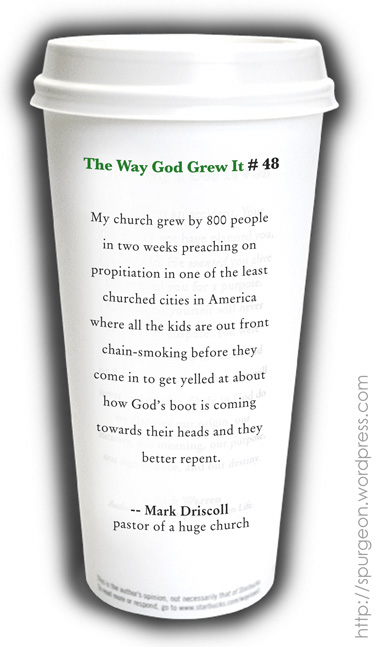
————
Propitiation? What’s that all about? … This blend was hand picked from the mountain peaks of the 2006 Desiring God National Conference: The Supremacy of Christ and the Church in a Postmodern World.
Monday, July 09, 2007
Why I Love the Church (Conclusion)
 By John MacArthur @ http://www.sfpulpit.com
The Church Is an Earthly Expression of Heaven
Here’s a yet another reason from Scripture why I love the church: It is like heaven on earth. I don’t mean that the church is perfect, or that it offers some kind of utopian escape from the realities of a sinful world. But I mean that the church is the one place where all that occurs in heaven also occurs on earth.
Christ instructed us to pray, “Your will be done, on earth as it is in heaven” (Matt. 6:10). In what sphere is that most likely to occur? In the United States Congress? Not likely. In the Supreme Court? Probably not. In the university? No. City Hall? Don’t count on it.
Where is God’s will done on earth as it is in heaven? Only in one place, and that is the church.
What goes on in heaven? If all the activities of heaven were to be brought to earth, what activities would predominate?
First of all, worship. In every biblical description where men of God had visions of heaven, the one thing that stands out most is worship. Praise, adoration, and devotion are constantly being offered to God in heaven. We see it, for example, in Isaiah 6:1-3, where the prophet Isaiah wrote,
I saw the Lord sitting on a throne, lofty and exalted, with the train of His robe filling the temple. Seraphim stood above Him, each having six wings: with two he covered his face, and with two he covered his feet, and with two he flew. And one called out to another and said, “Holy, Holy, Holy, is the Lord of hosts, the whole earth is full of His glory.”
We see it in Revelation 4:8-11, where the apostle John wrote,
And the four living creatures, each one of them having six wings, are full of eyes around and within; and day and night they do not cease to say, “Holy, Holy, Holy is the Lord God, the Almighty, who was and who is and who is to come.” And when the living creatures give glory and honor and thanks to Him who sits on the throne, to Him who lives forever and ever, the twenty-four elders will fall down before Him who sits on the throne, and will worship Him who lives forever and ever, and will cast their crowns before the throne, saying, “Worthy are You, our Lord and our God, to receive glory and honor and power; for You created all things, and because of Your will they existed, and were created.”
In other words, every creature in heaven is perpetually engaged in worship.
Worship is also one of the main activities of the church. In 1 Corinthians 14, where Paul described what took place in a typical meeting in the early church, he wrote, “When you assemble, each one has a psalm, has a teaching, has a revelation, has a tongue, has an interpretation. Let all things be done for edification” (v. 26). There he describes activities whose design is both to worship God and to edify the worshipers. And if an unbeliever came into the meeting, this was the desired response: “the secrets of his heart are disclosed; and so he will fall on his face and worship God, declaring that God is certainly among you” (v. 25, emphasis added).
A second activity of heaven is the exaltation of Christ. Having finished His earthly work, Christ is now seated at the Father’s right in glory in pure exaltation (Acts 5:31). God Himself has exalted His Son, and given Him a name above every name (Phil. 2:9). Christ is “exalted above the heavens” (Heb. 7:27). And throughout all eternity we will be occupied exalting His name (cf. Rev. 5:11-14). Meanwhile, the church is the one sphere on earth where Christ’s name is truly and genuinely exalted.
A third activity that takes place in heaven is the preservation of purity and holiness. Heaven is a holy place. Revelation 21:8 says “the cowardly and unbelieving and abominable and murderers and immoral persons and sorcerers and idolaters and all liars” are excluded from heaven, consigned instead to the lake of fire. Revelation 22:14-15 underscores the perfect purity of heaven’s inhabitants: “Blessed are those who wash their robes, so that they may have the right to the tree of life, and may enter by the gates into the city. Outside are the dogs and the sorcerers and the immoral persons and the murderers and the idolaters, and everyone who loves and practices lying.” No one is admitted to heaven who is not holy (Heb. 12:14).
Likewise, the church on earth is charged with preserving purity within her own midst. Matthew 18:15-20 lays out a process of discipline by which the church is to keep herself pure, if necessary through excommunication of members. It’s not necessary in this context to outline the whole discipline process, but take note of the promise Christ makes in verse 18: “Truly I say to you, whatever you bind on earth shall have been bound in heaven; and whatever you loose on earth shall have been loosed in heaven.”
Binding and loosing were rabbinical expressions that spoke of dealing with people’s guilt. An unrepentant person was said to be bound to his sin, and a repentant person was loosed. Here Christ suggests that when a church on earth follows the proper procedure for discipline, they in effect mediate heaven’s verdict in the earthly church. Heaven is in agreement with their decision. When the church on earth excommunicates an unrepentant member, the elders of that church are simply declaring what heaven has already said. Church discipline is therefore an earthly expression of heaven’s holiness.
Another activity of heaven that occurs in the church is the fellowship of the saints. Our fellowship in the church on earth is a foretaste of the perfect communion we will enjoy in heaven.
The church, then, is like an earthly expression of heaven. It is the closest we can get to heaven on earth.
There’s a lot of talk these days about “user-friendly” churches. Church growth experts counsel church leaders to try to provide an atmosphere in which “unchurched” people can feel comfortable and at home. That strikes me as an utterly wrong-headed approach to the church. “Unchurched” people who come into our fellowship out to leave saying to themselves, I have ever seen anything like this on earth! If they walk away thinking, Ah, that felt comfortable. That was familiar—then something is seriously wrong. The church should be like a preview of heaven.
The apostle Paul wrote of “the household of God, which is the church of the living God, the pillar and support of the truth” (1 Tim. 3:15). More than any other institution on earth, the church is where the truth of God is upheld. The church is called to lift up the truth and hold it high. Employing the truth as a weapon, we are to smash the ideological fortresses of Satan’s lies (2 Cor. 10:3-5). And it is in the pursuit of that goal that the church will ultimately realize her greatest triumph.
All of that is why I love the church. And as long as the Lord gives me breath, I hope to invest my life and energies in the ministry and advancement of the church’s mission.
Friday, July 06, 2007
Why I Love the Church (Part 4)
By John MacArthur @ http://www.sfpulpit.com


3. The Church Is the Most Precious Reality on Earth
There’s a third biblical reason I love the church: It is the most precious thing on this earth — more precious than silver, or gold, or any other earthly commodity.
How precious is the church? It demanded the highest price ever paid for anything. “You have been bought with a price” (1 Cor. 6:20). What price? “You were not redeemed with perishable things like silver or gold from your futile way of life inherited from your forefathers, but with precious blood, as of a lamb unblemished and spotless, the blood of Christ” (1 Pet, 1:18-19). Acts 20:28 refers to “the church of God which He purchased with His own blood.”
The church is so precious that the Son was willing to suffer the agonies of the cross and die in obedience to the Father so that this eternal love gift could become a reality. The apostle Paul reminded the Corinthians of this great reality: “You know the grace of our Lord Jesus Christ, that though He was rich, yet for your sake He became poor, so that you through His poverty might become rich.” (2 Cor. 8:9). That verse has nothing to do with earthly riches or material things. Christ was rich as God is rich — rich in glory (cf. John 17:5). Neither is the poverty spoken of an earthly poverty. Christ divested Himself of His glory. He went from sovereign supernatural deity, to taking upon Himself the form of a servant — and ultimately to a death on the cross in which all the force of divine wrath was poured out upon Him (Col. 2:6-8).
So the precious value of the church is seen here in the price that was paid, when the One who was as rich as God in fullness of glory, became as poor as someone alienated from God (cf. Matt. 27:46).
And, to return to the point of 2 Corinthians 8:9, Christ did this so that we might become rich. His dying made us heirs of God and joint-heirs with Christ (Rom. 8:17). In other words, in giving up His heavenly riches, Christ made it possible for the church to share in those riches. That makes the church the most precious thing on earth.
Thursday, July 05, 2007
Why I Love the Church (Part 2)
 By John MacArthur @ http://www.sfpulpit.com
2. The Church Is the Outworking of an Eternal Plan
In Titus 1:2, the apostle Paul writes of the “eternal life which God, who cannot lie, promised before time began” (New King James Version, emphasis added). In this context, the apostle Paul was describing his ministry, a ministry of evangelism and salvation “for the faith of those chosen of God”—the church (v. 1).
And as Paul describes his ministry, he outlines God’s redemptive purpose, from election (”those chosen of God,” v. 1), to salvation (”the knowledge of the truth,” v. 1), to sanctification (”which is according to godliness,” v.1), to final glory (”in the hope of eternal life,” v. 2). All of this is God’s work (cf. Rom. 8:29-30), something He “promised before time began.”
In other words, in eternity past, before anything was created — before time began — God determined to begin and to finish His redemptive plan. People were chosen. Their names were written down that they might be brought to faith, to godliness, and to glory. God “promised” this before time began.
To whom did God make the promise? This was before time, and therefore before creation. So there weren’t any people or other creatures around. To whom, then, did God make this promise?
We find the answer in 2 Timothy 1:9. There we read that God “saved us and called us with a holy calling, not according to our works, but according to His own purpose and grace which was given to us in Christ Jesus before time began” (NKJV). That verse ends with the same phrase we find in Titus 1:2: “before time began.” And here the apostle says God’s eternal purpose—this same promise that was made before the beginning of time—”was given to us in Christ Jesus.” The eternal pledge of our salvation, the divine covenant of redemption, involved a promise made by the Father to the Son before time began.
This is a staggering reality. In the mystery of the Trinity we see that there is an ineffable and eternal love between the Members of the Trinity. Jesus refers to it in His high priestly prayer: “Father, I desire that they also, whom You have given Me, be with Me where I am, so that they may see My glory which You have given Me, for You loved Me before the foundation of the world” (John 17:24, emphasis added).
That love must find an expression. True love always seeks ways to give. And in a demonstration of His perfect love for His Son, the Father made a pledge to the Son. And what was that pledge? He promised the Son a redeemed people—justified, sanctified, and glorified. He promised to bring the redeemed to ones to glory, that they might dwell in the very place where Father and Son have dwelt since before time began—the very realm of God. And this collective body of called-out ones—a people for His name (Acts 15:14) from every tribe and people and tongue and nation (Rev. 13:7)—would form a living temple for the Holy Spirit (Eph. 2:21-22), becoming the very dwelling-place of God.
That is the eternal promise the Father made to the Son. Why? As an expression of His love. The redeemed of humanity, then, are a gift from Father to Son.
With that in mind, consider Jesus’ words in John 6:37: “All that the Father gives Me will come to Me, and the one who comes to Me I will certainly not cast out.” That, again, affirms the utter invincibility of the church. Every individual ever redeemed—everyone ever given the gift of faith, forgiven, and justified before God by grace—is a love-gift from the Father to the Son. And not one of them will fail or be cast out. Would Christ turn down a love-gift from His own Father?
Furthermore, the importance of the doctrine of election emerges from all this. The redeemed are chosen and given to the Son by the Father as a gift. If you are a believer, it is not because you are more clever than your unbelieving neighbors. You did not come to faith through your own ingenuity. You were drawn to Christ by God the Father (John 6:44, 65). And every individual who comes to faith is drawn by God and given as a love gift from the Father to the Son, as part of a redeemed people—the church—promised to the Son before time began.
The full significance of God’s eternal purpose becomes clear as it is unfolded to us in the book of Revelation. There we get a glimpse into heaven, and what do you suppose the triumphant church is doing there? What occupies the glorified saints throughout eternity? They worship and glorify the Lamb, praising Him and serving Him—and even reigning with Him (Rev. 22:3-5). The collective body is pictured as His bride, pure and spotless and clothed in fine linen (19:7-8). They dwell with him eternally where there is no night, no tears, no sorrow, and no pain (21:4). And they glorify and serve the Lamb forever. That is the fullness of God’s purpose; that is the reason the church is His gift to His Son.
Now this eternal promise involved a reciprocal promise from the Son to the Father. Redemption was by no means the Father’s work alone. In order to accomplish the divine plan, the Son would have to go into the world as a member of the human race and pay the penalty for sin. And the Son submitted completely to the Father’s will. That is what Jesus meant in John 6:38-39: “I have come down from heaven, not to do My own will, but the will of Him who sent Me. This is the will of Him who sent Me, that of all that He has given Me I lose nothing, but raise it up on the last day.”
Redemption from sin could not be purchased by animal sacrifices or any other means. Therefore the Son came to earth for the express purpose of dying for sin. His sacrifice on the cross was an act of submission to the Father’s will. Hebrews 10:4-9 makes this very point:
For it is impossible for the blood of bulls and goats to take away sins. Therefore, when He comes into the world, He says, “Sacrifice and offering You have not desired, but a body You have prepared for Me; in whole burnt offerings and sacrifices for sin You have taken no pleasure. “Then I said, ‘Behold, I have come (in the scroll of the book it is written of Me) to do Your will, O God.’” After saying above, “Sacrifices and offerings and whole burnt offerings and sacrifices for sin You have not desired, nor have You taken pleasure in them” (which are offered according to the Law), then He said, “Behold, I have come to do Your will.”
So the Son submitted to the Father’s will, demonstrating His love for the Father. And the building of the church is therefore not only the Father’s expression of love to the Son, but also the Son’s expression of love to the Father.
All of this means that the church is something so monumental, so vast, so transcendent, that our poor minds can scarcely begin to appreciate its significance in the eternal plan of God. Our salvation as individuals is almost incidental. The real aim of God’s plan is not merely to get us to heaven. But the drama of our salvation has an even grander purpose: it is an expression of eternal love within the Trinity. We’re only the gift.
There’s one thing more worth noting about the Father’s eternal plan with regard to the church. Romans 8:29 says that those whom the Father chose to give to the Son He also predestined them to be conformed to the Son’s image. Not only would He would justify them, sanctify them, glorify them, and bring them to heaven so that forever and ever and ever they could say, “Worthy is the Lamb”—but He also determined that they would be made like the Son. As much as it is possible for finite humanity to resemble incarnate deity, we will be like Jesus Christ. This is “so that He would be the firstborn [prototokos] among many brethren” (Rom. 8:29). Prototokos refers not to someone born first in a chronology, but the premier one of a class. In other words, Christ is the supreme one over a whole brotherhood of people who are like Him.
Our glorification will instantly transform us into Christlikeness. John wrote, “When He appears, we will be like Him, because we will see Him just as He is” (1 John 3:2). Paul told the Galatians, “I am . . . in labor until Christ is formed in you” (Gal. 4:19). We’re being conformed to Christ’s image. And the good news is that this goal will be achieved. The church will emerge from all her trials triumphant, glorious, spotlessly arrayed to meet her Bridegroom.
How can we not rejoice in the prospect of that? How can Christians possibly be apathetic about the church?
One exuberant new Christian stood up to give a testimony in a public meeting. He had noticed that the congregation, mostly older believers, seemed to have lost some of the joy of their salvation. He said simply, “This week I read the end of the book, and you know what? In the end, we win!” That’s a pretty good eschatalogical perspective. The church is ultimately invincible. The purposes of God cannot be thwarted.
There is a fascinating conclusion to all this. Paul describes it in 1 Corinthians 15:24-28:
Then comes the end, when He hands over the kingdom to the God and Father, when He has abolished all rule and all authority and power. For He must reign until He has put all His enemies under His feet. The last enemy that will be abolished is death. For He has put all things in subjection under His feet. But when He says, “All things are put in subjection,” it is evident that He is excepted who put all things in subjection to Him. When all things are subjected to Him, then the Son Himself also will be subjected to the One who subjected all things to Him, so that God may be all in all.
Picture the scene. All Christ’s enemies are destroyed and defeated. All things are placed in subjection to the Son. The Father has given Him the great love-gift, the church, to be his bride and to be subject to Him. Christ is on the throne. All things are now subject to Him—except the Father, who put all things in subjection to His Son. “Then the Son Himself also will be subjected to the One who subjected all things to Him, so that God may be all in all” (v. 28).
In other words, when the Son brings the church to glory and the Father gives them to the Son as His eternal love gift, then the Son will turn around and give everything, including Himself, back to the Father.
This is a mind-boggling look at our future. This is God’s plan for the church. We are a people called out for His name, redeemed, conformed to His Son’s image, made to be an immense, incomprehensible, all-surpassing expression of love between the Persons of the Trinity. The church is the gift that is exchanged. This is God’s eternal plan for the church. We ought to be profoundly grateful, and eager, and thrilled to be a part of it.
Saturday, June 30, 2007
God's Purposes and the Church
The Importance of the Church
By
By
The word "ekklesia" means "gathering or assembly." Therefore, at the most basic level the church is the gathered or assembled people of God (see: Matt 16:18; Acts 19:32, 39). Beyond this the church is also presented as the new covenant community that fulfills the promise of passages like Jeremiah 31:31-34 (cf. Lk 22:20). It is a community empowered by the Holy Spirit in fulfillment of Isa 44:3-5; Ezk 11:19-20; 36:25-27; Joel 2:28-32. The church is also an eschatological community, part of the world to come which has broken into this age; or what one has described as an "outpost of heaven" that partakes of the classic "already/not yet" structure of the Bible. The church is God's dwelling or temple where he dwells in and with his people because of their relationship to Jesus Christ who is the ultimate meeting place between God and human beings (see: Jn 1:1-18; 2:19 cf. 1 Cor 3:16-17; 6:19; 2 Cor 5:1; 6:16; Eph 2:13-22; 1 Pet 2:5. The church is also the beginning of the new humanity (Eph 2:10-18) that God is creating, the humanity that will replace those who will not bow to his authority. The church is also described by other metaphors which enrich our understanding: the family of God, the bride of Christ, an olive tree, a field, a vine, the body of Christ, among others.
This very cursory overview of the biblical data reveals that "the church" is much more than sitting in "church" on Sunday morning, or if we are super orthodox, Sunday morning and evening! It is a community for teaching, worship, fellowship, discipleship, interaction and service. The church is also integral to the plan of God. Eph 1:22 indicates that Christ has been made head over everything for the sake of his church! In other words, at a personal level, the church is central in God's plan for you as a Christian. The question is whether or not you are in God's will?
We cannot speak about the church without appropriate reality checks. There are no perfect churches. No not one! Churches are composed of imperfect people who are growing in the grace of God. Churches are always changing with every person who is added or taken from them. Building strong churches takes commitment, time and hard work. John Fitzgerald Kennedy's famous quote applies here in a revised form: "Ask not what your church can do for you, but what you can do for your church!" This is the complete opposite of the popular consumer approach to church which asks as the question of first importance: "What's in it for me?"
It is also important to realize that the church is not for everyone except you! You need to become involved in a number of ways. First, by becoming a Christian and turning in repentance and faith to Christ. Second, you need to be baptized as a believer and join a local manifestation of the church. Third, you need to be as consistent as possible in your attendance and participation in the life of the church. Fourth, you need to support the church financially by giving sacrificially, proportionally and systematically. And fifth, you need to use your gifts to enhance the ministry of the church. Everyone has gifts given to us by God. Some gifts we know about, others we do not know about... yet. But we need to pray, seek the counsel of wise leaders and friends and look for opportunities to serve, and in these ways discover what God has for us.
Time only seems to go faster the older we get. Don't procrastinate, get involved today. A good church family will benefit you as an individual, couple and family. God's purposes in Christ are tied to the church in very significant ways (Eph 1:22-23). One question that we used to challenge ourselves with when working to establish Sovereign Grace Community Church was this: "If every one's commitment to this church was the same as yours. what would it look like?" This question puts the onus where it belongs: on the individual! What changes do you need to make in light of what the Bible teaches in this area?
Monday, June 25, 2007
The Church Versus the World
 By John MacArthur @http://www.sfpulpit.com
Why do evangelicals try so desperately to court the world’s favor? Churches plan their worship services to cater to the “unchurched.” Christian performers ape every worldly fad in music and entertainment. Preachers are terrified that the offense of the gospel might turn someone against them, so they deliberately omit the parts of the message the world might not approve of.
Evangelicalism seems to have been hijacked by legions of carnal spin-doctors, who are trying their best to convince the world that the church can be just as inclusive, pluralistic, and broad-minded as the most politically-correct worldling.
The quest for the world’s approval is nothing less than spiritual harlotry. In fact, that is precisely the imagery the apostle James used to describe it. He wrote: “Adulterers and adulteresses! Do you not know that friendship with the world is enmity with God? Whoever therefore wants to be a friend of the world makes himself an enemy of God” (James 4:4).
There is and always has been a fundamental, irreconcilable incompatibility between the church and the world. Christian thought is out of harmony with all the world’s philosophies. Genuine faith in Christ entails a denial of every worldly value. Biblical truth contradicts all the world’s religions. Christianity itself is therefore antithetical to virtually everything this world admires.
Jesus told His disciples, “If the world hates you, you know that it hated Me before it hated you. If you were of the world, the world would love its own. Yet because you are not of the world, but I chose you out of the world, therefore the world hates you” (John 15:18-19).
Notice that our Lord considered it a given that the world would despise the church. Far from teaching His disciples to try to win the world’s favor by reinventing the gospel to suit worldly preferences, Jesus expressly warned that the quest for worldly accolades is a characteristic of false prophets: “Woe to you when all men speak well of you, for so did their fathers to the false prophets” (Luke 6:26).
He further explained: “The world . . . hates Me because I testify of it that its works are evil” (John 7:7). In other words, the world’s contempt for Christianity stems from moral, not intellectual, motives: “And this is the condemnation, that the light has come into the world, and men loved darkness rather than light, because their deeds were evil. For everyone practicing evil hates the light and does not come to the light, lest his deeds should be exposed” (John 3:19-20). That is why no matter how dramatically worldly opinion might vary, Christian truth will never be popular with the world.
Yet in virtually every era of church history there have been people in the church who are convinced that the best way to win the world is by catering to worldly tastes. Such an approach has always been to the detriment of the gospel message. The only times the church has made any significant impact on the world are when the people of God have stood firm, refused to compromise, and boldly proclaimed the truth despite the world’s hostility. When Christians have shrunk away from the task of confronting popular worldly delusions with unpopular biblical truths, the church has invariably lost influence and impotently blended into the world. Both Scripture and history attest to that fact.
And the Christian message simply cannot be twisted to conform to the vicissitudes of worldly opinion. Biblical truth is fixed and constant, not subject to change or adaptation. Worldly opinion, on the other hand, is in constant flux. The various fads and philosophies that dominate the world change radically and regularly from generation to generation. The only thing that remains constant is the world’s hatred of Christ and His gospel.
In all likelihood, the world will not long embrace whatever ideology is in vogue this year. If the pattern of history is any indicator, by the time our great grandchildren become adults, worldly opinion will be dominated by a completely new system of belief and a whole different set of values. Tomorrow’s generation will renounce all of today’s fads and philosophies. But one thing will remain unchanged: until the Lord Himself returns and establishes His kingdom on earth, whatever ideology gains popularity in the world will be as hostile to biblical truth as all its predecessors have been.
(Today’s post was adapted from John’s book, Why One Way?)
Friday, June 15, 2007
Trading Holiness For The World's Favor
Quoting William Gurnall . . .
 |  When we lose man's love we gain God's blessing. "Blessed are you, when men say all manner of evil against you falsely, for my name sake" (Matthew 5:11). God's providence is a perfect roof over our heads to defend us from the storm of man's rage. But it is a different story when a saint is caught in sin and gives the ungodly opportunity to speak evil of him. Man reviles and God frowns. His Word does not open its shelter then to hide you from the assault of reviling tongues. But when the wicked hate you for your holiness, God is bound by promise to pay you love for their hatred and blessing for their cursing. Can we ever complain about man's disrespect when obedience and holiness advance us to a higher place in the King's favor? When we lose the world's love we gain its reverence and honor.
The people who will not love you because you are holy cannot help but respect and fear you for that same reason. But every time you give up a little holiness to gain false love from sinners, you forfeit the reverence which their consciences secretly paid to your life. Like Samson, a Christian walking in the power of holiness, is greatly feared by the wicked; but if sin exposes an impotent spirit, he is captured and falls under the lash of their tongues and the scorn of their hearts. Poverty and a low class in society cannot make you contemptible as long as you keep on the breastplate of righteousness. Majesty can reign in a holy heart even when it is dressed in rags. For instance, the righteousness of David commanded reverence from Saul, and the king paid homage to his exiled subject: "He wept, and said to David, Thou art more righteous than I" (Samuel 24:16,17). And this is as it should be - carnal men must admit that they are overpowered by the holy lives of saints. And this shall happen as you behave in that distinctive and singular manner called for by God, doing things that even the best of our unbelieving neighbors cannot do.
|  |
| From: | The Christian in Complete Armour, (year 1665)
| |
Subscribe to:
Posts (Atom)