Showing posts with label Book Review. Show all posts

Wednesday, April 22, 2015

Book Review: Honest Evangelism by Rico Tice


If there is anything that gets most Christians nervous, it's the topic of evangelism. We get distracted, apathetic, preoccupied, fearful or overwhelmed. Rico Tice seems to come alongside and say I know what you are feeling, I feel it too. Rico Tice's approach to evangelism in "Honest Evangelism: How to Talk about Jesus even when it's tough", is the approach of a friend that knows how you feel. His work is the most honest approach to evangelism that I've read. It's not a technical, expositional, historical, or case study approach. It's one mans fears and hopes for evangelism, shared with the rest of us.

His first words of admitting evangelism is hard, puts us on the footing of work that is ahead. Yet almost immediately, he provides a biblical hope in the task.

In his first chapter Rico shows how believers are already equipped to share the gospel. He warns of the inevitable hostility that people will exhibit and it is that hostility that he sees as the main reason why people don't do evangelism. What seems to be a helpful element in each chapter is showing how within the problem lies the pathway to the solution: "The same rising tide of secularism and materialism that rejects truth claims and is offended by absolute moral standards is proving to be an empty and hollow way to live". The interesting dichotomy that he presents in our task is how it is "more and more likely to find people quietly hungering for  the content of the gospel, even as our culture teaches them to be hostile towards it"

Knowing what to expect, in the second chapter Rico presents a helpful mindset to present the gospel: "talk to people about Jesus because we want to, long to, and are excited to, even though it's tough". The reality of the consequences of hell provide the antithesis to delight.

Lest we get too far a this point, Rico provides a helpful idol inventory in chapter three, that might be getting in the way of our evangelism. Chapter four provides the most solid theological examination through sovereignty, grace, and power What would be a natural follow up to this theological foundation, chapter five provides some helpful content to our message. From being quick to listen, slow to speak (James 1:19), Rico suggests we present the truth of the gospel from an everyday, natural part of our conversations with people. From this everyday gospeling is a refreshing natural approach instead of all to "now-I-am-sharing-the-gospel-with-you" canned methodology. In a simple to remember summary, Rico suggest a "identity, mission, call" description of Christ (2 Cor. 4:5) as a good summary of the gospel. Much like Jesus approach His own explanations, Rico suggest checking understanding with questions. Ask who they think Jesus is (Mk. 8:27-29)  Secondly, explain His mission: show why He came (Mk. 8:30). As an answer to guilt, death (Mk. 8:31). Finally, present His call (Mk. 8:34). Rico obvious has the reader in mind at this point, for he invites the read to consider if they have repented of their sin.

Chapter 6 tries to eliminate common excuses for evangelism and invites the reader to just be themselves. Rico presents biblical examples of evangelism from Peter (confrontational), Paul (intellectual) the ex-blind man (testimonial), and the woman at the well (invitational). I would have appreciated more detail at this point. I was wondering if it is appropriate to use an approach related to the audience, although it may not be our usual way of thinking. In a brilliant follow up to individual approaches, Rico points to the "striving together" role that the church has. This section could have had a chapter each, especially a "church wide" approach to evangelism.

In "getting started (or re-started), in chapter seven, Rico surveys the changing methodology of evangelism, giving modern barriers. This is one section that I think many books on evangelism forget. Rico flat out presents the need for time and effort in the task. His approach is unusual in suggesting that we ask our audience particular questions. Finally, he presents the character qualities necessary to not cause unnecessary offence His conclusion in chapter 8, reiterates the need for prayer, proclamation and availability. Naturally, the appendix contains lists of helpful resources.

Honest evangelism is honest: honest about fears and the future reality of the task. It is hard to get much more personal. This work is an excellent addition for the everyday believer in Christ to fulfill their calling to evangelize.


Monday, February 27, 2012

Book Review: "Mere Apologetics: How to Help Seekers & Skeptics Find Faith"

Mere Apologetics: How to Help Seekers & Skeptics Find Faith

Baker Books / 2011 / Paperback

Retail:$16.99 US

In the spirit of C. S. Lewis's Mere Christianity, Alister McGrath's Mere Apologetics seeks in his own words to equip readers to engage gracefully and intelligently with the challenges facing the faith today while drawing appropriately on the wisdom of the past. Rather than supplying the fine detail of every apologetic issue in order to win arguments, McGrath aims to teach a method that appeals not only to the mind but also to the heart and the imagination. It is an introduction to apologetics.

Focusing on the core themes of the Christian faith and its effective communication to the non-Christian world, McGrath sees this as a mindset of engagement that interacts with the ideas of our culture rather than running away from them or pretending they can be ignored. His states that his aim is to convert believers into thinkers, and thinkers into believers, engaging our reason, imagination, and our deepest longings. He does not see this as a defence or hostile reaction against the world per se, but sees it as a welcome opportunity to exhibit, celebrate and display the treasure chest of the Christian faith. He encourages believers to appreciate their faith and to explain, and commend it to those outside the church, in all its intellectual, moral imaginative and relational richness. (p.11).

McGrath states that he is not committed to any particular school of apologetics but drawn on their collective riches. Although not defined as such, I would see his approach as primarily an evidentialism approach to apologetics with slight hints of presuppositionalism and classical apologetics. He takes great pains to avoid using such terminology and states that he will give "pointers to more advanced resources that will allow you, the reader, to take things further in your own time" (p.12).

Starting at perhaps a classical apologetic base, McGrath begins with Augustine, and quotes 1 Pt. 3:15 seeing apologetics is essentially “a defence” (15). He states the basic themes of apologetics, first with defending (p.17). Searching out the barriers to faith, arising from misunderstanding or misrepresentation he draws on apologetics like Pascal and shows how apologetics engages the mind (Mt. 22:37; Rom. 12:2). Secondly, in Commending, he sets out to allow the truth and relevance of the gospel to be appreciated by the audience (p.19). Third, in Translating, he draws on apologists like Lewis to show how the Christian faith is likely to be unfamiliar to may audiences and the need for it to be explained using familiar or accessible images, terms, or stories (p.20). He distinguishes apologetics from evangelism (p.21) and gives the limitations of apologetics (p.23).

Chapter two moves from Modernity to Post modernity showing how each age generates its own specific concerns and critiques of the Christian faith (p.28). McGrath defines his approach in first understanding the faith, the audience, communicate with clarity, find points of contact,  present the whole gospel, and practice, practice, practice. He is helpful in specifics such as finding points of contact through the witness of history that are already embedded in human culture and experience (Acts 14:17) but misses a key opportunity to succinctly define what he means when he says in presenting the whole gospel. A simple, succinct, scriptural statement is woefully lacking on this point.

In the third chapter McGrath specifies that apologetics is not a set of techniques for winning people to Christ or a set of argumentative templates designed to win debates, but a willingness to work with God in helping people discover and turn to his glory (p.41). The approach almost seems anti-Christocentric, and frankly made me a bit nervous at this point. Thankfully he begins with setting things in context with a story from the ministry of Jesus in Mark 1. McGrath seems to be drawing on more presuppositional thoughts in specifying that conversion is not brought about by human wisdom or reasoning, but is in its deepest sense something that is brought about by God (1 Cor. 2:5). He is a little weak in saying that human nature is only wounded and damaged by sin (and not dead in trespasses and sin) yet accurately states that people are not capable of seeing thing as they are (2 Cor. 4:4). He concludes the chapter in a very helpful picture of how the cross and resurrection of Christ achieves victory over sin and death, brings healing to broken and wounded humanity and demonstrates the love of God for humanity.

Using Peter’s Pentecost sermon (Acts 2), Paul’s sermon to the Athenian philosophers (Acts 17),  and Paul's legal speeches to the Romans (Acts 24-26)  McGrath sums up their approaches to address specific audiences, identify the authorities and use lines of argument that will carry weight with the audience (p.68).

McGrath then goes on to show the "Reasonableness of the Christian Faith" showing how apologetics is an important tool in “persuading people that Christianity makes sense” (71). His evidential base shines here in his statements of how apologetics shows that there is a good argumentative or evidential base for core beliefs of Christianity. He sees such an approach to include developing intellectual arguments for the existence of God, or historical arguments for the resurrection of Jesus (p.72).  His metaphysical treatment of science is insightful showing how science can give explanation as the identification of causes, the quest for the best explanation and the metanarrative of the unification of our view of reality. For someone who is so careful to avoid terms to classify each approach of apologetics, this chapter certainly defines elements of an evidentialism approach. .

Chapter six, Pointers to Faith: Approaches to Apologetic Engagement, has some of the best apologetics treatment in the book. In the section entitled Clues, Pointers and Proofs he moves into the concept of `worldviews` to signs pointing to the greater reality of God. He makes an important point that `No one is going to be able to prove the existence of God... yet one can consider all the clues that point in this direction and take pleasure in their cumulative force` (p.95). McGrath then gives clues from origins of the universe, design, structure, morality (ontology), desire-longing, beauty, relationally, and eternality in how they all weave together clues as to a pattern. These address “both the ‘reason within’ and the ‘reason without’—the rationality of the human mind, and that embedded in the deep structure of the universe” (102). He contends that these identifying “clues about the meaning of the universe . . . are significant pointers to the capacity of the Christian faith to make sense of life” (121). He charges that the apologist then must demonstrate how these pointers actually direct us to the reality God has graciously revealed in his Word. 

Chapter seven moves into Gateways for Apologetics in Opening the Door to Faith. McGrath states how the classical rational defence of the faith is largely ineffective in the contemporary post-modern culture. He states that ``Apologetics is about building bridges, allowing people to cross from the world they already know to one they need to discover. It is about helping people to find doors they may never have known about, allowing them to see and enter a world that exceeds anything they could have imagined`` (p.127).  He  states how we must answer questions such as: Who am I? Do I really matter? Why am I here? Can I make a difference? It must be kept in mind that: ``Neither science nor human reason can answer these questions. Yet unless they are answered life is potentially meaningless… There are times when it is just as important to show Christianity is real as it is to show it is true’ (p. 138). We must remember that ``Many Christians… prefer to use words…to commend our faith. Yet we need to be aware that, in a post-modern context, images [have] special authority and power, transcending the limitations placed on words’ (p. 149). Linking historical examples, he moved from approaches of explanation, argument (from design, origination, coherence and morality), stories to images. He provides some of the most balanced treatments in this section giving both arguments, examples and critiques of each approach.

If it is not quite evident at this point, the challenge of apologetics is enormous: ``Apologetics is about communicating the joy, coherence, and relevance of the Christian faith on the one hand, and dealing with anxieties, difficulties and concerns about that faith on the other`` (p. 157). McGrath encourages the apologetics to develop a personal approach in reflecting on: ``the questions being asked, the situation of the people asking them, and the resources available to answer them, yet never to give an answer to a question that doesn't satisfy you in the first place`` (p.159). He then proceeds to give some basic points to be gracious, consider the real question, and don't give pre-packaged answers to honest questions. Real biblical wisdom is employed here by McGrath: ``One way of dealing with this issue that I have found helpful is to welcome the question, and then ask the questioner if he would mind sharing why this is a particular concern for him. This helps me work out what the real question is and address it properly (p.161). Finally, McGrath suggests we learn from other apologists, in noting both the tone and content of their responses. In putting the theory to practice, McGrath considers two of the most common challenges in apologetics of why God allows suffering, and if Christianity is just a crutch. He considers these topics theologically and then provides apologetic responses. If this wasn't insightful enough, McGrath explains why he approached these question in the manner in which he did.

The final paragraph sums up the book well: ``This short book can never hope to teach you everything about the science and art of apologetics. It can only get you started. yet hopefully if will have gotten you interested in this field, and helpful you to appreciate why apologetics is to stimulating and important. Don't be discouraged if you have found the ideas difficult to master or apply. This book simply maps out the territory, now it's up to you to explore in depth and in detail-something that is both fascinating and worthwhile. And how many things in this life are like that? (p. 185). The sections ``For Further Reading`` at the end of each chapter enable the research to continue. The rest is up to each apologist. The rationale, theory, and explanations are given for the task. There are no excuses left. This is no mere theoretical exercise, souls are at state.

My only wish, was that McGrath would have included the technical categories, at least in footnotes, to allow for precise classification and further study. Without these, the book becomes limited for formal study in a seminary or bible college. For the everyday reader, it is hard to come up with a more comprehensive yet readable volume for defending the faith. May God use this work to change lives for His kingdom.

Product Information

Format: Paperback
Number of Pages: 208
Vendor: Baker Books
Publication Date: 2011
Dimensions: 9.00 X 6.00 (inches)
ISBN: 0801014166
ISBN-13: 9780801014161

 “Book has been provided courtesy of Baker Publishing Group and Graf-Martin Communications, Inc.
Available at your favourite bookseller from Baker Books, a division of Baker Publishing Group“.

Book Review: "Pastors in the Classics"

 
Pastors in the Classics: Timeless Lessons on Life and Ministry from World Literature Leland Ryken, Philip Graham Ryken, Todd A. Wilson Baker Books, 2012-01-01 - 192 pages

I am sure that many a pastor or author wished that someone had taken the time to look into all the novels, plays, morality tales, and poetry where pastors played a prominent role and provide "a road map to literary masterpieces in which the pastor's experience is a major part of the story" (p.11).  The authors are amazingly explicit in their aims and goals: "first to facilitate the reading of some great works of literature", show "ways in which the works portray and clarify issues in the minister's life and vocation",  finally to place "the minister's life within the broader Christian context" (p.12). These are in essence the differences between telling and showing what to do and not do in ministry.

There are four uses that the authors foresee for this collection: to enhance a reader's enjoyment and understanding of the works that are discussed, group discussion, improve the ability to make right moral choices and finally to be a readers' guide to the works that they cover (p.13). Two of these are excellently achieved, one is weak and another is woefully inadequate. Pastor's in the Classics will help with the enjoyment and understanding the work covered. I would have preferred Ryken to have more input on the moral choice objective by providing more of a biblical framework. Finally, the group questions are so brief, that any group would really need to take extensive notes of the primary sources to discuss the themes. The four "Portraits of Ministers" questions (p.14) really need to be kept in mind in examining any of the works in question.

From the author's description, part 1 is a reader's guide to twelve important classics written over four centuries and covering seven different nationalities. Each chapter not only describes and interprets the work in question, it also highlights a specific feature of pastoral ministry explored in the work. One of the most helpful features are the scriptural passages that begin each chapter. I would have appreciated an index of these texts that would have enabled an expositor to refer to the work in question as a sermon/lesson illustration. The topics vary from sexual sin, to slander, love, and suffering. Although the reviews are of classic sources, they read like everyday issues: challenges of ministry, complaints about church meetings, how hard it is to love the sheep, the relentless approach of next week's sermon, opportunities for personal ministry, candid revelations from the congregation and asking the lord to help moment by moment (p.106). Like the scriptural references, a thematic index would be helpful for future reference. Most of the topic headings are clear, but a few (eg. Witch Wood) can be a bit cryptic at times.

The authors describe Part 2 as a handbook on fifty-eight entries on works of literature that include significant discussion of ministry and illuminate issues in ministry (p.113). They see these of works that define the canon of literary masterpieces that deal with the pastor's experience, offering reading suggestions for both ministers and lovers of literature. From the familiar (The Canterbury Tales; Cry, the Beloved Country; and The Scarlet Letter) to the lesser-known (Silence, Witch Wood) to the surprising (A Portrait of the Artist as a Young Man). They describe this as a collection that uncovers the good, the bad, and the ugly ways in which pastors have been presented to the reading public for the past half millennium. They are much briefer than the first section and are presented in a helpful alphabetical order.

Pastors in the Classics is a very useful resource to summarizing this and it's almost amazing that this work has not been written earlier. With few explicit biblical references and with some scriptural quotations at the beginning of the chapters more applicable than others, I hope a second edition will expand to include more contemporary works and add the most needed scriptural and thematic indexes. The most disappointing lack is of a conclusion on how literature had tended to portray pastoral ministry or how this had changed over time. It could include some helpful tips for future authors or perhaps how literary portrayals of pastors tend to be more accurate than the more common portrayal in other media forms.

"Book has been provided courtesy of Baker Publishing Group and Graf-Martin Communications, Inc. Available at your favourite bookseller from Baker Books, a division of Baker Publishing Group".

Product Details
Paperback: 184 pages
  • Publisher: Baker Books (January 1, 2012)
  • Language: English
  • ISBN-10: 0801071976
  • ISBN-13: 978-0801071973
  • Product Dimensions: 8.9 x 6 x 0.6 inches
  • Shipping Weight: 9.6 ounces


Thursday, February 09, 2012

Review: The Priority of Preaching by Christopher Ash

Marketers will tell you that in order to sell something, your product or service must be distinguished from the competition. When Christopher Ash wrote The Priority of Preaching, he explicitly stated that: “This little book is for ordinary pastors who preach regularly to ordinary people in ordinary places, who may dream of being world-renowned [i.e. impressive and strategic] but are going to be spared that fate” (p.12). Right from the start, you know this is not your ordinary book on preaching.

Ordinarily, those who wish to market the Gospel will tell you that you need to devise a unique message, in a unique way to the unique people of your audience. It is a dangerous attempt to gain prominence. That had been tried and warned about before (Mt. 20:20-28).
Ash takes the word of God at face value and shows how it in itself is unique, to each unique person and uniquely relevant. What Ash does is to put the confidence in preaching on God and His inerrant, infallible word. What a preacher will then be stuck with is the unique power, authority and world changing scripture

Beginning as a series of addresses given at the 2008 Evangelical Ministry Assembly in London, the Christian Focus Publishers/Proclamation Trust Media release of The Priority of Preaching, focuses on the preaching of Moses in the book of Deuteronomy. Ash states that his objective is to “persuade (or at least unsettle) those doubtful about preaching, and to deepen the conviction of those already converted to the priority of preaching.” (p.13).

The first section looks at The Authority of the Word Preached (Deuteronomy 18:9-22) Chapter one considers the authority of the expository preacher in speaking the very words of God (2 Tim. 4:2). It begins with a brief history of homiletics, as well as setting the stage with the ever real warning of those who will not tolerate sound teaching (2 Tim. 3:1-9; 4:3-4). Scripture is the foundation of the church (Eph. 2:20) and do not let anyone despise you (ie. disregard what you say) (Titus 2:15). Ash warns the preacher to "beware the shortcut of mystical authority" (p. 40) with a lazy assumption that preaching does not require hard word in preparation (1 Tim. 5:17). Not too many should be teachers (James 3:1). It is a spiritual gift only given to some (Eph. 4:11).

With the case of the preachers' authority being the word of God, Ash makes an intriguing statement on how preaching is cross cultural: "Every culture knows what it is to sit and listen to an authoritative human being speak. That is not culturally specific. You don't need to be literate to do that. You don't need to be educated to do that. You don't need to be fluent or confident in debate to do that". (p.27). Many contemporary so called "group Bible studies" have practically placed their own authority over scripture: "discussion substitutes for submission to the word of God...people in fact sit above the Word of God." (p. 29). A better alternative is proposed where the group take the Sunday passage, seek to further understand it, and hold each other accountable for how they live it.

Ash provides an interesting transition from old covenant prophet (prophetic and revelatory) to new covenant preacher (proclamatory). I found Ash's discussion intriguing on how Paul himself found the need for preaching face to face necessary and not just with providing a scroll alone (2 Pt. 2:1). With the word preached, all the other ministries of the word flourish: "In all the other contexts in which we teach and admonish one another and speak the word of Christ to one another (Col. 3:16), we are much more likely to submit and not evade by endless discussion, if we have as our top meeting priority (alongside prayer) sitting together under the preached word" (p.36).

The second section shows Preaching that Transforms the Church (Deuteronomy 30:11-20). Ash deals with the reality of distractions yet having preaching that grips (p.46). He presents a series of four preaching themes. As interesting as they were, they were light on new covenant application. However, Ash makes some helpful practical applications such as envisioning preaching as "silent dialogue" (p.53), having "urgent passionate clarity" (p. 61), presenting in a language the audience will understand (p.62-63), and offering Christ in our preaching with confident grace (p. 72).

The third sections looks at Preaching that Mends a Broken World (Deuteronomy 4:5-14). Ash discusses how the world is broken (p.76ff) with the need for consistent order. Ash shows how Deuteronomy signals four ways the standard shape of the church as the pattern (p.79) word (p.80) place (p.81) and people (p.82) for the assembly. The new covenant transition from the book of Hebrews would have been better interwoven within these pictures instead of a few pages later. When Ash presents the assembly on its wider biblical canvas, the examples go from the world crisis of distress (false worship always leads to scattering (p.83) and how God promises to gather a reassembled world (p.84). The picture of fulfillment in Christ is now presented with great illustrations from the book of Hebrews. Practical applications are put into practice with illustrations on gathering to hear the word (p.91), how it brings unlikely people together (p.92), and how the word of grace shapes us together (p.98).

The appendix looks at Seven Blessings of Consecutive Expository Preaching. He notes and explains these seven blessings. He shows how Consecutive Expository Preaching 1) Safeguards God’s Agenda Against Being Hijacked by Ours. 2) Makes It Harder for Us to Abuse the Bible by Reading it Out of Context. 3) Dilutes the Selectivity of the Preacher. 4) Keeps the Content of the Sermon Fresh and Surprising. 5) Makes for Variety in the Style of the Sermon. 6) Models Good Nourishing Bible Reading for the Ordinary Christian. and how Consecutive Expository Preaching 7) Helps us Preach the Whole Christ from the Whole of Scripture

The only limitation I see to this work are those I believe the author self-imposed. This is not a Biblical theology of preaching, christocentric fulfillment's or an exegetical, grammatical technical guide. The work almost exclusively concerns itself with Moses' words from Deuteronomy as a helpful model of the confidence in God's word.

Ash is surprisingly candid with sharing feelings that many who preach the Gospel have privately felt yet are often reluctant to express. His influences are explicitly stated and he is not afraid to point out dangerous yet popular approaches to preaching today. As a reader, his writing is personal, practical and pithy. The layout of the book is clear and straightforward. The publisher has to be greatly commended for their efforts in aiding this clarity. With such a simple effort to cite references in footnotes instead of end notes, the reader does not have to ever be distracted with the points at hand.

Not only would this be a highly beneficial resource for anyone preaching the word of God it is also helpful for anyone who needs to understand how scripture uniquely empowers and directs. This would help in not only corporate decision making, but individual and familial as well.

Product Details • Paperback: 128 pages • Publisher: Christian Focus (June 15, 2009) • Language: English • ISBN-10: 184550464X • ISBN-13: 978-1845504649 • Product Dimensions: 8.1 x 5 x 0.4 inches • Shipping Weight: 4 ounces

Wednesday, January 11, 2012

Book Review: "Engage: A Guide to Creating Life-Transforming Worship Services "

Engage: A Guide to Creating…Engage: A Guide to Creating Life-Transforming Worship Services
Nelson Searcy (Author), Jennifer Dykes Henson (Author), Jason Hatley (Author)

Engage was created to address several things the authors saw as difficulties in modern worship. From the weekly cycle of worship planning, their summary from the back cover begins: "No matter how great Sunday's worship service was, there's always another Sunday lurking at the end of the next week that must be planned. Church leaders often fall into ruts, working on automatic pilot just trying to get things together, which does not allow for much creativity or focus on designing services that lead to transformation for those involved in them".

Built in to that objective are two significant assumptions: there should be creativity in worship and people are the primary designers of it. I suspect that the authors would highly agree with the first and strongly disagree with the second. The reason why I stated the second assumption is due to the structure of the book. Since there is no development of a biblical foundation of worship, the reader moves right to current practice evaluation and creativity.

Notice how this is going to be achieved, once again from the back cover: "Engage is a step-by-step, stress-free guide to planning worship services that allow for and foster true life change. Comprehensive in scope, Engage provides teaching pastors, worship leaders, and volunteers with the tools they need to work together to develop and implement a worship planning system that improves communication, enhances creativity, and honors Jesus every week".

Once again within these statements, there are important assumptions, one being that planning worship should be "stress-free". Without going into an extended exposition of worship here, should there not be some "stress" in approaching worship where one considers their sin, repents of it and desperately clings to Christ? Should not even the process of worship itself come from some blessed "stress" of joyful praise, to heart wrenching lament? Notice what is seen as the solution to the challenge of weekly worship planning: "The key to getting out of the tailspin and cooperating with God to do church at a higher level can be summed up in one word: planning" (p.11). Off and running, if the participant has not totally surrendered to God and is biblically rooted in engaging God, this can be a dangerous assumption.

All these important considerations aside, Engage tries to achieve their objectives in four parts. The first section deals with determining Your Philosophy of Worship. When the chapter begins with a quote from Cicero on philosophy, this did not strike me as a healthy place to start a discussion on worship. The authors suggest using the acronymn WORSHIP: W = 'Work as a Team', O = 'Outline Your Preaching Calendar', R = 'Repentance is the Goal of Worship', S = 'Sunday Matters', H = 'Honor God through Excellence', I = 'Invite People to Take the Next Steps', P = 'Planning Honors God'. The closest thing that the reader can hope for in terms of biblical exposition is a bracket noting "see Isaiah 6 for additional study on how repentance follows true worship"(p.35). Sure, repentance is needed for worship, but should the goal not be for people to genuinely ascribe Worth to God, ie "worth-ship"? To begin with the end in mind is a good tool in planning worship, and asking questions like what do we want people to know/feel/and do when they leave (p.39), are helpful to consider but perhaps our first questions should not what do the people want, but what does God expect and want from us?

Introductory concerns aside, the authors indeed put many helpful planning ideas and examples in their work. Frequently, in each section of the book, the reader is encouraged to visit the ministry site www ChurchLeaderInsights.com/Engage, to examine and discuss the concepts further. I found this approach quite helpful over the standard foot/endnote method to delve further into topics of the readers interest.

The second section deals with the preaching calendar. The authors begin their section with a warning: "...people forget the majority of the information they hear from a communicator within twenty-four hours" (p.51) Without having a citation of these "numerous studies", I would charge that there is a difference between having a listener quote points in a message and have an internal conceptual change. Isa 55:10-11 "For as the rain and the snow come down from heaven and do not return there but water the earth, making it bring forth and sprout, giving seed to the sower and bread to the eater, [11] so shall my word be that goes out from my mouth; it shall not return to me empty, but it shall accomplish that which I purpose, and shall succeed in the thing for which I sent it (ESV).

Furthermore, I believe the authors misunderstand the primary objective of preaching: "You stand in front of your people on Sunday mornings for one reason and one reason only; to connect God's truth to real life in a way that leads to radical transformation" (p.53) But God's truth already connects to real life (2 Tim.3:16-17). Our job as preachers is to accurately expound and explain the word of God to help people see how this is so (2 Tim.4:2). My heart was relieved in the direction on page 59 to preach the whole counsel of God (Acts20:27) and how a preaching calendar can help ensure this by focusing too much on our "favorite" topics. Although generalized, the authors note particular times of the year with the frequent patterns of attendance and types of topics that could correspond to such times. They suggest a balance of attraction, growth and balance.

The third section deals with planning and conducting worship services. The planning of a message series over particular time horizons is deal with followed by three general types of worship formats. The "simple worship order" structures singing, video, teaching, testimony and offering. The "split worship order" structures video, music, drama, message followed by the same. Finally, the "salsa worship order" has video, music, video, message followed by the same. Some helpful requirements close the formats, including: high accountability, punctuality, excellence and conversation. I would have loved a whole chapter on excellence itself. The following chapter includes an inverted triangle of each potential creative element in order of potential impact. This is highly debateable with a scary suggestion to "think outside the box (p. 122). If that box is scripture, I would not suggest it. Chapter eight shows how all this can work together with a trial run. As idealized as this is, you would need some committed worship team to spend quite a few hours each week and a lot of work ahead of time to accomplish this. Finally, chapter nine concludes with an interesting quadrant of four options to diagnose your current engagement level in the process with suggestions to improve communication and role clarification.

Finally, the fourth section deals with evaluating and improving worship services. It certainly made sense to work on roles and communication before undertaking this. The warning of not playing the "blame game" from the previous chapter really comes in to play. Although I think a biblical context for evaluation and correction would have been helpful, the general tone is gracious. Simple questions like: "what went right/wrong, what was missing or confusing" can be insightful. I would take caution in many of the overally planned elements that the authors suggestion that might restrict Spirit lead diversions. The direction to "keeps things upbeat" (p.180) is certainly shallow. There are times of joy, conviction, direction, lament etc. It can't all be upbeat.

The appendices give a sample preaching, planning calendar, sample order of services, communication template for Pastor to Creative Team, meeting notes, message research schedule and example.

In conclusion, this is a very focused book. There are a lot of other elements of worship, like music selection, instrumentation, worship team building and homiletics, seem to be deliberately not address. This book can be a helpful tool to consider some new aspects of worship, but I fear without a framework that is grounded in scripture with a clear God-glorifying objective always front and center, the planning of preaching or worship may be more personally driven than Spirit led.

Rating: 3 stars of 5.

"Book has been provided courtesy of Baker Publishing Group and Graf-Martin Communications, Inc. Available at your favourite bookseller from Baker Books, a division of Baker Publishing Group".

Paperback: 240 pages
Publisher: Baker Books (Oct 1 2011)
Language: English
ISBN-10: 0801072174
ISBN-13: 978-0801072178
Product Dimensions: 21.3 x 14 x 1.8 cm
Shipping Weight: 272 g ( )

Tuesday, November 22, 2011

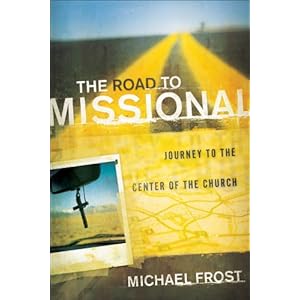
Book Review: "The Road to Missional: Journey to the Center of the Church" by Michael Frost

The need for this work is summed up well in the introduction by Alan Hisrsh: He sees a disturbing trend where "the term missional is now being appropriated at a massive rate. But so very often this is being done without the foggiest idea of what it actually means and the impact that it should have on our thinking and practices" (p.11). "When everything becomes missional, then nothing becomes missional. This book speaks directly into that situation" (p.12).

Michael Frost sees his task as "an attempt to reclaim the word 'missional' from the grips of conventional churches bent on finding a new buzzword to meet the annual fixation for something new and 'relevant'".

He spends a great deal of time describing what a missional Church is and his not. A missional church then, is a church that realises this Missio Dei and has a "wholesale and thorough reorientation of the church around mission" (p16). “Mission is both the announcement and the demonstration of the reign of God through Christ. "It is our automatic response to God's reign and rule, proven through Christ, revealed through the Spirit. Therefore, any collective of believers set free from the disorder of this present age, who offer themselves in service of the mission of their God to alert people to the new unfolding order of things, can rightly be called a missional church." (38)

To contrast, he makes it clear that mission is not primarily concerned with church growth. It is primarily concerned with the reign and rule of the Triune God. If the church grows as a result, so be it.” (p24). It "is not about evangelism, It is not about sending, but being sent. Missional is like slow cooking, where disciples incarnate deeply within the communities they are in or called to be in. No quick fix. No rush to pile up numbers of conversions. No snappy 'four spiritual laws.' " (46). 

Since he recognizes that God reigns and rules through Christ, whatever you do that alerts people to the fact of the rule of God, is missional. The strength and problem with many of these contrasts is that there is a lot of room for action. While he affirms this action by both ‘announcement and demonstration’ (p35) almost all the focus and the examples are on ‘demonstration’. It would be best to look elsewhere for much of the "announcement" or content of the message.  Although Frost quotes quite extensively from various missional authors, his treatment of the Scriptural message of the "announcement" is infrequent. You need to go though twenty-five pages before the first text is cited. Interesting  Biblical treatment such as "The Cross as Metaphor/Paradigm" (p. 90ff) are few and far between. Taking concepts like the incarnation by quoting The Message that "The Word became flesh and blood and moved into the neighbourhood" (Jn. 1:14) is so offensive, that his argument for moving into the neighbourhood (proximity) (p. 123) is undermined.

The missional approach often seems to be living out a "lordship" of Christ's self-sacrificial life, but it is often not careful in what it advocates. One, for example sees a renewal of "monastic practices-confession, repentance, Bible reading, prayer..." (p.79). Calling these spiritual disciplines "monastic" contradicts a missional connection with the community. Likewise, the trend to define one's self on what you don't do (don't drink/smoke/gamble/hang out with people who do) sounds more like old school "fundamentalism" than "pietism". Yet, I would agree with Frost that this kind of spirituality "outsources the need to do the daily work of keeping in step with the Spirit of the God" (p.85). Again a good point is made with a poor choice of terms: "Church people worry that the world might change the church, Kingdom people work to see the church change the world" (p.103). Perhaps using a term like "religious" would have been preferable for Christ came to establish a "church", or called out people for Himself to be agents of His Kingdom.

There seems to be a very "grass roots" feeling to the work of mission. Things like structure, leadership, doctrinal standards and accountably are woefully lacking. Seeing congregations "led by humble men and women" (p.79) perhaps even hints at the author's desire for "egalitarian" leadership.

I found myself laughing in chapter four on "triumphant Humiliation" in the description of false persecution that some feel: "Maybe when your neighbor ignores you, it's not because he hates the light of the Lord that shins from you. Maybe he just thinks you're a jerk. Maybe we get most of the rejection we do because, well, we deserve it" (p.83). This is a much needed wake up call for contemporary Christianity.

Frost missed a great opportunity to take his Christocentric Kingdom model in dealing with the topic of peace in chapter five. His treatment of reconciliation, justice and beauty only finds meaning through the cross. Understanding how the work of Christ enables reconciliation, justice and beauty truly informs these concepts. His treatment on "beauty" is so weak, that it is essentially without meaning. Yet, he did give biblical elements of reconciliation and justice. The contemporary facts for these things provides a useful link of doctrine and need.

Frost' conclusion wisely sums up his point. The main point in "The Road to Missional" is simply this: "becoming missional is not about making congregations more appealing for a new generation; rather, becoming missional is about equipping and releasing people to be the church in their neighborhoods, regardless of what style of worship they prefer of the size of the congregation. Becoming missional is all about tapping into the missio Dei in order to be a foretaste of the reign of God in Christ. This is rooted in the cross and God's shalom. And do, becoming missional is not simply a matter of language or programming ' it is a never ending process and a 'calls it followers to the disciplines of sacrifice, service, love, and grace; and a mission that delights in beauty, flavor, joy, and friendship" (146).

Yet, it does no good to try to do the "mission" of Christ and not proclaim His words while doing do. Our message may counteract our methods. This work is helpful in suggesting ways to live out the message of Christ. Yet, I fear we may quickly forget and get side-tracked if we do not continue to learn about the person and words of Christ in order to check our actions to His mission.

Rating: 2.5 stars of 5.

Product Details

  • Paperback: 160 pages
  • Publisher: Baker Books (Oct 1 2011)
  • Language: English
  • ISBN-10: 0801014077
  • ISBN-13: 978-0801014079
  • Product Dimensions: 22.6 x 15.2 x 1.3 cm
  • Shipping Weight: 227 g
"Book has been provided courtesy of Baker Publishing Group and Graf-Martin Communications, Inc.
Available at your favourite bookseller from Baker Books, a division of Baker Publishing Group".

Monday, October 31, 2011

Book Review of " CLOSE ENOUGH TO HEAR GOD BREATHE"

Book Review of " CLOSE ENOUGH TO HEAR GOD BREATHE: The Great Story of Divine Intimacy"
By: Greg Paul
Thomas Nelson
Publishers
Published  2011
Price: $15.99 US

In "Close Enough to Hear God Breathe", we are told that we will "encounter a rich message that recounts the story of a God who has been inviting all of humanity, and each individual, into his tender embrace since time began". "The message that I want people to hear is this," the author states, "I think it's very clear that the whole message of scripture, and the whole message of the human life, is that God is saying to you, 'You are my child. I love you and I'm pleased with you'." It is a book that he sees dealing with "love, faith and belonging"

The author, Greg Paul describes the book as "general theology couched in stories". It is a collection of family stories including ones about Paul's four grown children, his family and ministry at the Sanctuary street mission and stories from scripture. Paul, certainly brings his captivating experience into the writing of this book. He describes Sanctuary as "a ministry where the wealthy and poor share their experiences and resources daily and care for the most excluded people in the city, including addicts, prostitutes, the homeless, and gay, lesbian, and transgendered people".

His experience with difficult circumstances has certainly affected his writing style. Paul says that the world we live in conditions us against believing that we are unequivocally loved by God—or in fact that we could be unconditionally loved by anyone. "They are very strident voices and we hear them all around us: in our work places, in our families, on television. Voices who seek to define us for their own benefit. Equivocal voices who tell us 'You're good if you do this. You're bad if you do something else.' Driven by someone else's profit motive, a thirst for power, neediness. We get conditioned to think God will only love us if we do what he requires.". Unfortunately this "unconditional love" does not bode well with the necessity of repentance. His statement that "my Father does see me as very good" (p. 39) here and elsewhere do not really wrestle with our bondage to sin and need of redemption. We are "very good" in terms of being in Christ, but this must be explicitly stated, else we are left with a very erroneous misunderstanding.

Further on this: "The voices that my people have heard—the people who are part of my core community—are voices who say 'You were beaten or raped because you're bad, and that's all you deserve.' The last thing they need to hear is that they are a dirty, rotten sinner on their way to hell. Because whether or not they understand that theologically, they already feel it in their bones. "What they need to hear is the same thing you or I need to hear. That God says, 'You are my child, and I love you, and I delight in you.' "If people begin to hear that, it's an incredibly healing word to them. It's the only healing word.". Yet, the message of the cross is that we all deserve God's wrath. But the grace of God is extended for those who believe. I would disagree that people already "feel it in their bones" that they are sinners. Although some of the most difficult situations that Paul deals with most likely have a very desperate outlook, if you were to ask most people, they would respond that they believe they are basically good.

He has an interesting approach to scripture: "The idea that reading scripture can be an intimate experience is something that's been nagging away at me for a long time," he says. "I've become more and more convinced that the whole gig—whether you're leading a church, or raising a family, or dealing with street level people—the whole thing is about intimacy with Jesus". Unfortunately this "intimacy" does not seem to extend to too much biblical interaction.

The promise is that "the reader learns to hear the voice of God speaking in the ordinary events and relationships of life, as well as in the broad, deep current of Scripture". If this were the case it would have been a captivating read, but Scripture is not presented forthrightly. The author claims that "reading the Bible ought to be like putting ones head on Gods chest. Close Enough to Hear God Breathe will help readers do just that. And when they do, they'll hear him whisper, You're my child, my love, my pleasure". Yet, the reader is left to read scripture on their own time for "Close Enough to Hear God Breathe" only indirectly refers to Scripture. The best you might get is which chapter of a book a reference is from. When Biblical characters are referred to, how they exactly "heard from God" is not really explored.

For the format of the book, don't expect much explanation from the chapter titles in the Table of Contents, for they are vague and do a poor job of linking with the overall theme. Chapter six, is as good as any for showing the overall format. Entitled “Hammer and Nails”, Paul describes a time where he was renovating his house and his son, who was five-years-old, wanted to help.  Paul gave his son a hammer suitable for a child and let him pound nails into boards, while Paul himself worked on the renovation.  Paul’s son was so interested and so intent on his “work”, and while they weren’t exactly productive, it was such a pleasure for Paul to share these things with his son.  Paul goes on in the chapter to parallel this story to God letting us help Him with his work, and how we are like children compared to how God would do things.  

As toughing as this story is, his "theological" discussion around this story was so misrepresentative, I am quite surprised that the publisher let it go. Paul completely misstates what Reformed theology is. He states that Calvin started "his famous TULIP theological system with the letter T- T for total depravity...I just think his theological system starts too late, essentially ignoring the foundational value of the creation story" (p.55). A first year theology or history student would tell you that the TULIP was an abbreviation in response to Arminian challenges. Reformed theology starts the story with the Glory of God and His purposes in election, which is well before creation. Paul  seems completely ignorant of Reformed theology and this misrepresentation should not have been allowed to pass by the publisher.

Yet, there are occasional insightful treatments, like his treatment of redemption. He distinguishes how someone "deems" something to have a judgment on his and to then "redeem" to render a new judgement (p.104). He ties entomological treatment to popular media, and situations in Job, and Galatians. What I found fascinating, was his previous critique of Calvin in having a flawed system yet Paul completely misses the great Romans 8 chain of salvation.

The book includes a readers guide but it doesn’t make much reference to Scripture so don’t expect to find a full blown Bible study guide.  I wish this book had been more practical and hands on in it’s approach for hearing from God. This is not a book I would recommend if you’re looking for Biblical instruction on intimacy with God. The readers guide would have had a better use as application points set in or at the end of each chapter. The many theological flaws and lack of any real Biblical treatment will misdirect someone to actually be "Close Enough to Hear God Breathe". Avoid this book at all costs.

Book has been provided courtesy of Baker Publishing Group and Graf-Martin Communications, Inc.
Available at your favourite bookseller from Bethany House, a division of Baker Publishing Group

Friday, October 28, 2011

Book Review: What is the Mission of the Church?

DeYoung, Kevin and Greg Gilbert. What Is the Mission of the Church?: Making Sense of Social Justice, Shalom, and the Great Commission. Wheaton, Ill. Crossway, 2011, 288pp. Review by Matthew Kratz*.

"Mission creep" is a topic primarily discussed in military operations, but very applicable for the battle that the Church is called to undertake (1 Tim. 1:18). There are many things that the Church can do. There are many things that the Church should do. For centuries, often heated debates have dealt with doctrines like the Gospel, Kingdom, Church, Mission and a myriad of other topics applied to a such diverse fields as evangelism, discipleship, community, politics, and requests for assistance.

In the midst of a debate that has often generated more heat than light, Kevin DeYoung and Greg Gilbert have done some careful examination of the central mission of the Church with remarkable Biblical clarity in their new book, What Is the Mission of the Church?

The book is divided into three parts: “Understanding Our Mission,” “Understanding Our Categories,” and “Understanding What We Do And Why We Do It,” with part two being the bulk of the book.

Understanding Our Mission

DeYoung and Gilbert make the reasonable assumption that their present audience is primarily Christian (p. 15) and begin with the central question of: “What is the mission of the church?” Acknowledging that this is not strictly a biblical word as a noun (p. 17), yet a verb of dealing with one being sent. It implies that one is specifically sent to do something and therefore, not everything. That this is a particular assignment is an important distinction for it frames the terms of reference in the arguments to come. With a prayer for humility, understanding and pastoral approach, the authors present their thesis at the end of chapter one, stating, “We will argue that the mission of the church is summarized in the Great Commission passages…We believe the church is sent into the world to witness to Jesus by proclaiming the gospel and making disciples of all nations” (26).

In chapter two, the authors begin their exegetical treatment of various biblical texts dealing with commission. In this examination they critique other views that take certain passages as paradigmatic for our understanding of the church’s mission, which certain other authors have taken above all others and unnaturally limited the mission. Putting it all together with questions of who, why, what, where, how, when and to whom? (p.. 59), DeYoung and Gilbert show how we must ask these important questions of biblical texts in order to understand exactly what the mission is.

Understanding Our Categories

Section two begins with chapter three showing how the topics of creation, fall, redemption, and consummation  relate to mission. Chapter four highlights how those who take either a too "narrow" or too "wide" consideration of Gospel, have muddied the understanding of mission (p.93) through either dilution or reduction (p.111). Chapter five discusses how the kingdom of God relates to mission. Periodically, DeYoung and Gilbert summarize their argument combining their various examinations. Here they summarize what they examined in this section by saying that the kingdom of God is "God's redemptive reign, in the person of his Son, Jesus Messiah, which has broken into the present evil age and is now visible in the church" (p. 127).  They explain how the kingdom will be finally and fully established, and how one gets into the kingdom. Section two concludes with an discussion of social justice, dealing with various passages that touch on loving one's neighbour, sin, responsibility, justice, kindness, humility, generosity, and faith shown through works. Always applying what is discussed, chapter seven ties all these complexities of determining a biblical theology of wealth, poverty, and material possession to what the authors admit they have yet to specifically define in "social justice" to such obvious yet political incorrect moral obligations of proximity priority (p. 183). Chapter eight concludes with a discussion of the New Heavens and the New Earth with the "cultural Mandate" (p. 208). The terms of reference are brilliant in any discussion of continuity/discontinuity.

Understanding What We Do and Why We Do It

Part three sums up the book as the authors helpfully discuss important distinctions such as duties of individual Christians versus duties of the institutional church looking at why and how we do good.  What then is our responsibility? DeYoung and Gilbert present a quote from Gilbert J. Gresham Machen:

"The responsibility of the church in the new age is the same as its responsibility in every age. It is to testify that this world is lost in sin; that the span of human life—no, all the length of human history—is an infinitesimal island in the awful depths of eternity; that there is a mysterious, holy, living God, Creator of all, Upholder of all, infinitely beyond all; that he has revealed himself to us in his Word and offered us communion with himself through Jesus Christ the Lord; that there is no other salvation, for individuals or for nations, save this, but that this salvation is full and free, and that whoever possesses it has for himself and for all others to whom he may be the instrument of bringing it a treasure compared with which all the kingdoms of the earth—no, all the wonders of the starry heavens—are as the dust of the street. An unpopular message it is—an impractical message, we are told. But it is the message of the Christian church. Neglect it, and you will have destruction; heed it, and you will have life." (p.248). 

DeYoung and Gilbert follow-up Machen's quote with these words: "It is not the church’s responsibility to right every wrong or to meet every need, though we have biblical motivation to do some of both. It is our responsibility, however—our unique mission and plain priority—that this unpopular, impractical gospel message gets told, that neighbors and nations may know that Jesus is the Christ, the Son of God, and that by believing, they may have life in his name." (p. 249).

This summary and the epilogue are worth the price of the book itself. When the "floodgates open" in a dialogue between a seasoned Pastor and typical "missional" concerns, DeYoung and Gilbert effectively wrap up their previous theological considerations in helpful pastoral concerns. If all this was not helpful enough, the general and scriptural index enable this work to be a reference that will bode well in any consideration of mission.

Summary
Kevin DeYoung and Greg Gilbert provide a careful, practical, biblical exegetical treatment of social justice, peace and the great commission in a consideration of what is the mission of the church.

*A copy of this book has been graciously provided by Crossway to enable this review.