Showing posts with label Resources. Show all posts

Tuesday, January 08, 2013

DVD-Based Study sneak peek (Who Do You Think You Are? curriculum preview)

Gen. George Marshall was a tireless and exemplary servant for his country and leaders during World War II. Likewise, the Apostle Paul promises us that as we labor both in this world and to God, we will receive just rewards for our faithfulness and effort.

This clip is a preview of Session #15, "I Am Rewarded," from the DVD-Based Study of Pastor Mark's new book Who Do You Think You Are? Take your small group through a study of Ephesians with this 16-week curriculum.

Learn more about the book and the study resources available: pastormark.tv/book
Learn how your church can join the Ephesians campaign: marshill.com/campaigns

Tuesday, February 05, 2008

I Became a Christian and All I Got Was This Lousy T-Shirt by Vince Antonucci


Through provocative storytelling and gut-level honesty, Antonucci unearths the life Jesus lived and wants us to experience, challenging us to move past spiritual boredom into a faith that's exciting, beautiful, and powerful.

Group Activities at:
http://www.lousytshirtbook.com/book.htm

Here is what the six weeks have in store:

Week One: Identity

- Sample Sermon (PDF)

- Small Group Questions (PDF)

- Song Ideas (PDF)

- Illustration Video: Kris in Counseling, Session One (youTube)

- Fun Creative Idea: Fun with Names (PPT)

- Week 1 Fun Creative Idea Instructions (PDF)
- Week 1 Background Slides (PPT)

Week Two: Intensity

- Sample Sermon (PDF)

- Small Group Questions (PDF)

- Song Ideas (PDF)

- Illustration Video: Kris in Counseling, Session Two (youTube)

- Fun Creative Idea & Instructions: Hungry Hungry Hippos (PPT & PDF)
- Week 2 Background Slides (PPT)

Week Three: Imitate

- Sample Sermon (PDF)

- Small Group Questions (PDF)

- Song Ideas (PDF)

- Illustration Video: Kris in Counseling, Session Three (youTube)

- Fun Creative Idea: The Top 10 Least Popular Self Help Books (PPT)
- Week 3 Fun Creative Idea Instructions (PDF)
- Week 3 Background Slides (PPT)

Week Four: Interrupted

- Sample Sermon (PDF)

- Small Group Questions (PDF)

- Song Ideas (PDF)

- Illustration Video: Kris in Counseling, Session Four (youTube)

- Fun Creative Idea & Instructions: Selah (PPT & PDF)

- Fun Creative Idea: The Top 10 Signs You Need More Balance (PPT)
- Week 4 Fun Creative Idea Instructions (PDF)
- Week 4 Background Slides (PPT)

Week Five: Intimacy

- Sample Sermon (PDF)

- Small Group Questions (PDF)

- Song Ideas (PDF)

- Illustration Video: Kris in Counseling, Session Five (youTube)

- Fun Creative Idea: Funny T-Shirts (PPT)
- Week 5 Fun Creative Idea Instructions (PDF)
- Week 5 Background Slides (PPT)

Week Six: Influence

- Sample Sermon (PDF)

- Small Group Questions (PDF)

- Song Ideas (PDF)

- Illustration Video: Kris in Counseling, Session Six (youTube)

- Fun Creative Idea: The Top Ten Signs You’re Dead (PPT)

- Week 6 Creative Idea Instructions (PDF)

- Creative Idea: Dash Video (youTube)
- Week 6 Background Slides (PPT)

(If the above links do not work, go directly to:
http://www.lousytshirtbook.com/experience.htm)

About Vince:

Vince Antonucci is the founder and lead pastor of Forefront Church, an innovative church for the unchurched in Virginia Beach. Vince's passion is creatively communicating biblical truth to help people find God, and he also serves with the Emerging Leadership Initiative (ELI). Vince and his wife, Jennifer, have two kids and live in Virginia Beach, Virginia. Learn more about Vince at his blog www.vinceantonucci.com.

Wednesday, August 29, 2007

"The Reason for God" by Tim Keller

From http://theologica.blogspot.com

Here's the semi-final table of contents for Tim Keller's forthcoming book, The Reason for God: Belief in an Age of Skepticism, to be published by Penguin:

Introduction – All doubts are leaps of faith

PART 1 - The Leap of Doubt
1. There can’t be just one true religion.
2. A good God could not allow suffering.
3. Christianity is a straitjacket.
4. The church is responsible for so much injustice.
5. A loving God would not send people to hell.
6. Science has disproved Christianity.
7. You can’t take the Bible literally.

Intermission

PART 2 - The Grounds for Faith
8. The clues of God
9. The knowledge of God
10. The problem of sin
11. Religion and the gospel
12. The (true) story of the cross
13. The reality of the resurrection
14. The Dance of God

Epilogue – Where do we go from here?

Friday, July 20, 2007

Harry Potter: Anything of Value?

by Dan Miller @ http://www.sharperiron.org

At midnight tonight is the release of Harry Potter and the Deathly Hallows by J.K. Rowling. This seventh and final book about “the boy who lived” will be released about 10 years after the completion of the first book of the series. The books, of course, are wildly popular. As of this writing (July 16), more than 1.3 million copies of book seven have been pre-ordered potter_regard.jpgon Amazon.com. In the first printing, 12 million copies have been reserved for the U.S. market alone.
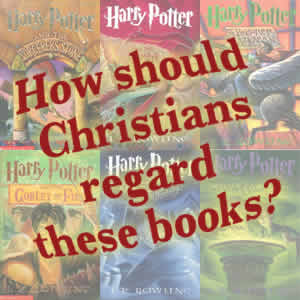
Over the last several years, there has been great speculation regarding what will happen to Harry and his fellow characters. It has also been a period of concern for Christians regarding the appropriateness of children reading books that include magic. This summer, the speculation will be over, but the concern will continue. How should Christians regard these books?

I could easily write several papers on this series. First, we might consider whether the presence of “magic” in the books is objectionable. In this paper, I don’t intend to offer a conclusion about whether the reader should allow Harry Potter in his life and home. Instead, I hope to offer some information about material the books actually contain. The reader should use information about the books to make his own judgment about reading them.

It would be great to address the question of danger in the books. Dr. Kevin Bauder has already done that (The Christian and Fantastic Literature, Part 7, The Harry Potter Books), and I largely agree with him.

It’s possible that some of our members view Harry Potter as evil. That fact, in itself, would make an interesting discussion. Rowling does do some important things to place barriers between the magic in her books and that which her readers might find in the real world. But I have to say that I don’t think she does that as well as C.S. Lewis did. I would say that this aspect of the books earns Rowling a poor grade. It should give us caution, and because of it individuals might refuse to read the books, and many parents will not allow their children to read them. The magic does serve to make the series more interesting and colorful. But the stories are not about magic. They are about good versus evil. They are about making good choices and depending on help from good people.

It also would be appropriate to discuss the moral values of the books. Do they teach appropriate mores and taboos? Is wrongdoing punished? I won’t try to answer these questions here, but parents of children who read these books should understand how to discuss morals in the books. Harry undergoes positive character development in each story, and parents should be able to point that out to young readers.

This paper centers on the question of whether the series contains anything of positive value. Some have questioned whether the books have anything valuable to say. I believe the books have a lot to say. The most important thing about these stories is the way they echo the greatest story every told—the death, burial, and resurrection of Jesus Christ. If you have viewed these books as evil, my statement might surprise you. J.K. Rowling is a member of the Church of Scotland. We would view the Church of Scotland as theologically liberal but one with some good basic creeds. Rowling has said that C.S. Lewis’ Narnia books are among her favorites. Rowling has said that she does not believe in magic or witchcraft, and she refuses to speak of her faith until after the series is published, saying that the revelation would give too much away in the plot of the last book.

In light of the above, before explaining the Christian symbolism, I need to make a couple disclaimers:

1. Rowling has not explained her faith. I am not claiming that these symbols are Christian. And I am certainly in no position to judge Rowling’s faith.

2. The books do give exposure to magic similar to what we find in our world. That and the moral questions should make us cautious. Therefore, I am not wholeheartedly endorsing these books. Nor am I recommending that everyone read them. What I do want to do is give information about the books. This way, Christians will be able to intelligently discuss the books and hopefully use those conversations to point others to Christ.

So how do these books echo the great story of Christ? And why would SharperIron readers care?

Spoiler Alert: The rest of this paper addresses events that occur in the first six books. I will be giving away endings. So if you want to read the books with a sense of mystery, not knowing what will happen next, you may not want to finish this paper.

Harry’s story begins when he is one year old. Voldemort, the villain of the series, tries to kill the infant Harry, but Harry’s mother blocks his first attempt when she throws herself in front of Voldemort’s killing curse. This loving self-sacrifice provides the most powerful “magic” in the books. It gives Harry the protection he needs to survive the second curse Voldemort aims at him.

Each book in the series has a plot of its own, but all books follow a predictable pattern for Harry’s final conflict. At the end of each year, Harry descends to a place associated with hell or death, calls for help or makes a statement of faith (usually), dies (either nearly or figuratively), is helped by something or someone in the story (a picture of Christ), and is raised again.

I have included a chart of these event below. Though I created this chart from memory, John Granger, author of Looking for God in Harry Potter and other works concerning the first four books of the Harry Potter series, has previously discussed much of it. I am in debt to him for some of the symbolism here.


The Philosopher’s Stone* The Chamber of Secrets The Prisoner of Azkaban The Goblet of Fire The Order of the Phoenix The Half-Blood Prince
Descent and Death Harry goes down past the three-headed dog, through Devil’s Snare (i.e., into hell). There he battles Voldemort, who tries to kill him, but Dumbledore comes to the rescue. Harry goes down to the lair of the serpent, the Chamber of Secrets. There, while defeating the serpent, Harry is pierced by a poisonous fang. Harry goes down to the lake by the forest, where he is attacked and nearly killed by dementors. Harry goes to a graveyard. There he battles Voldemort, who again nearly kills him. Harry goes down into the Ministry of Magic. Some of the battle occurs in the “death room.” Harry goes down to a lake, which is filled with the dead. There he is nearly killed and added to the dead of the lake.
Christ Picture 1) The Philosopher’s Stone

It transforms base metals into gold.

It produces the elixir of life.

It is “blood-red.”

2) Dumbledore

He is aloof throughout most of the books. While not consistently depicting God, he does at times seem to depict a child’s idea of God.

Fawkes, the Phoenix

He dies and is resurrected.

He has healing powers.

(See Clement, ch. 25-26 and Turtullian)

1) A hippogriff

Having the hind of a horse (lord of land) and the front of a griffin (lion-eagle, lord of sky), the hippogriff depicts the human-divine nature of Christ. Harry hears the hippogriff being killed. But after an amazing turn in the plot, we discover that the hippogriff was not actually killed. Plot-wise, he is resurrected.

2) Harry’s patronus

Patronus is Latin for “one like the Father.”

Fawkes

He is heard in the song that comes from the wands. The wands contain tail feathers from Fawkes.

Fawkes Dumbledore

Before they escape from the lake, a basin of horrible liquid must be drunk. As Dumbledore drinks 10 cups of liquid, he reacts as though he feels pain and guilt.

Dumbledore dies soon after this. His last words to Harry are, “I am with you.”

Call for Help
or Expression of Faith
Harry’s purpose in entering the final conflict of the book is to keep Voldemort from getting the stone. It is Harry’s expression of faith in Dumbledore that brings the aid of Fawkes. To draw near the hippogriff, Harry must humble himself by bowing before him. Harry’s patronus is produced by Harry’s statement of belief, “expecto patronum” (“I am expecting one like the father”). The word expecto may be found in the second to last line of the Nicene Creed.
In Harry’s final confrontation with Voldemort, Harry’s love for his friends protects him.
Help from the Christ Picture Dumbledore rescues Harry in the presence of the philosopher’s stone. Fawkes pecks out the deadly eyes of the serpent, removing that sting of death. Harry’s patronus takes the form of a stag. It defeats the dementors, saving Harry’s life.The hippogriff carries Harry up and away from the forest/lake. Fawkes’ song encourages Harry and weakens Voldemort. This time he gives his life to save Harry and Dumbledore. Dumbledore drinks the cups of guilt (?). He then makes fire, which allows them to escape.
Help from Others Ron and Hermione help Harry overcome various obstacles. Harry is given a sword from Godric Griffindor, one of the school’s founders. Godric lived long ago; the exact time is unknown. Ron and Hermione are again by Harry’s side. Echoes of Harry’s father and mother distract Voldemort while Harry escapes. Multiple members of the Order of the Phoenix fight on Harry and Dumbledore’s behalf. Multiple members of the Order of the Phoenix fight on Harry and Dumbledore’s behalf.
Ascent After driving off Voldemort, Dumbledore carries Harry up to the hospital wing. Harry awakens three days later. Fawkes carries Harry back up out of the chamber. The hippogriff carries Harry up to the highest tower, where they set the “prisoner of Azkaban” free. Harry is returned to the school from the graveyard. Dumbledor’s magic brings Harry up and out of the “death room” and the Ministry of Magic. Dumbledore and Harry escape from the lake of the dead and return to the castle.

*The Philosopher’s Stone was published in the United States as The Sorcerer’s Stone.

So why should SharperIron readers care about Harry Potter? Why not just ignore the series? Perhaps we should make use of the current popularity of these stories. We should say to our friends and acquaintances, “Do you know why the books are so good? They are good because they are echoes of an even better story—the true story of the death, burial, and resurrection of Jesus Christ.” Many are interested in the series, even if they aren’t fans. We should see the popularity of Harry Potter as an excellent opportunity to speak about our faith in a different and culturally relevant way.

I do not mean that I think we should use Harry Potter to explain the gospel on a general basis. I mean only that the books can give us a point of contact. With it, we can bring up the subject of Jesus Christ by connecting with something some people like.

Again, don’t take this article as an endorsement of the books. I like them, and I have greatly enjoyed trying to figure out what comes next. I’ll go on record with only one prediction: Sadly, Hagrid will die.

I am interested to see where Rowling goes in her seventh book, Harry Potter and the Deathly Hallows. But tonight will also be somewhat sad—the greatest interlibrum of my lifetime will be over.

miller_small1.jpgDan Miller is an ophthalmologist living in Cedar Falls, Iowa. He received a B.S. in Premed from Bob Jones University in 1991 and an M.D. from The University of South Carolina School of Medicine in 1995. He serves as youth leader and board member at Cedar Heights Baptist Church, also in Cedar Falls. He has been happily married to Jenny since 1992. His opinions are not necessarily those of his church or SharperIron.

Friday, May 18, 2007

Where Have All The Good Books Gone?

Quoting Joseph M. Bianchi . . .

A walk through your local Christian book store will reveal a vast array of titles whose themes range from self-help to identifying which demon you are afflicted by. In this sorry state of affairs, one has to ask: "Where have all the sound, doctrinal books gone?".


The real question, however, is, "Where have all the well taught, well discipled Christians gone?" The core of the issue is not the plethora of shallow, theologically unsound books that are flooding the market, but their huge success. It is indeed unmistakable that the church of Jesus Christ in the latter half of the twentieth century has retreated into a superficial, theological ghetto, that mirrors the culture, rather than transforms it.

The directive of Scripture is, "be not conformed - but transformed." (Rom. 12:2) Yet, the church of late has little, if any, problem adopting the methods, jargon and appearance of the world. It must be noted that the responsibility for this must be shared equally by both individual Christians and church leaders. The time that, years ago, was spent in diligent study of the Word of God is now spent in front of a TV or computer screen and or hustling kids back and forth from soccer practice.

Thursday, May 03, 2007

The Truth War


Additional Formats | New Download Releases


WATCH VIDEO

The Truth War: Fighting for Certainty in an Age of Deception
By: John MacArthur
Thomas Nelson / 2007 / Hardcover


Retail Price: $22.99 US
CBD Price: $13.79 US
You Save $9.20 (40%)

Product Information:

Format: Hardcover
Number of Pages: 240
Vendor: Thomas Nelson
Publication Date: 2007
Dimensions: 9.25 X 6.25 X 1.0 (inches)
ISBN: 0785262636
ISBN-13: 9780785262633
UPC: 0020049023747
Availability: In Stock

Front Cover | Front Flap | Table of Contents | Excerpt | Back Flap | Back Cover |

Product Close-up | Editorial Reviews

Publisher's Description:

Right now, Truth is under attack, and much is at stake. Christians are caught in the crossfire of alternative Christian histories, emerging faulty texts, and a cultural push to eliminate absolute Truth altogether. As a result, many churches and Christians have been deceived. Worse still, they propagate the deception that poses itself as Truth! In The Truth War John MacArthur reclaims the unwavering certainty of God’s Truth and anchors Christians in the eternal, immovable promises that are found in His Word.

ChristianBookPreviews.com:

Looking for a good book on the importance of fighting for and defending biblical truth? Look no further. John MacArthur's The Truth War: Fighting for Certainty in an Age of Deception is just what you need. When those like the Emergent Church leaders are claiming we cannot know for sure what the Bible teaches, that we cannot be certain whether things like homosexuality are sin, MacArthur shows how the Bible is not ambiguous about these matters at all. And further, the Bible warns that we would see false teachers claim such things. The fact of the matter is, the church is warned often by the writers of the New Testament, and Jesus Himself, that wolves in sheep's clothing would come.

The Truth War has eight chapters, which are all prefaced by the introduction "Why Truth Is Worth Fighting For." Right off the bat, MacArthur explains why truth is important to defend. Each following chapter deals with an important aspect of the battle:
-"Can Truth Survive in a Postmodern Society?" (Chapter 1);
-"Spiritual Triumph: Duty, Danger, and Guaranteed Triumph" (Chapter 2);
-"Constrained into Conflict: Why We Must Fight for the Faith" (Chapter 3);
-"Creeping Apostasy: How False Teachers Sneak In" (Chapter 4);

-"Heresy's Subtlety: Why We Must Remain Vigilant" (Chapter 5);
-"The Evil of False Teaching: How Error Turns Grace into Licentiousness" (Chapter 6);
-"The Assault on Divine Authority: Christ's Lordship Denied" (Chapter 7); and

-"How to Survive in an Age of Apostasy: Learning from the Lessons of History" (Chapter 8).
-All this great discussion is followed by the appendix: "Why Discernment Is Out of Fashion."

An important theme MacArthur takes up in the book is Postmodernism, the philosophical engine that drives the Emergent Church movement. He is right when he says "Postmodernism is simply the latest expression of worldly unbelief," and that it is "proud rebellion against divine revelation" (p. 25). While false teaching masquerading as biblical Christianity has always posed a threat to the church, "most Christians nowadays simply don't care about the prevalence of false doctrine, nor do they take seriously their duty to fight against apostasy" (p. 47).

The real problem, as MacArthur sees it, is that the true church is battling apostate teachers who are espousing corrupt teaching. "They frequently remain and continue to function as preachers, teachers, or authors. Certainly they pretend to be Christians. They cover up their defection with subtlety. They profess faithfulness to the truth even as they try to undermine its foundations" (p. 66). "[A]postate religion is dynamic in the same way gospel truth is---but it produces exactly the opposite results. It intensifies sin's bondage, multiplies sin's pollutions, and magnifies sin's consequences" (p. 122).

The level of apostasy now in the church is not helped by the amount of people filling our pews who may not be genuine Christians. "Churches today are filled with people like that. They drift from church to church. They are often more concerned about whether they like the music than they are about whether they are hearing the truth. They are usually absorbed in religion for self-centered reasons. They want a better life. They are 'recovering' sinners looking for fellowship. They are therefore susceptible to anyone who promises to meet their 'felt needs.' They are the first-line victims of false religion" (p. 182).

The Truth War is must-reading for all Christians. It reminds us of the essential fact that Christianity is a matter of truth and truth is always worth fighting for.

-Ray Hammon. Christian Book Previews.com

Friday, January 26, 2007

Mapping New Testament Social Networks

From the ESV Bible Blog @http://www.esv.org/blog/2007/01/mapping.nt.social.networks

The recent launch of Many Eyes, a data visualization site, lets us make a start toward mapping New Testament social networks:

A network diagram showing co-occurrences in the New Testament with Jesus as the hub.

The live visualization at Many Eyes lets you pan and zoom around to your heart’s content. (You need the Java plugin for your browser to be able to interact with the visualization.)

The data set behind the visualization isn’t perfect. While it disambiguates people with the same name (John the apostle and John the Baptist, for example), it only tracks occurrences in the same chapter. In other words, just because two people appear in the text near each other, that doesn’t mean they have a relationship. So you have Joseph the Old Testament patriarch linked to Jesus even though they obviously weren’t contemporaries. You’d need an ontology about New Testament names to map deeper relationships.*

But it’s a start and may help you make some useful insights. This data set only includes three or more co-occurrences. We also uploaded a complete list of co-occurrences in the New Testament, but the data set breaks the visualization software at the moment. And there are so many nodes that it isn’t that useful. But feel free to play with our data sets and come up with interesting visualizations of your own.

We’ll leave you with a treemap diagram of similar data:

A treemap diagram showing co-occurrences in the New Testament. Again, Jesus is the most prominent figure, with links to David, Abraham, Timothy, and Peter being most plentiful.

In treemaps, each section has a label (e.g., “Jesus”), and the size and color of the enclosed boxes show the relationships. For example, Peter, Moses, and Paul are the most common names linked with Jesus. Why Paul? Well, Paul has a habit of introducing himself and greeting people in the name of Jesus when he begins his letters. The association of the two is either a feature or a bug of the data set, depending on your perspective.

Via O’Reilly Radar.

* Also see the post at Blogos for a way of using Many Eyes to look at parallel Gospel passages.

Thursday, October 05, 2006

Christian Podcasts


by seeker

Christian Podcasts: AYAGP has a list of Best Christian Podcasts. I'd like to add the following: